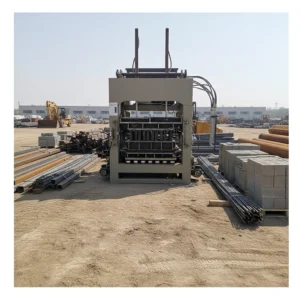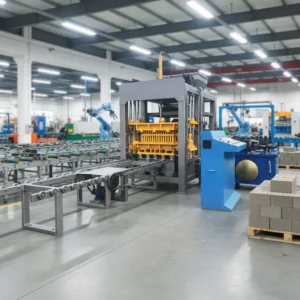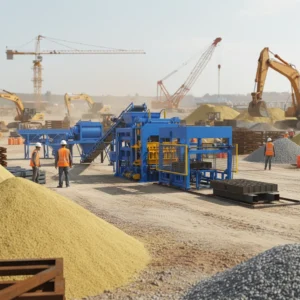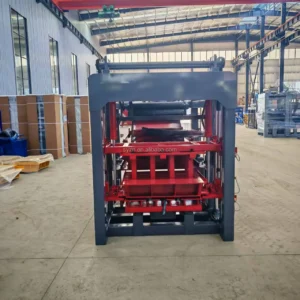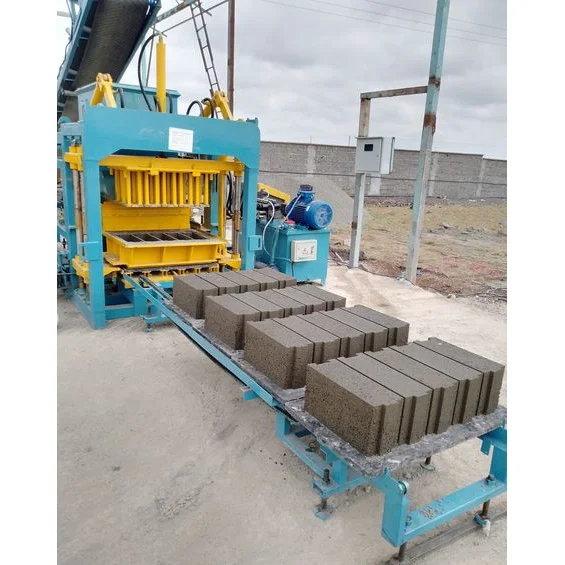
Matched Line Engineering — the QT4-15A is supplied as a complete concrete block making machine production line where press, mixer, pallet feeder and stacker are specified together, so no station waits on another during continuous runs.
Technical Specifications
| Parameter | Value |
|---|---|
| Model | QT4-15A |
| Product Type | Automatic Hydraulic Concrete Block Making Machine |
| Overall Dimensions (L×W×H) | 7100 × 1600 × 2610 mm |
| Total Weight | 3 T |
| Rated Power | 18.45 kW |
| Mixer Model | JQ350 |
| Vibration Frequency | 4600 r/min |
| Exciting Power (Vibration Force) | 40–50 kN |
| Molding Cycle | 15–25 s |
| Pallet Size | 850 × 550 × 25 mm |
| Mould Format | Hollow block, solid brick, paver, curbstone |
| Output Capacity | 408 pcs/h based on 400×200×200 mm hollow block, 4 pcs/mould |
| Output Capacity | 510 pcs/h based on 400×150×200 mm hollow block, 5 pcs/mould |
| Output Capacity | 2100 pcs/h based on 240×115×53 mm solid brick, 18 pcs/mould |
| Daily Output | 3264 pcs/8 hr based on 400×200×200 mm hollow block |
| Daily Output | 4080 pcs/8 hr based on 400×150×200 mm hollow block |
| Daily Output | 17000 pcs/8 hr based on 240×115×53 mm solid brick |
| Automation Level | Semi-automatic with automatic stacker included |
| Raw Materials | Crushed stones, sand, cement, dust, fly ash |
| Voltage & Frequency | To be confirmed with buyer |
| Control System | To be confirmed (PLC or relay logic) |
| Certification | To be confirmed (CE or other) |
Application Suitability
| Application | Material or Output |
|---|---|
| Hollow block production for building construction | Crushed stone, sand, cement, fly ash blended to local aggregate profile |
| Solid brick manufacturing for housing projects | Cement and fine aggregate mix with standard 240×115×53 mm format |
| Paving block and kerbstone production | High-density concrete mix with mould change on the same press |
| On-site block production for development contractors | Semi-automatic line suitable for project sites with limited infrastructure |
| Small to medium-scale block plants | JQ350 mixer matched to press cycle so output flows without material gaps |
Why the Pallet Question Should Come Before the Quotation
A block machine is only as productive as the pallet handling system feeding it.
I have watched a concrete block making machine production line sit idle for half a shift because the buyer sourced pallets locally at a slightly different thickness, and the stacker could not grip them. The pallet size of 850 × 550 × 25 mm on the QT4-15A is not arbitrary — it dictates the curing rack slot width, the forklift tine spacing, and the stacker jaw opening. When a quotation omits pallet specification entirely, the buyer ends up stacking wet blocks by hand, which is exactly the scenario that kills daily output. [NEED_CITE: pallet handling standards in concrete block manufacturing]
How Line Stations Are Matched to Prevent Bottlenecks
Every station on the QT4-15A line is configured so that the JQ350 mixer discharge rate, the pallet feeder advance speed, and the press cycle of 15–25 seconds stay synchronized. When the mixer delivers material faster than the press can mould it, wet concrete sits in the hopper and begins to set. When the press is faster than the pallet feeder, the operator watches empty cycles tick by. The concrete block making machine production line is only honest about output when each station’s capacity is stated against the same block format.
What Happens After the Press — Stacker and Curing Handoff
The automatic stacker included with the QT4-15A lifts loaded pallets and places them onto curing racks or trolleys without manual intervention. This removes the bottleneck that most semi-automatic plants face: operators dragging heavy pallets to the curing area while the press waits. The stacker must be matched to the pallet weight and dimensions, which is why the 850 × 550 × 25 mm pallet is specified as part of the line rather than left to local sourcing. [NEED_CITE: concrete curing requirements for structural block strength]
Reading the Specs That Actually Determine Daily Output
The vibration force of 40–50 kN at 4600 r/min works together with hydraulic pressure to compact the concrete mix into a dense block. Vibration alone cannot achieve target strength if hydraulic pressure is insufficient, and vice versa. The moulding cycle of 15–25 seconds varies with block format — a 400×200×200 mm hollow block draws more material and needs longer compaction than a solid brick, which is why the daily output drops from 17000 pieces for solid brick to 3264 pieces for large hollow blocks. The JQ350 mixer pan diameter and discharge timing must match whichever format runs longest, so the press never starves between cycles. Pallet material selection — whether fiber, bamboo, or PVC — affects surface friction and how cleanly the green block releases during demoulding.
The Cost of Skipping Line Integration Checks
When the mixer is oversized for the press, the operator wastes material that sets in the hopper before it can be moulded. When the stacker is undersized or rated for a different pallet dimension, pallets jam at the transfer point and the entire concrete block making machine production line halts. I have seen buyers pay for an automatic stacker only to bypass it manually because the curing rack spacing did not match the pallet width — effectively paying twice for the same labour. Mismatched voltage and frequency cause motor overheating within the first week, often before the buyer realises the damage is warranty-excluded. [NEED_CITE: electrical supply compatibility for industrial machinery exports]
Why Buyers Source This Line Through Shiyue
Block machinery is the single focus here, so the QT4-15A is supplied with its mould, pallet, mixer and stacker specified as one system rather than assembled from separate vendors. Configuration is set against the buyer’s actual mix design and local aggregate, not a catalogue default — that means the vibration force and hydraulic pressure are matched to what the sand and cement in your region can actually produce. Moulds are designed for the formats your market sells, and custom drawings are supported when standard formats do not cover local demand. Automation level is selectable, so a plant can start with the semi-automatic setup and add automatic pallet feeding or batching later. Installation support includes operator training so your team understands mould change, cycle tuning and daily maintenance from the first week.
Documentation & Verification
- Line layout drawing showing each station position and material flow direction
- Capacity calculation sheet stating the exact block format assumed for every output figure
- Mould drawing and format list for hollow block, solid brick, paver and kerbstone
- Hydraulic and electrical schematic with voltage and frequency marked per your confirmation
- Pallet specification sheet covering size, material and recommended quantity of 300–500 pieces
- Factory test record on your chosen block format before the line is crated for shipment
Installation, Commissioning & Support
- Foundation must accommodate the 7100 × 1600 mm press footprint plus mixer and stacker clearance
- Electrical supply must match confirmed voltage and frequency with a dedicated circuit for the 18.45 kW rated power
- Assembly state to be confirmed before shipment so on-site erection matches available crane and forklift capacity
- First-run commissioning includes cycle time tuning and vibration adjustment against your local aggregate sample
- Operator training covers mould change procedure, stacker reset and daily greasing points
- Wear parts list and mould maintenance schedule provided for planning first replacement orders
Before You Send an Inquiry
Share your target block format, daily output requirement, and the raw materials available at your site so the line can be configured around your actual conditions. Confirm your local voltage and frequency, the PLC display language your operators need, and whether you have existing pallets or curing racks that the new stacker must accommodate. If you are replacing a press within an existing line, provide the pallet size and mixer model already in use so we can identify which stations can stay and which must change.
Frequently Asked Questions
Q: How are the line stations matched so the press is not left waiting for material or pallets?
A: The JQ350 mixer output, pallet feeder advance rate, and press cycle of 15–25 seconds are calculated together during configuration. If the mixer delivers faster than the press can mould, wet concrete sets in the hopper. Each station is sized against the same block format so continuous runs hold their stated output without idle gaps.
Q: What output can I realistically expect per block format, and what is each figure based on?
A: Output is stated per format: 3264 pieces per 8-hour shift for 400×200×200 mm hollow blocks, 4080 for 400×150×200 mm hollow blocks, and 17000 for 240×115×53 mm solid bricks. Each figure assumes four, five and eighteen pieces per mould respectively, and the moulding cycle within the 15–25 second range.
Q: How many pallets do I need, and what material is recommended for my curing conditions?
A: A starting inventory of 300–500 pallets at 850 × 550 × 25 mm covers the press output and curing rotation. Material choice depends on your climate and curing method — fiber and bamboo resist moisture in open-air curing, while PVC suits steam curing environments.
Q: Which stations can I reuse from an existing setup, and which must be replaced?
A: Existing mixers can sometimes stay if their discharge rate matches the QT4-15A cycle. Pallets must match 850 × 550 × 25 mm exactly or the stacker will not function. Curing racks need slot widths aligned to the pallet dimensions.
Q: What is included in the quotation and what do I need to source locally?
A: The line includes the host press, JQ350 mixer, pallet feeder, automatic stacker and moulds for confirmed formats. Pallet quantity, curing trolleys and raw material stock are typically buyer-sourced. Voltage and control language are confirmed before production begins.