
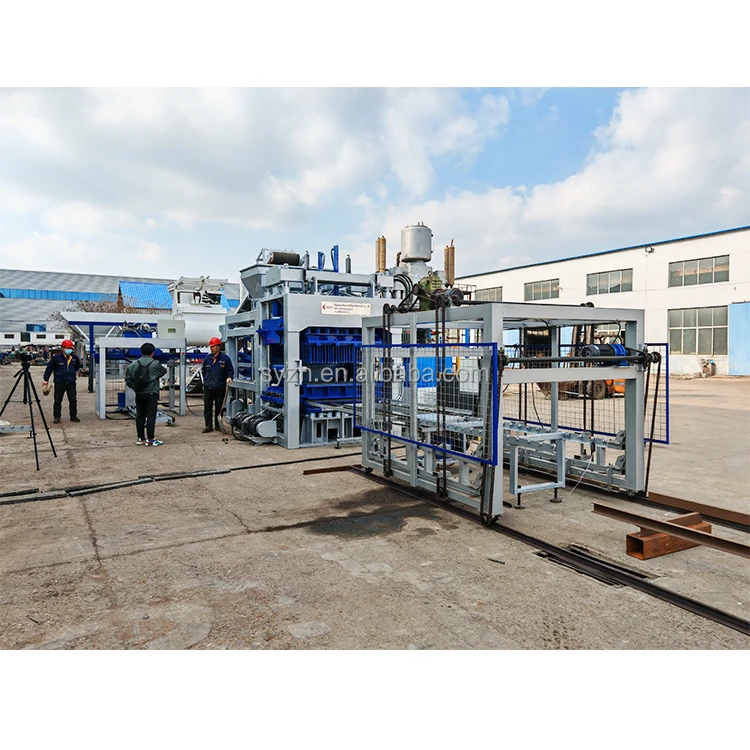
Matched System Sizing — Every station from the mixer to the curing rack is cycle-balanced against the QT18-15 press so the 90 kW main drive never sits idle waiting on upstream feed or downstream pallet handling.
Technical Specifications
| Parameter | Value |
|---|---|
| Model | QT18-15 |
| Product Type | Automatic Hydraulic Concrete Block Making Machine |
| Overall Dimensions (L×W×H) | 9350 × 2520 × 2950 mm |
| Net Weight | 18 T |
| Rated Power | 90 kW |
| Voltage & Frequency | 380 V (configurable to buyer’s site supply) |
| Control System | PLC (display language configurable) |
| Demoulding Method | Hydraulic |
| Pallet Size | 1350 × 1350 × 30 mm |
| Vibration System | Four external vibration motors, constant total power |
| Upper Mould Synchronization | Dual-side synchronous gear, four-point stabilization |
| Material Feeder | European design with turning arm cylinder |
| Vibration Damping | Airbag system with adjustable air pressure per brick type |
| Output Capacity (Hollow Block 400×200×200 mm) | 18 pcs/mould, 4320 pcs/hour, 34560 pcs/day |
| Output Capacity (Hollow Block 400×150×200 mm) | 24 pcs/mould, 5760 pcs/hour, 46080 pcs/day |
| Automation Level | Automatic |
| Color Options | According to buyer request |
| Warranty | 1 year |
| Standards | ISO 9001:2008, CE |
Application Suitability
| Application | Material or Output |
|---|---|
| High-capacity hollow block production | Crushed stone, sand, cement and fly ash mixes for 400×200×200 mm and 400×150×200 mm formats |
| Interlocking brick manufacturing | Laterite, quarry dust and cement blends for dry-stack walling units |
| Paver brick production | Fine aggregate and cement mixes for heavy-duty pedestrian and vehicular paving |
| Multi-format concrete product plants | Shared pallet circulation across hollow, solid and kerbstone formats on a single line |
Why "Pieces per Hour" Means Nothing Without the Rest of the Line
A press is only as fast as the slowest station feeding it or clearing its output.
The QT18-15 block machine production line can press a pallet every cycle, but if the mixer cannot deliver a fresh batch in time, or if six workers are manually dragging pallets to the curing yard because no stacker was quoted, that rated capacity is theoretical. I have stood on sites where the operator spent half the shift waiting on the batching hopper and the other half watching pallets pile up on the floor. [NEED_CITE: typical cycle mismatch between block press and manual pallet handling]. The quotation must include every station from raw material in to cured blocks out, with cycle times stated per format, not a single headline number.
Raw Material Flow and Batching Synchronization
The material feeder on this QT18-15 block machine production line uses a European-design turning arm cylinder that traverses the mould cavity faster than gravity-feed hoppers, filling the 1350×1350 mm pallet area with a more uniform material bed. This matters because uneven fill creates density variation across the pallet — blocks on one side cure harder than blocks on the other. The feeder must receive its charge from the mixer within the press cycle window, which is why the mixer drum capacity and discharge time are specified together with the press, not sourced separately.
Downstream Pallet Circulation and Curing Rack Alignment
Once the press completes a cycle, the wet pallet must leave the demoulding station before the next cycle begins. The pallet size here — 1350 × 1350 × 30 mm — dictates the curing rack spacing, the forklift tine width and the stacking pattern in the yard. If the curing racks on site were built for a smaller pallet, every pallet must be manually re-stacked before it enters the rack, adding labour and breakage. [NEED_CITE: pallet dimension mismatches causing manual re-handling in block plants]. The QT18-15 block machine production line specification therefore confirms pallet size against the buyer’s existing rack geometry and forklift capacity before the order is placed.
How Vibration, Pressure and Feeder Design Shape Block Density
The four external vibration motors deliver constant total power with a lower starting load per motor, meaning the press reaches full vibration amplitude faster at start-up and between cycles. That faster ramp-up shortens the non-productive portion of each cycle. The dual-side synchronous gear with four-point stabilization keeps the upper mould descending evenly across the entire 1350×1350 mm pallet, so hydraulic pressure is distributed uniformly rather than concentrated at one corner. Combined with the airbag vibration damping system — adjustable by air pressure rather than mechanical shims — the operator can tune amplitude for a fragile interlocking brick and then switch to a dense paver without stopping to change hardware. The result is consistent block-to-block density within a run and predictable strength across formats.
The Cost of Leaving Stations Out of the Quotation
When a line is quoted as a press-only package, the buyer discovers after arrival that pallet handling, stacking and curing were never included. Workers end up carrying 18 T worth of wet concrete pallets per shift by hand. Pallets warp because they sit on uneven ground instead of entering a rack. Block breakage climbs before the product even reaches the yard. [NEED_CITE: hidden costs of incomplete block line quotations]. The QT18-15 block machine production line avoids this by specifying every station as one matched system with documented cycle times per format, so the buyer can verify daily tonnage before signing the purchase order.
Why Buyers Source This Line Through Us
Block machinery is our single focus, which means the press, mould, pallet and handling equipment are specified as one integrated system rather than assembled from unrelated suppliers. Each configuration is set against the buyer’s actual mix design and local aggregate, not pulled from a catalogue default. Mould design covers the formats the buyer’s market actually sells, including custom drawings when standard formats do not match. The automation level is selectable — a plant can start with semi-automatic pallet handling and add full stacking later without replacing the press. Installation and commissioning include operator training so the crew understands cycle matching from day one.
Documentation & Verification
- Line layout drawing showing every station from mixer to cubing with cycle time per block format
- Machine specification sheet confirming voltage, frequency and PLC display language before production
- Mould drawing and format list for each block type the buyer plans to produce
- Full hydraulic and electrical schematic with component identification for maintenance planning
- Factory test record run on the buyer’s specified block format before dispatch
- Wear parts and mould list with part numbers for first reorder planning
Installation, Commissioning & Support
- Foundation plan sized for the 18 T net weight and 9350 mm machine length with anchor bolt positions
- Dedicated power circuit rated for the 90 kW total load at the confirmed voltage and frequency
- Machine shipped in dismantled configuration with reassembly supervised on site by our technician
- First-run parameter setting for hydraulic pressure, vibration amplitude and feeder timing per block format
- Operator training covering mould change procedure, airbag pressure adjustment and daily greasing points
- Wear parts kit shipped with the machine covering the first replacement cycle for high-wear components
What We Need to Build Your Line Layout
To size the complete QT18-15 block machine production line around your plant, we need the block formats you plan to sell, your target daily output per format, the raw materials and aggregate available locally, and the dimensions of your curing yard and existing forklifts. Include your site voltage, frequency and preferred PLC display language so the electrical package is confirmed before fabrication begins.
Frequently Asked Questions
Q: How is the output capacity verified for each block format?
A: Every capacity figure is tied to a specific block format, mould cavity count and pallet size. The 4320 pieces per hour rating, for example, applies to 400×200×200 mm hollow blocks at 18 pieces per mould. We provide a format-by-format capacity table in the line layout so you can verify daily output for every product you plan to manufacture before the order is confirmed.
Q: How do you ensure upstream and downstream stations match the press cycle?
A: Each station — mixer discharge, feeder traverse, press cycle, pallet transport and stacking — has a documented time budget. The slowest station determines the line output. We calculate and share this bottleneck analysis in the proposal so you see exactly where cycle time is spent and can approve or adjust station sizing before fabrication.
Q: What pallet material and size is specified, and how does it fit my curing racks?
A: The standard pallet for this line is 1350 × 1350 × 30 mm, available in bamboo or steel depending on your curing method. Before the order, we confirm rack spacing, forklift tine width and yard layout so the pallet circulates from press to rack to dispatch without manual re-handling or breakage.
Q: Can the automation level be staged over time?
A: Yes. The press and mould package can ship with semi-automatic pallet handling, leaving the stacking and cubing stations as a later addition. The PLC architecture and mechanical interfaces are designed to accept the upgrade without replacing the main press or rewiring the control cabinet.
Q: What documentation do I receive before confirming the order?
A: You receive a line layout drawing, station-by-station capacity breakdown, pallet specification, mould drawings for each format, and a confirmation sheet for voltage, frequency and PLC language. Production does not begin until these documents are signed off by both sides.



