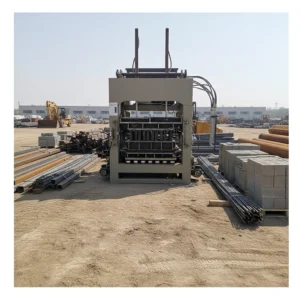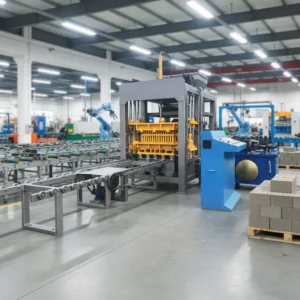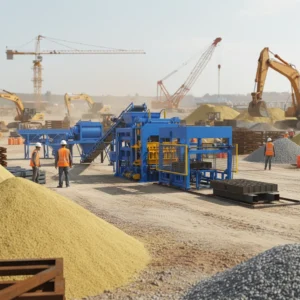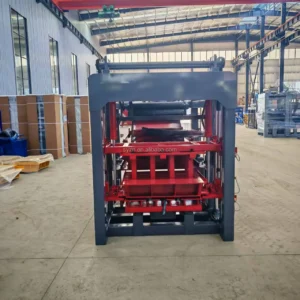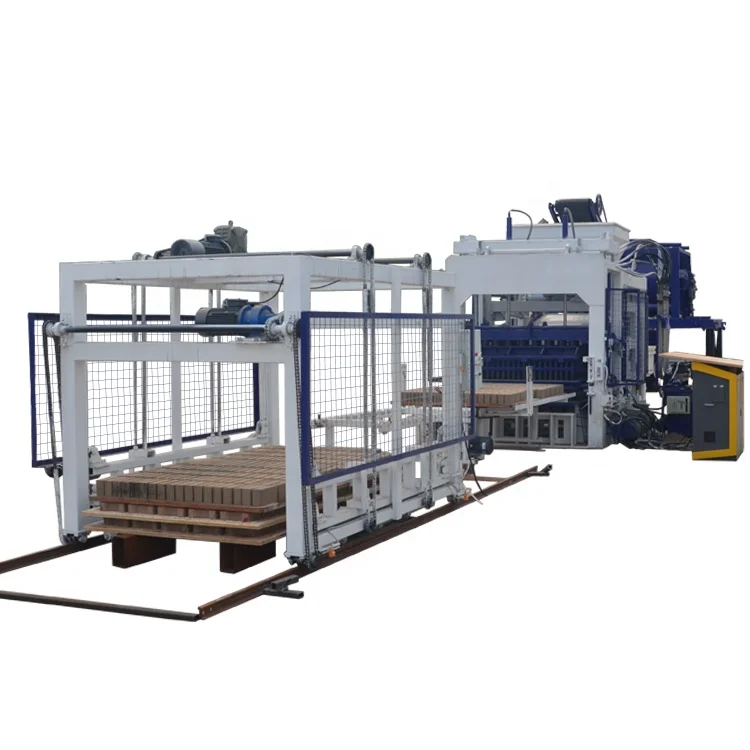
Line balance engineering — Every station from raw material feeding through curing rack handling is cycle-matched to the QT12-15 press so no single point throttles daily throughput.
Technical Specifications
| Parameter | Value |
|---|---|
| Product Type | Fully Automatic Hydraulic Block Making Machine |
| Model | QT12-15 |
| Total Power | 62 kW |
| Pallet Size | 1300×900 mm |
| Moulding Cycle | 15–30 seconds (basis not stated in source — confirm block format / material / thickness) |
| Vibration Type | Table vibration |
| Vibration Technology | Dynamic and static table with frequency conversion control, four-axis vibration |
| Feeding System | Press-in arch breaker with 360° rotation |
| Noise Reduction | Flexible vibration reduction on pressure head; adjustable pressure air bag on mould box |
| Voltage | Customized to buyer’s local industrial voltage (exact V/Hz to be confirmed) |
| Automation Level | Fully automatic (extent of pallet feeding, stacking, cubing to be confirmed) |
| Mould Compatibility | Wall blocks, porous bricks, pavement bricks, slope protection bricks |
Application Suitability
| Application | Material or Output |
|---|---|
| High-volume hollow and solid wall block production | Crushed stone, sand, cement, fly ash blends |
| Paving block and kerbstone manufacturing | Fine aggregate with cement binder |
| Porous and permeable brick production | Coarse aggregate graded for water infiltration |
| Slope protection brick manufacturing | Heavy-duty mix designs for erosion control |
| Fly ash brick plant expansion | Fly ash, lime, gypsum, sand formulations |
What a Cycle Time Figure Hides About Your block machine production line
A press rated at 15–30 seconds per cycle only delivers that pace when every upstream and downstream station keeps up.
I once watched a Middle East plant owner stand beside a high-capacity press, pallets piling up on the floor because the mixer could not discharge fast enough. The press sat idle between every other cycle. That gap between quoted cycles per hour and actual daily output is where most block machine production line projects lose money, and it has nothing to do with the press itself [NEED_CITE: typical block plant throughput losses from station mismatch].
How Station Synchronization Keeps the Press Running
The QT12-15 press demands a steady supply of mixed material and empty pallets at intervals as short as 15 seconds. If the batching and mixing station takes 45 seconds to discharge a batch that the press consumes in two cycles, the press idles through every third window. In a block machine production line built around this press, raw material feeding, mixing discharge, pallet feeding and stacker removal must each complete within the moulding cycle or the whole line slows to the slowest station.
Where the Bottleneck Usually Hides
Mixer discharge, pallet return conveyors and green block stacking are the three stations that most often fall behind. A mixer with insufficient tip speed leaves the press waiting for material. A pallet return path that is one section too long adds seconds per cycle that accumulate into lost pallets per shift. Stacking equipment that cannot lift and index a full rack before the next pallet exits the press forces the operator to intervene manually [NEED_CITE: common block line bottleneck stations identified during commissioning].
Reading the Specs That Actually Matter
Total power of 62 kW must cover vibration, hydraulic pumping and all auxiliary drives simultaneously; undersized power supply on site will trip breakers under peak draw. The 1300×900 mm pallet size dictates the curing rack dimensions and forklift capacity the plant already has or must purchase. Four-axis table vibration with frequency conversion control keeps product height consistent across the pallet surface, reducing rejection rates from uneven blocks. The 360° rotating press-in arch breaker distributes material evenly into the mould cavity, which matters especially for deep hollow block formats where uneven fill causes weak corners.
The Cost of Skipping Line Balance Calculations
When a buyer purchases the press alone and sources supporting equipment separately, station cycle times are rarely reconciled before installation. The mixer arrives with a discharge gate that empties in 60 seconds, but the press needs material every 20 seconds. The pallet feeder runs on a different voltage than the PLC expects, requiring an on-site transformer that delays commissioning. The stacker was specified for a lighter pallet size, so it jams on the 1300×900 mm boards loaded with wet blocks. Each mismatch costs days of lost production and emergency freight for replacement parts [NEED_CITE: block plant commissioning delays caused by uncoordinated equipment sourcing].
Why Line-Level Procurement Changes the Outcome
Every station around the QT12-15 is specified as part of one matched system, so the mixer discharge rate, pallet feed speed and stacker index time are calculated against the press cycle before production begins. Configuration is set against the buyer’s actual mix design and local aggregate, not a default catalogue setting that may not match available raw materials. Mould design covers the formats the buyer’s market actually sells, and the mould change system is selected so format switches take minutes rather than hours. Automation level is selectable, allowing a buyer to start with semi-automatic pallet handling and add full stacking and cubing later without replacing the press. Documentation includes a line layout with capacity calculation that states the block format assumed, so the buyer knows exactly what daily output to expect before the machine ships.
Documentation & Verification
- Line layout and capacity calculation stating the block format assumed for cycle time
- Machine specification sheet with confirmed voltage, frequency and PLC language
- Mould drawing and format list matching the buyer’s target product range
- Pallet specification aligned to curing rack dimensions and forklift capacity
- Hydraulic and electrical schematic for on-site maintenance reference
- Factory test record on the buyer’s selected block format before dispatch
Installation, Commissioning & Support
- Foundation plan drawn for 1300×900 mm pallet footprint and 62 kW total load
- Electrical supply confirmation for buyer’s local voltage before production begins
- Station-by-station cycle time verification during on-site commissioning
- PLC display language set to operator’s working language prior to shipment
- Operator training covering mould change, daily maintenance and fault diagnosis
- Wear parts and mould list provided with recommended replacement intervals
What We Need to Size Your Line
Share the block format or formats you intend to produce, along with the daily output target for each. Provide the raw materials available locally and any existing curing rack or forklift specifications so we can match pallet size and handling equipment. Confirm your site voltage, frequency and preferred PLC display language to avoid commissioning delays after arrival.
Frequently Asked Questions
Q: How is daily output calculated when the line includes feeding, mixing, stacking and curing?
A: Daily output is calculated from the slowest station in the complete line, not from the press cycle alone. We run a station-by-station cycle time analysis for your specific block format, including mixer discharge, pallet feed, press moulding, stacking and rack handling, and quote a realistic figure based on that bottleneck.
Q: Which supporting stations are included in the quotation and which are buyer-supplied?
A: The quotation lists every station from raw material feeding through cubing. Any item designated as buyer-supplied is flagged clearly so there are no gaps when the line is installed. This prevents situations where pallet handling or stacking is assumed but not priced.
Q: How do we confirm that station cycle times match so the press is not left waiting?
A: Before production, we provide a line layout showing each station’s cycle time against the QT12-15 moulding cycle for your chosen block format. If any station is slower, we adjust its specification or add parallel capacity so the press runs continuously.
Q: What pallet size and material does the line assume, and can it be adjusted?
A: The standard pallet size is 1300×900 mm, matched to the QT12-15 press platen. If your existing curing racks or forklift fleet require a different dimension, the pallet and all handling stations can be reconfigured before production to avoid on-site modification.
Q: What voltage, frequency and PLC language options are confirmed before shipment?
A: Voltage and frequency are customized to your local industrial supply. The PLC display language is set to your operator’s working language. Both are confirmed in writing before production begins so the line is ready for commissioning on arrival.