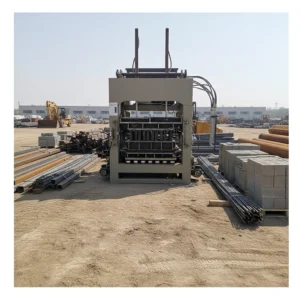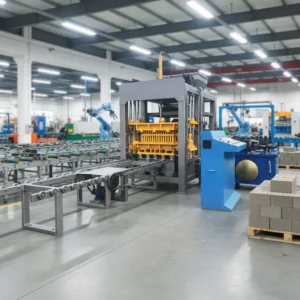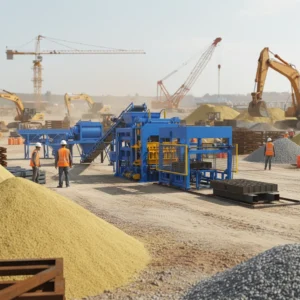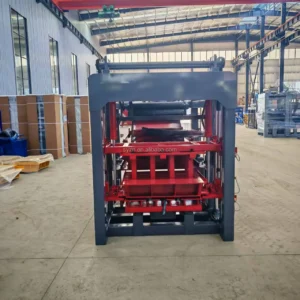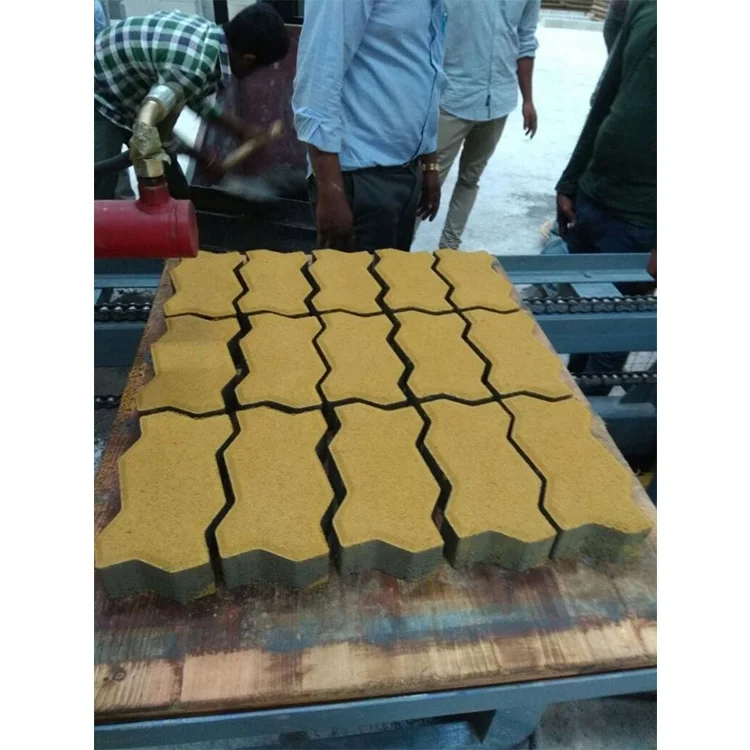
Matched System Integration — Every upstream feeder, mixer, and downstream stacker in this QT12-15 line is timed against the press cycle so the host machine never sits idle waiting for pallets or material.
Technical Specifications
| Parameter | Value |
|---|---|
| Model | QT12-15 |
| Product Type | Concrete Block Making Machine Line |
| Total Installed Power | 62 kW |
| Pallet Size | 1300 × 900 mm |
| Moulding Cycle | 15–30 seconds (basis to be confirmed by block format and material) |
| Vibration System | Table vibration with dynamic and static table |
| Vibration Force | 120 kN |
| Voltage | Configured to local industrial supply |
| Mould Compatibility | Customized to target block format |
| Control System | PLC-based with language options confirmed before production |
| Press-in Feeding | 360° rotating arch breaker |
| Wear Protection | Replaceable cloth platform wear-resistant plate |
Application Suitability
| Application | Material or Output |
|---|---|
| Hollow block production | Crushed stone, cement, sand, and fly ash aggregates |
| Solid block production | Dense aggregate mixes for load-bearing walls |
| Interlocking brick production | Fine-graded sand and cement for dry-stack formats |
| Paving block production | High-strength mix designs with surface pigmentation |
| Porous brick production | Permeable aggregate blends for stormwater management |
| Slope protection brick production | Coarse aggregate with reinforced mould cavities |
Why "Cycles per Hour" Tells Only Part of the Story
A block making machine production line is only as fast as its slowest supporting station.
I once watched a high-output press sit idle for seconds between every cycle because the pallet return conveyor could not keep pace. The quoted cycle time looked impressive on paper, but real daily output fell well short of what the buyer had budgeted for. When raw material feeding, mixing, pallet feeding, stacking, or curing rack handling lags behind the press, the entire block making machine production line loses throughput that no catalogue number will ever reveal [NEED_CITE: line synchronization standards in concrete product manufacturing].
Feeding and Mixing Stations That Match Press Demand
The 360° rotating press-in arch breaker on the QT12-15 distributes raw material into the mould cavity from multiple angles, reducing fill time and preventing uneven density zones. This matters because a block making machine production line with slow or uneven feeding produces blocks with inconsistent weight and strength across the same pallet. The upstream mixer must deliver batches at a rate that ensures the hopper never starves between cycles, keeping the press working at its intended rhythm.
Pallet Circulation and Downstream Handling
With a 1300 × 900 mm pallet, the return conveyor, stacker, and curing rack system must all be dimensioned around that footprint. If the curing area uses a different pallet size or the forklift cannot handle the loaded weight, pallets pile up at the press exit and the operator starts pulling them by hand. A properly specified block making machine production line accounts for every pallet from mould exit through curing and cubing, eliminating manual intervention that erodes daily output [NEED_CITE: pallet handling best practices in block plants].
Vibration Force and Hydraulic Pressure as a Matched Pair
The QT12-15 delivers 120 kN of vibration force through a four-axis table system that distributes excitation evenly across the pallet surface. This even distribution keeps block height consistent from corner to corner, which is critical when the buyer’s market demands tight dimensional tolerances for interlocking or paving formats. The table vibration system pairs dynamic and static tables with frequency conversion control, allowing the operator to adjust vibration acceleration and forming speed to the specific mix design and block thickness being run. The replaceable wear-resistant plate on the cloth platform means that routine maintenance does not require a full production stop — the plate swaps out during a scheduled shift break, keeping the line available for more operating hours.
The Hidden Cost of Mismatched Line Stations
When supporting equipment is sourced separately or specified without reference to the press cycle, the gaps show up on the first day of production. A mixer that batches too slowly forces the press into a holding pattern. A stacker that cannot clear cured pallets fast enough backs material up into the press zone. Buyers who focus only on the host machine specification often discover these bottlenecks only after installation, when reconfiguring the line means additional capital and weeks of lost production [NEED_CITE: common causes of block line underperformance].
Why Source the Full Line from One Supplier
Block machinery is our single focus, which means the QT12-15 press, moulds, pallets, and every supporting station are specified as one coordinated system. We configure the line against the buyer’s actual mix design and local aggregate rather than a catalogue default. Mould design covers the formats the buyer’s market actually sells, including custom drawings for non-standard profiles. Automation level is selectable, so a plant can start with semi-automatic pallet handling and add stacking or cubing later. Installation includes operator training on the full line, not just the press, so the team understands how each station affects overall output.
Documentation & Verification
- Line layout drawing with station-by-station cycle time for your target block format
- Capacity calculation sheet stating the block format assumed for each output figure
- Mould drawing and format list matching your market requirements
- Pallet specification sheet with size, material, and load rating
- Hydraulic and electrical schematic for the complete line configuration
- Voltage, frequency, and PLC language confirmation before production begins
Installation, Commissioning & Support
- Foundation plan dimensioned for the QT12-15 press footprint and 62 kW total power draw
- Dedicated electrical circuit specification matched to confirmed local voltage and frequency
- Station-by-station assembly sequence with pallet conveyor alignment checkpoints
- First-run parameter setting for vibration force and moulding cycle on your mix design
- Operator training covering press, mixer, feeder, stacker, and curing rack controls
- Wear parts and mould inventory list with reorder intervals for continuous operation
Preparing a Productive Inquiry
To specify this block making machine production line accurately, we need your target block formats with dimensions, required daily output per format, local aggregate and cement sources, available workshop area and ceiling height, and existing curing yard layout with forklift capacity. Share your local voltage and frequency along with preferred PLC display language so the control system ships ready for commissioning.
Frequently Asked Questions
Q: How is daily line output calculated and which block format does the capacity figure assume?
A: Every output figure in our line proposal states the exact block format, dimensions, and moulding cycle used in the calculation. We do not quote a single headline number. The buyer receives a capacity table showing hollow block, solid block, and paving block outputs separately, so the daily target can be checked against the specific format the plant will run most often.
Q: Which supporting stations are included in the block making machine production line quotation?
A: The standard line scope covers raw material feeding, mixing, pallet feeding, the QT12-15 press, automatic stacking, curing rack handling, and cubing. Each station is listed individually in the quotation with its own cycle time, so the buyer can see exactly what is included and confirm that no manual pallet handling is required between press exit and finished output.
Q: How are cycle times matched between the press and upstream or downstream equipment?
A: We time every station with the press cycle as the reference point. The mixer batch interval, pallet feeder index speed, stacker clearance rate, and curing rack conveyor speed are all set so the press completes its moulding cycle without waiting. If any station naturally runs slower, we add buffer capacity or adjust its specification before the line ships.
Q: What pallet size and material does the line require and does it match our existing curing area?
A: The QT12-15 uses a 1300 × 900 mm pallet, and we specify pallet material — bamboo, steel, or composite — based on the buyer’s curing method and climate. Before production, we confirm that this pallet size fits the buyer’s existing curing racks and that the loaded pallet weight is within the capacity of the forklift already on site.
Q: What voltage, frequency, and control language will the line be configured for before shipment?
A: We confirm the buyer’s local industrial voltage, frequency, and preferred PLC display language during the proposal stage and lock these values before production begins. The electrical schematic delivered with the line matches the confirmed supply, and the PLC interface ships in the agreed language so commissioning can start immediately on arrival.