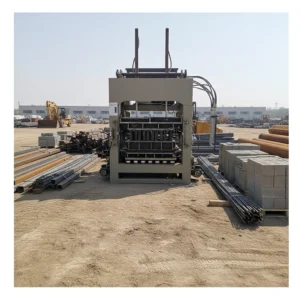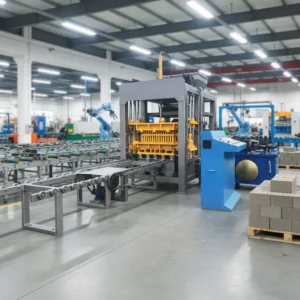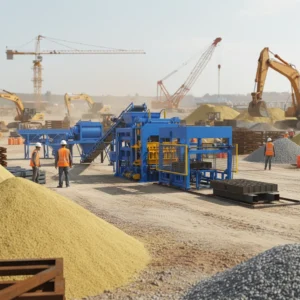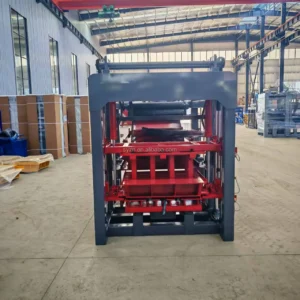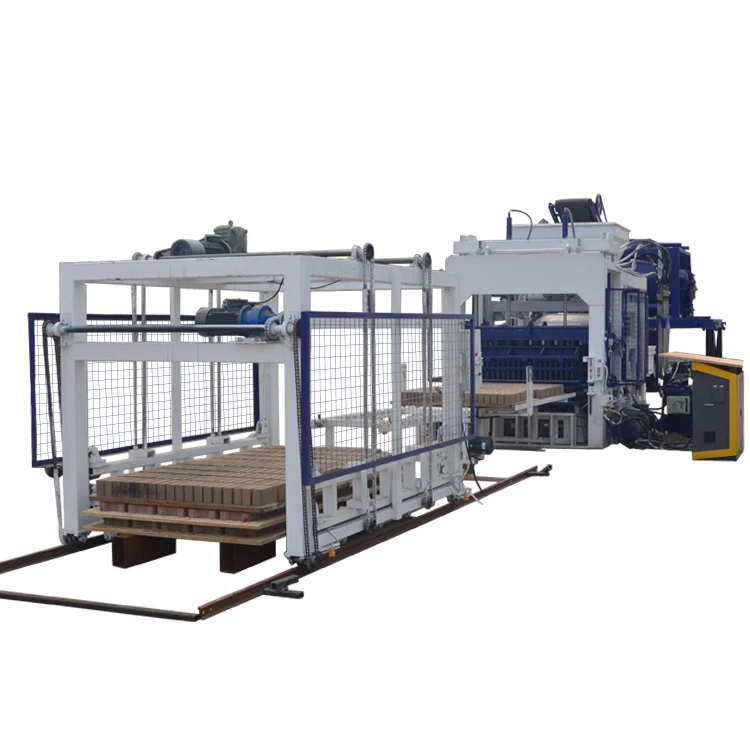
Matched system engineering — every station from raw material feeding to stacking is paced against the QT10-15 press cycle so no unit sits idle waiting on the next.
Technical Specifications
| Parameter | Value |
|---|---|
| Product Type | Hydraulic Block Making Machine |
| Model | QT10-15 |
| Vibration Technology | Dynamic and static table with frequency conversion |
| Vibration Acceleration | 20g |
| Vibration System | Four-axis vibration with forced synchronization gear shaft |
| Excitation Force Distribution | Evenly distributed across the pallet surface |
| Feeding System | 360° press-in arch breaker for rapid material distribution |
| Cloth Platform | Replaceable wear-resistant plate |
| Vibration Table | Flexible pressure head reduction with adjustable air bag in mould box |
| Mould Adaptability | Configurable for hollow blocks, porous bricks, pavement bricks, slope protection bricks, wall blocks |
| Output Capacity | (basis to be confirmed per block format and material) |
| Cycle Time | (basis to be confirmed per block format) |
| Hydraulic Pressure | (basis to be confirmed) |
| Pallet Size | (basis to be confirmed) |
| Control System | (basis to be confirmed) |
| Voltage & Frequency | (basis to be confirmed) |
| Key Features | Multi-format mould adaptability, noise-reducing air bag system, frequency conversion vibration |
Application Suitability
| Application | Material or Output |
|---|---|
| Hollow block production plants | Fly ash, crushed stone, and cement mixtures |
| Pavement brick manufacturing | Cement-bound aggregate with surface pigments |
| Porous brick production | Lightweight aggregate and cement blends |
| Slope protection brick forming | Coarse aggregate with high cement content |
| Wall block production for housing projects | Local sand, gravel, and cement combinations |
Why the Line Around the Press Matters More Than the Press Itself
A QT10-15 block making machine production line is only as fast as its slowest upstream or downstream station.
Plant owners who focus exclusively on press specifications often discover after commissioning that the mixer cannot deliver material quickly enough, or that pallets are being fed manually while the press cycle completes. I have seen QT10-15 installations where the belt conveyor between the mixer and the host machine was undersized, leaving the press idle between cycles. The daily output fell well short of what the press alone could theoretically produce. Sizing every station around the QT10-15 block making machine production line means matching feed rates, pallet circulation speed, and stacking capacity to the actual press cycle time for your target block format [NEED_CITE: line synchronization standards in block manufacturing].
Raw Material Feeding and Mixing Matched to Press Demand
The mixer and conveyor feeding the QT10-15 block making machine production line must deliver a fresh batch to the press hopper before each cycle begins. When the conveyor speed or mixer discharge rate lags behind the press cycle, the machine idles and daily throughput drops. Every belt width, motor rating, and mixer capacity in this line is calculated against the press cycle time for your specific block format and mix design, not pulled from a standard catalogue.
Pallet Circulation and Stacking as Part of the System
Pallet handling is where many block lines bottleneck after the press. If pallets are not returned to the feed station quickly enough, the press waits. The stacking station must also clear cured product at a rate that keeps pallets in circulation. On this QT10-15 block making machine production line, pallet feeding, return conveyor speed, and stacking intervals are scoped together with the press so that no station starves the next [NEED_CITE: pallet circulation rate calculations for block plants].
How Vibration and Pressure Work Together at the Press
The QT10-15 uses a dynamic and static table system with frequency conversion to achieve 20g vibration acceleration. The static table stop device allows the excitation force to act fully on the mould cavity rather than dissipating into the frame. Four-axis vibration with a forced synchronization gear shaft distributes force evenly across the pallet, which keeps block height consistent from corner to corner. Hydraulic pressure compresses the mix while vibration settles fine particles into voids — both must be set according to the aggregate grading and cement content of your local mix to reach target block strength.
What Undersized Conveyors and Mismatched Pallets Cost You
When the conveyor between mixer and press is too narrow or slow, the press completes its cycle and then waits — sometimes for several seconds per cycle. Over a ten-hour shift those seconds compound into thousands of missing blocks. I once reconfigured a belt conveyor for a client after the original specification left the host machine starving for material, and the output gain was immediately visible on the shift tally. Similarly, choosing pallet size without considering the curing rack dimensions and the forklift already in your yard means pallets may not stack or transport correctly once production starts [NEED_CITE: common block line bottleneck causes in new plant setups].
Why Sourcing the Full Line from One Supplier Matters
Specifying the QT10-15 press, pallets, conveyors, mixer, stacker, and curing racks as one matched system eliminates the gaps that appear when each station comes from a different vendor. Capacity calculations are stated per block format so you know exactly what to expect before the line ships. Mould designs are matched to the formats your market actually sells, including custom drawings when needed. Automation level is selectable, allowing a semi-automatic start with a defined upgrade path later. Installation, commissioning, and operator training are included so the line runs correctly from the first shift.
Documentation & Verification
- Line layout drawing with capacity stated per block format
- Machine specification sheet matched to your local mix and aggregate
- Pallet specification confirming size, material, and load rating
- Hydraulic and electrical schematic for on-site maintenance
- Voltage, frequency, and PLC language confirmation before production
- Factory test record on your target mould before dispatch
Installation, Commissioning & Support
- Foundation plan sized to QT10-15 vibration load and press weight
- Dedicated power circuit matched to confirmed voltage and frequency
- Machine assembled on site with all line stations connected and paced
- First-run parameter setting for your mix design and block format
- Operator training covering mould change, pallet handling, and daily checks
- Wear parts and mould list supplied with initial spare recommendations
What to Share When Requesting a Line Proposal
To scope a QT10-15 line correctly, provide your target block formats with dimensions, the daily output you need per format, and a sample or description of your local raw materials and aggregate. Share your site dimensions including ceiling height and curing area layout, along with the local voltage and frequency. If you already have pallets, forklifts, or upstream equipment on site, include those specifications so the line is configured around what you have.
Frequently Asked Questions
Q: How is daily capacity calculated for this QT10-15 line, and which block format is assumed?
A: Capacity is calculated per block format using the cycle time for that specific mould, the number of blocks per pallet, and the available production hours per shift. The quotation states daily output for each format you plan to produce, not a single generic figure. This prevents surprises when you switch from hollow blocks to pavers.
Q: Which stations around the press are included in the line quotation?
A: The quotation covers raw material feeding, mixing, pallet feeding, the QT10-15 press, stacking, and curing rack handling. Cycle times at each station are matched so the press is never left waiting. Any station you prefer to supply yourself is clearly noted, and the interface requirements are documented.
Q: What voltage, frequency, and PLC language will be confirmed before shipping?
A: Voltage and frequency are confirmed in writing during the proposal stage to match your local grid. The PLC display language is agreed at the same time so operators can read the interface from the first day of production. These details are locked before manufacturing begins to avoid commissioning delays.
Q: How is the line configured for my local raw materials rather than a default setup?
A: Your local aggregate type, grading, and cement availability are reviewed before the line is specified. Mixer type, conveyor speed, and press vibration and pressure settings are then chosen to suit that mix. This ensures block strength meets your market standard without forcing a material change.
Q: What support comes with installation, and what is the typical lead time?
A: The line ships with foundation drawings, assembly supervision, commissioning, and operator training on your site. Lead time depends on configuration complexity and current production scheduling, and is confirmed in the quotation. Wear parts and mould support continue after the line is running.