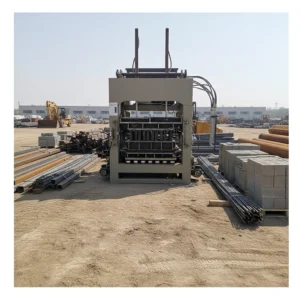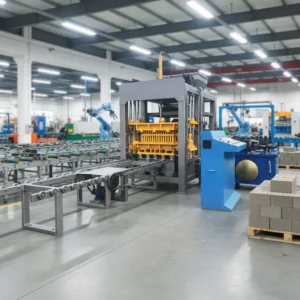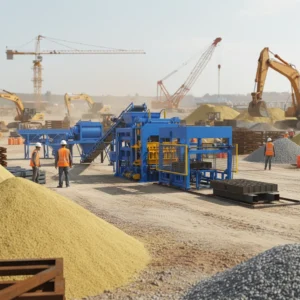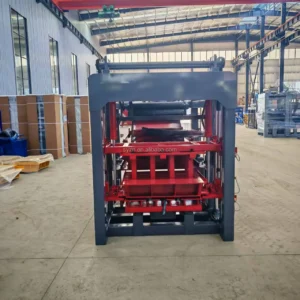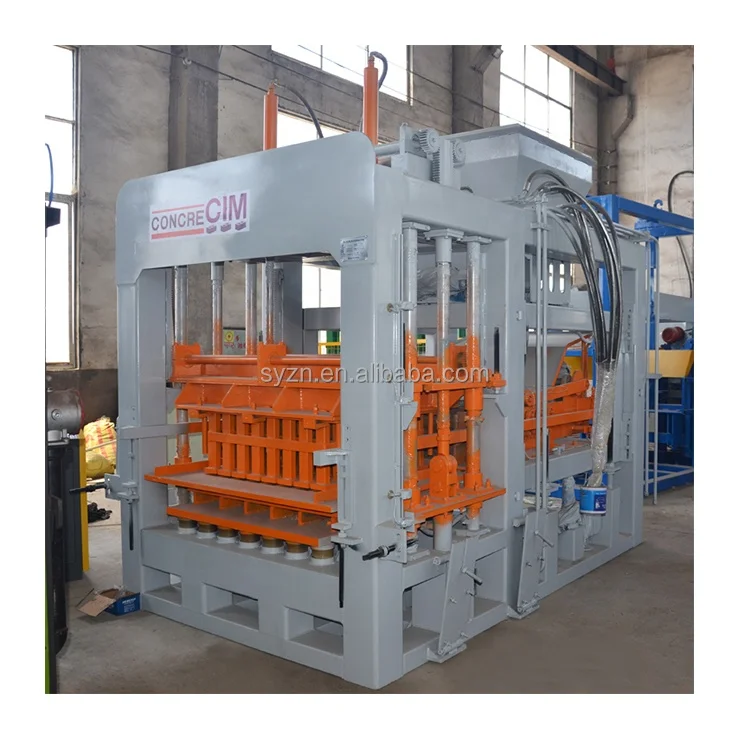
Single-Focus Line Integration — the QT10-15 block making machine production line is specified as one coordinated system where press, pallet feed, conveyor, and hopper cycle times are calculated together before any steel is cut.
Technical Specifications
| Parameter | Value |
|---|---|
| Model | QT10-15 |
| Product Type | Automatic Hydraulic Block Making Machine |
| Moulding Cycle | 15–20s (hollow block & standard brick formats); 20–25s (paving block formats) |
| Output Capacity | 1800–2400 pcs/h based on 400×200×200mm hollow block, 10 pcs/mould |
| Output Capacity | 2160–2880 pcs/h based on 400×150×200mm hollow block, 12 pcs/mould |
| Output Capacity | 8928–11160 pcs/h based on 240×115×53mm standard brick, 62 pcs/mould |
| Output Capacity | 5184–6480 pcs/h based on 200×100×60mm paving block, 27 pcs/mould |
| Output Capacity | 4032–5040 pcs/h based on 225×112.5×60mm interlocking brick, 24 pcs/mould |
| Control System | PLC control cabinet |
| Hydraulic System | Independent integrated hydraulic station |
| Vibration Mode | Vertical station mode resonance with automatic FM-AM |
| Included Components | Pallet feed machine, block making machine, storage hopper, conveyor, hydraulic unit, PLC control cabinet |
| Mould Change | Simple replacement, multi-format capability (mould change time basis to be confirmed) |
| Voltage & Frequency | Configurable to buyer site supply (basis to be confirmed) |
| Hydraulic Pressure | Rating depends on final configuration (basis to be confirmed) |
| Vibration Force | Rating depends on final configuration (basis to be confirmed) |
| Pallet Size | Sized to match curing area and forklift (basis to be confirmed) |
| Overall Dimensions | Dependent on line layout (basis to be confirmed) |
| Net Weight | Dependent on line layout (basis to be confirmed) |
| Rated Power | Dependent on line layout (basis to be confirmed) |
| Automation Level | Automatic with PLC, pallet feeding, conveyor, storage hopper |
| Stacking Method | Configuration depends on buyer automation level selection (basis to be confirmed) |
| Standards | CE declaration where applicable |
| Warranty | 1 year for whole machine (excluding spare parts) |
Application Suitability
| Application | Material or Output |
|---|---|
| Hollow block production | Crushed stone, sand, cement, and fly ash mixes for 400×200×200mm and 400×150×200mm formats |
| Standard brick production | Fine aggregate and cement blends for 240×115×53mm solid brick formats |
| Paving block production | High-strength concrete mixes with pigment for 200×100×60mm interlocking pavers |
| Interlocking brick production | Graded aggregate and cement for 225×112.5×60mm dry-stack formats |
| On-site contractor production | Locally sourced aggregate for project-specific block types at development sites |
| Format expansion for existing plants | Mould changeover to add paver or interlocking formats to an established block range |
Why "Pieces per Hour" Means Nothing Without the Block Format
A capacity figure divorced from block size, mould cavity count, and cycle time is marketing noise, not engineering data.
Every QT10-15 block making machine production line we ship carries a capacity document that names the exact block format behind each output number. I once reviewed a competitor quotation that promised a flat "2400 blocks per hour" without specifying format — the buyer assumed hollow blocks but the figure was based on small solid bricks. The shortfall became visible only after the line was running and the curing yard sat half empty [NEED_CITE: capacity calculation standards in concrete block machinery procurement].
That mismatch forced the buyer to run double shifts just to meet contractual delivery volumes. On the QT10-15, a 400×200×200mm hollow block yields 1800–2400 pieces per hour at 10 cavities, while the same press producing 240×115×53mm standard bricks at 62 cavities reaches 8928–11160 pieces per hour. The machine does not change; the format does. Stating the premise protects the buyer from planning a plant around a number that was never meant for their product.
How Line Stations Stay Synchronized with the Press Cycle
When you plan a complete block production setup around the QT10-15 block making machine production line, the press is only the starting point. The pallet feed machine must deliver a fresh pallet before the mould lifts, the storage hopper must charge the feeder box within the moulding cycle, and the conveyor must clear finished blocks before the next press stroke begins. If any station lags, the press sits idle and daily output drops regardless of what the nameplate says.
We calculate the travel time, charge time, and return time for every station and write them into the line layout document the buyer receives before production starts. This is the same approach used on any high-output concrete block line: cycle parity across stations is non-negotiable. The PLC control cabinet coordinates these timings so that adjustments on one station automatically propagate to the others.
Matching Material Handling to the Buyer’s Curing Area
A QT10-15 block making machine production line produces blocks fast enough to fill a curing yard in a single shift, but only if pallet circulation keeps up. Pallet size determines how many blocks travel per cycle, and pallet material determines how long each pallet survives the vibration table before warping. We confirm pallet dimensions against the buyer’s existing curing racks and forklift tines before the first pallet is ordered [NEED_CITE: pallet specification practices for hydraulic block machines].
Wood, bamboo, and composite pallets each behave differently under vibration and moisture. Choosing the wrong material means pallets crack within weeks, blocks land unevenly, and scrap rates climb. The line quotation specifies the pallet type, quantity for a full shift rotation, and the rack spacing the buyer should prepare on site.
Reading the Specs That Actually Govern Block Quality
Vibration mode on the QT10-15 uses vertical station mode resonance with automatic FM-AM. In practice, the system adjusts vibration frequency to the mould format, so a heavy hollow block receives a different resonance profile than a thin paving block. This keeps block density consistent across formats without the operator manually retuning the vibration table each time a mould change is performed.
The independent integrated hydraulic station sits isolated from the host vibration and dust. Hydraulic valves in block machines that share a frame with the vibration table tend to develop internal leaks as seals wear from constant shock loading. Separating the hydraulic unit extends valve life and keeps pressing force stable across long production shifts.
The PLC control cabinet ties the pallet feed machine, storage hopper, conveyor, and press into one timing loop. When a buyer switches from hollow block to paving block, the operator selects the new programme and the entire line adjusts — hopper charge volume, vibration duration, and pallet feed interval all change together. This coordination is what keeps the QT10-15 block making machine production line running at rated cycle times across every format it supports.
The Cost of Ignoring Line Timing at the Quotation Stage
I once configured a full automatic block line for a European buyer where the mixing station fed at a slightly slower rate than the press expected. The host machine waited roughly twelve seconds every cycle for the hopper to charge. Over a ten-hour shift that dead time accumulated to thousands of missing blocks per day. The buyer saw the gap on day one and called immediately — the conversation was not pleasant [NEED_CITE: common causes of output shortfall in automated block plants].
The lesson applies to every QT10-15 block making machine production line we ship. If the supporting equipment is sized from a catalogue page rather than calculated against the press cycle, the buyer pays for automation that never actually runs automatically. Line timing is the single most expensive detail to fix after installation, and the cheapest to fix before.
Why Buyers Place the Line Order Here
Block machinery is the only product category this company makes, so the press, mould, pallet, and handling equipment are specified as one matched system rather than assembled from unrelated suppliers. That single focus means the QT10-15 block making machine production line arrives with components that were selected to work together, not adapted to fit after delivery.
Configuration is set against the buyer’s actual mix design and local aggregate, not a catalogue default. Mould design covers the formats the buyer’s market actually sells, with custom drawings available when a local standard differs from the international catalogue. Automation level is selectable — a buyer can start with semi-automatic pallet handling and add full stacking and cubing later without replacing the press.
Every line ships with installation support that includes operator training on the specific PLC programme written for the buyer’s block formats. Documentation covers the full line, not just the press, so the local maintenance team has hydraulic and electrical schematics for every station.
Documentation & Verification
- Line layout and capacity calculation stating the block format assumed for each output figure
- Machine specification sheet with hydraulic and electrical schematic for local maintenance
- Mould drawing and format list covering every block type the buyer’s market requires
- Voltage, frequency, and PLC display language confirmation before production begins
- Factory test record on the buyer’s specified block format before dispatch
- Packing photographs and customs documentation support for smooth port clearance
Installation, Commissioning & Support
- Foundation plan sized to the QT10-15 vibration load and overall line footprint
- Power supply matched to confirmed voltage and frequency with dedicated circuit for the hydraulic station
- Machine dismantled for container loading and reassembled on site with alignment verification
- First-run commissioning on the buyer’s local aggregate to validate block strength and cycle time
- Operator training on PLC programme selection, mould change procedure, and daily maintenance checklist
- Wear parts list and mould inventory plan covering the first replacement cycle
What to Share Before Requesting a Quotation
Tell us which block formats your market sells and the daily volume you need for each one. Share your local aggregate type, available curing area dimensions, and the voltage and frequency at your site so the QT10-15 block making machine production line can be configured to match your conditions rather than a generic template.
Frequently Asked Questions
Q: How is the QT10-15 daily output calculated, and which block format is each figure based on?
A: Every output figure is tied to a specific block size, mould cavity count, and cycle time. For example, hollow block output is stated at 400×200×200mm with 10 cavities at 15–20 seconds per cycle. The capacity document that accompanies each quotation lists every format separately so daily planning uses the correct number for the product you actually sell.
Q: How do pallet feeding, mixing, and conveyor stations match the press cycle?
A: Each station’s travel, charge, and return times are calculated against the QT10-15 press cycle before the line is built. The PLC control cabinet synchronizes the pallet feed machine, storage hopper, and conveyor so the press never waits for material or pallets. This timing map is included in the line layout document you receive with the quotation.
Q: What pallet size and material does the QT10-15 require?
A: Pallet dimensions are confirmed against your curing rack spacing and forklift tines before ordering. Material — wood, bamboo, or composite — is selected based on vibration load and local humidity. The quotation specifies pallet type, quantity for a full shift rotation, and expected service life under your production schedule.
Q: How is voltage, frequency, and PLC language confirmed before shipment?
A: These details are locked during the configuration stage, before production starts. The buyer confirms site voltage, phase, and frequency, and selects the PLC display language. The confirmation document is signed by both sides and referenced during factory testing so the line arrives ready to power on without electrical modification or control panel translation.
Q: What supporting equipment is included in the line quotation, and what needs separate sourcing?
A: The standard quotation covers the pallet feed machine, block making machine, storage hopper, conveyor, hydraulic unit, and PLC control cabinet. Raw material batching silos, cement screw conveyors, and curing rack systems are typically sourced locally or added as optional scope. The quotation clearly separates included items from optional items so there are no surprises at dispatch.