
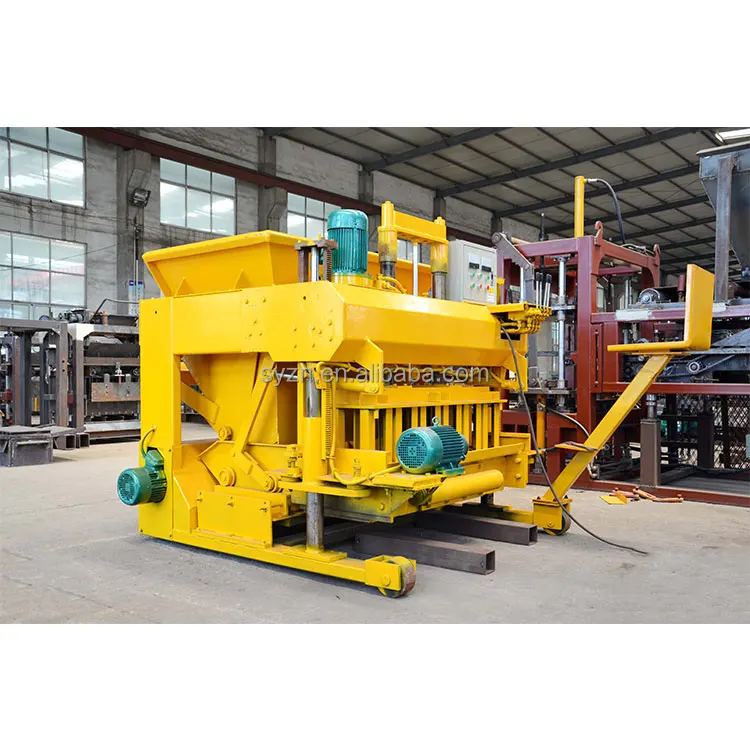
Line-First Engineering — A mobile press only performs when mixer output, curing layout and handling are matched to its cycle time, so every station is sized together.
Technical Specifications
| Parameter | Value |
|---|---|
| Model | QMY6-25 |
| Product Type | Mobile Block Making Machine |
| Rated Power | 9.6 kW |
| Overall Dimensions (L×W×H) | 2000 × 2100 × 1650 mm |
| Vibration Form | Three-dimensional excitation |
| Vibration Frequency | 3200 Hz |
| Moulding Cycle | 25–30 s |
| Moving Method | Automatic movement with hydraulic steering |
| Pallet Requirement | No pallet required (egg-laying on ground) |
| Output Capacity | 1080 pcs/h based on 400×200×200 mm hollow block |
| Output Capacity | 1260 pcs/h based on 400×150×200 mm hollow block |
| Output Capacity | 1620 pcs/h based on 400×120×200 mm solid block |
| Output Capacity | 1800 pcs/h based on 400×100×200 mm solid block |
| Shift Output (8 h) | 8600 pcs based on 400×200×200 mm hollow block |
| Shift Output (8 h) | 10000 pcs based on 400×150×200 mm hollow block |
| Shift Output (8 h) | 12960 pcs based on 400×120×200 mm solid block |
| Shift Output (8 h) | 14400 pcs based on 400×100×200 mm solid block |
| Automation Level | Mobile, single-operator |
| Warranty | 1 year (excluding wear parts) |
Application Suitability
| Application | Material or Output |
|---|---|
| On-site hollow block production for housing projects | Crushed stone, sand, cement, water (local aggregate dependent) |
| Solid block production for load-bearing walls | Crusher dust, gravel, cement blends |
| Satellite production for remote construction sites | Locally sourced aggregates mixed on a flat concrete slab |
| First-plant entrepreneurship with minimal fixed infrastructure | Standard concrete mixes laid directly onto a curing floor |
Why the Voltage Question Must Precede the Quotation
Electrical mismatch at arrival halts commissioning longer than any mechanical issue.
I still remember a job for a Middle East contractor where the block line was built around a 380V motor set, only to find the site fed 440V at 60Hz. Every motor tripped on the first run, and the variable-frequency cabinet had to be air-freighted in, leaving the crew idle for two weeks. That mobile block making machine sat silent while the blocks the contractor had promised to the site schedule went unmade [NEED_CITE: voltage and frequency standards by export market]. Since then, the first document requested from any buyer is a photograph of the on-site distribution board.
Matching Mixer Throughput to the QMY6-25 Cycle
The QMY6-25 lays a block every 25–30 seconds, which means the pan mixer upstream must deliver a fresh batch within that same window or the press stands empty. In a mobile block making machine setup, the mixer is often undersized because buyers focus on the press output and treat the mixer as an afterthought. A mixer that cannot keep pace turns a rated cycle into a stop-start rhythm, reducing actual shift output below the figures quoted.
Designing the Curing Floor Around Daily Volume
A mobile egg-laying press deposits blocks directly on the ground, so the curing area must absorb the full shift output without congestion. If the floor is too short, freshly laid blocks are stepped on before initial set; if too spread out, a single operator cannot cover the distance. Planning the curing layout as part of the line, rather than as a leftover space, keeps the mobile block making machine running continuously and the blocks undamaged during the critical first hours [NEED_CITE: concrete curing best practices for on-site block production].
What the Vibration and Hydraulic Specs Actually Mean On-Site
The three-dimensional excitation at 3200 Hz compacts the mix from multiple axes, which matters most when local aggregates are angular or poorly graded — common conditions in project-site batching. Hydraulic steering allows the QMY6-25 to advance precisely along a straight line, keeping the block rows aligned so that the curing area remains orderly and forklifts can later collect cubes without knocking fresh work. The 9.6 kW rated power is low enough for portable generators, but the generator must still sustain peak draw during the vibration spike or the motor stalls mid-cycle. These parameters together determine whether the blocks leave the machine at consistent density or vary from row to row [NEED_CITE: relationship between vibration frequency and block compressive strength].
The Hidden Cost of Underspecifying the Line
A mobile press that arrives without a matched mixer, water metering unit or curing-area plan forces the buyer to source those stations locally at short notice, often paying premium prices and accepting mismatched capacities. The result is a line where one station waits on another, and the daily output drops well below expectation. Worse, if the electrical panel is not rated for the site supply, the entire installation pauses while replacement components are shipped — a delay that can stretch project timelines and incur penalty clauses [NEED_CITE: typical on-site commissioning delays from equipment mismatch].
Why Buyers Place the Full Line Order Here
Block machinery is our single focus, so the QMY6-25 is never quoted as a standalone press; material feeding, mixing, curing layout and handling are specified as one system. Configuration is set against your local aggregate and target block format, not a catalogue default. Mould design covers the formats your market actually sells, with custom drawings available. Automation level is selectable, letting you start with single-operator mobile production and add feeding or stacking stations later. Installation support includes operator training so the crew is producing saleable blocks before the engineer leaves site.
Documentation & Verification
- Line layout drawing showing mixer position, curing area dimensions and machine travel path
- Capacity calculation sheet stating the block format assumed for each output figure
- Hydraulic and electrical schematic with confirmed voltage, frequency and panel language
- Factory test record on your selected mould before container loading
- Operation and maintenance manual translated to operator language
Installation, Commissioning & Support
- 9.6 kW power draw confirmed against site generator or grid feed before dispatch
- Machine delivered fully assembled; only hydraulic steering linkage requires on-site connection
- First-day production run supervised to set vibration duration and cycle timing to your mix
- Single-operator training covers steering alignment, mould change and daily greasing points
- Wear parts list identifies vibration motor mounts and hydraulic seals for first reorder
What to Include in Your First Inquiry
Send a photograph of your on-site distribution board so that the correct voltage and frequency can be confirmed before build. Specify the exact block dimensions and daily volume your project requires, along with the aggregate types available locally. Indicate the curing floor area you can allocate, so that the line layout can be drawn to match the QMY6-25 output and keep the press running without idle time.
Frequently Asked Questions
Q: How is the daily output figure calculated, and which block format is it based on?
A: Each shift output is measured over an eight-hour run and tied to a specific block size. For example, 8600 pieces per shift assumes 400×200×200 mm hollow blocks, while 14400 pieces assumes 400×100×200 mm solid blocks. The calculation already factors the 25–30 second moulding cycle, so any variation in format changes the number accordingly.
Q: What mixer capacity keeps the QMY6-25 running without waiting for mix?
A: The mixer must deliver a fresh batch within the 25–30 second moulding cycle to avoid idle time. Pan mixers with a working volume matched to the press hopper, combined with a batching hopper that pre-weighs aggregate, keep the flow continuous throughout the shift.
Q: How should the curing floor be laid out for the volume this machine lays per shift?
A: The curing area must accommodate the full shift output without overlapping rows. Width is set by the machine travel path, while length is calculated from the number of blocks laid per hour multiplied by shift hours, plus turning space for the operator to reverse at each row end.
Q: Can the QMY6-25 be upgraded into a fixed plant line later?
A: Yes. Stations such as an automatic pallet feeder, stacker and curing-rack handler can be added around the press when you move to a fixed layout. The original QMY6-25 continues as the forming station, so the initial capital is retained rather than replaced.


