
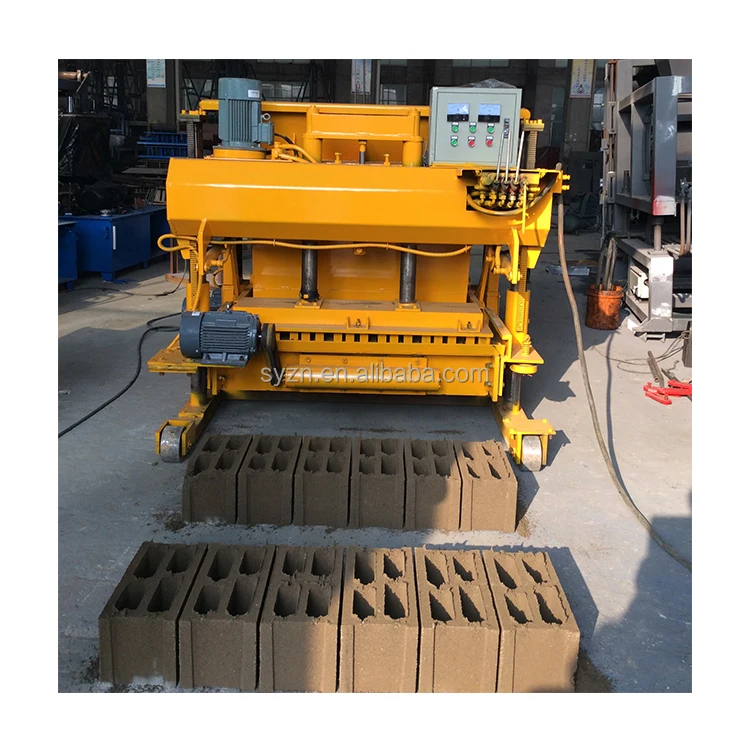
Line-Matched System — every mixer, feeding and handling station is sized to keep the egg-laying press running without waiting for the next batch.
Technical Specifications
| Parameter | Value |
|---|---|
| Model | QMY6-25 |
| Product Type | Mobile Egg Laying Block Making Machine |
| Molding Capacity | 6 pcs/mold |
| Hydraulic Pressure | 16 MPa |
| Vibration Form | Mold Vibration |
| Molding Cycle | 20s–25s (basis not stated in source — confirm block format / material / thickness) |
| Turning Method | Hydraulic |
| Total Power | 9.6 kW |
| Total Mass | 2.5 Tons |
| Pallet Requirement | None (egg laying type) |
| Block Format Range | Hollow blocks and big solid blocks |
| Automation Level | Manual operation, one-person operable |
| Basic Configuration | QMY6-25 host, JS500 mixer, dump truck |
| Optional Stations | PLD800 batching machine, cement silo, screw conveyor, loading machine, block clamper |
| Mixer Options | JS500 double shaft mixer, pan mixer JQ500 or JQ750 |
| Voltage | Configurable to buyer site (voltage and frequency to be confirmed) |
| Mould Change | Customizable moulds available (change time to be confirmed) |
| Warranty | 1 year for whole machine, excluding spare parts |
Application Suitability
| Application | Material or Output |
|---|---|
| On-site construction projects | Hollow and solid blocks from crushed stone, sand and cement |
| Housing developments across multiple sites | Mobile production moving with the project |
| First plant for entrepreneurs | Low-infrastructure block manufacturing without fixed pallet circuits |
| Regions with limited material handling | Egg laying directly onto curing floor, no pallet logistics |
| Contractors self-supplying masonry | Daily output matched to crew laying speed |
Why the Supporting Line Decides What the Press Actually Produces
A mobile block machine production line only delivers its quoted output when every station from mixer to curing floor keeps pace with the press cycle.
Buyers often focus on the host machine and treat the rest as accessories. I have walked onto sites where the JS500 mixer was still blending the previous batch while the press sat idle, or where the dump truck could not reach the machine fast enough on soft ground [NEED_CITE: typical material flow bottlenecks in mobile block production]. The QMY6-25 completes a mold every 20 to 25 seconds depending on format, so any gap in the feed chain turns directly into lost cycles. That is why this mobile block machine production line is specified as a connected system rather than a list of separate purchases.
How the Stations Connect Around the Press
The JS500 double shaft mixer sits at the head of the line, discharging into a dump truck or optional screw conveyor that feeds the QMY6-25 hopper. When the optional PLD800 batching machine is added, aggregate proportions are metered before mixing, which removes the variation that comes from manual shoveling. Each station must finish its cycle before the press completes a mold, otherwise the 20s–25s rhythm breaks and daily output drifts downward.
Matching the Mixer Choice to the Site
The pan mixer JQ500 or JQ750 is an alternative for sites that run drier mixes or need faster discharge, while the JS500 double shaft handles a wider range of aggregate sizes. Selecting the wrong mixer for the local sand gradation means the press receives an inconsistent feed and block density varies from one mold to the next. [NEED_CITE: relationship between mixer type and concrete homogeneity in block production] Specifying the mixer as part of the mobile block machine production line means the discharge timing and batch volume are already aligned with the six-piece mold capacity.
Reading the Specifications That Matter on Site
Hydraulic pressure at 16 MPa combined with mold vibration determines how tightly the concrete is compacted inside each cavity. If the pressure is too low for the buyer’s aggregate, the blocks leave the mold with weak green strength and may crack during curing. The egg laying design means blocks are deposited directly onto the ground, so the curing floor must be level and hard enough to support wet concrete without settling. Total power at 9.6 kW is modest, which allows the line to run from a standard site generator, but the generator must be sized for the starting surge of the hydraulic pump, not just the running load. Voltage and frequency must be confirmed before the motor is wound, otherwise the machine arrives with a winding that does not match the local supply.
What Happens When the Line Stations Are Mismatched
When the mixer capacity is smaller than the press appetite, the operator waits for every second batch. When the curing area is too close to the machine travel path, freshly laid blocks are driven over before they gain strength [NEED_CITE: curing area planning for egg laying block machines]. These problems do not show up in a catalog specification sheet; they only appear once the line is running on the buyer’s ground.
Why This Line Is Specified Together
Block machinery is the single focus here, so the QMY6-25 host, mixer, batching and handling stations are documented as one system with defined connection points. Configuration is set against the buyer’s local aggregate and target block format rather than a default list. Mould drawings are produced for the exact dimensions the buyer’s market requires, and optional stations like the cement silo and screw conveyor are quoted with their interface details to the host machine. Factory testing runs the complete line before dispatch, so cycle timing between stations is verified rather than assumed.
Documentation & Verification
- Line layout drawing showing station spacing and material flow direction for the QMY6-25
- Capacity calculation stating the block format assumed for the 20s–25s cycle
- Mould drawing with dimensional list matching the buyer’s target block
- Hydraulic and electrical schematic with confirmed voltage and frequency
- Factory test record covering full line run with the selected mixer type
- Packing photographs of host machine and each supporting station before loading
Installation, Commissioning & Support
- Level hardened curing floor required; area sized for daily output at 2.5 ton machine weight
- Power supply confirmed for 9.6 kW running load plus hydraulic motor starting surge
- Mixer positioned for gravity or conveyor feed to match QMY6-25 hopper height
- Mould installed and vibration frequency tuned to buyer’s mix during first production run
- Operator trained on one-person cycle including turning, moving and laying sequence
- Wear parts list with hydraulic seal and vibration spring replacements documented
What to Include in Your Inquiry
Send the target block dimensions, local aggregate type and source, and the daily volume your site requires. State the available voltage and frequency, and whether a batching machine or silo is already on site. With these details, the line can be configured and a capacity calculation returned that names the exact block format behind every number.
Frequently Asked Questions
Q: What block format and daily output does the 20s–25s cycle time assume?
A: The molding cycle depends on block dimensions, wall thickness and concrete mix. We provide a capacity calculation that names the specific format used for the calculation, so you can compare it directly against your daily target rather than relying on a generic number.
Q: Which supporting stations are included and where do cycle times need to match?
A: The basic line includes the JS500 mixer and dump truck. Optional batching machine, cement silo and screw conveyor extend the front end. Every station must complete its task within the 20s–25s press cycle, and we document the timing at each connection point.
Q: How is voltage and mixer type confirmed for the destination site?
A: Voltage, frequency and motor winding are confirmed before production starts. Mixer selection between JS500 double shaft and pan mixer JQ500 or JQ750 is based on your aggregate gradation and mix design, documented in the line proposal.
Q: What curing area is required when no pallets are used?
A: Egg laying places blocks directly on the ground, so the curing floor must be level, hardened and large enough for the day’s output plus curing time. We calculate the required area from your target block format and daily volume.
Q: Can the line be upgraded with batching and automatic feeding later?
A: The QMY6-25 accepts the PLD800 batching machine, cement silo and screw conveyor as additions. Connection points on the host machine are already in place, so stations can be added without structural modification to the press.


