
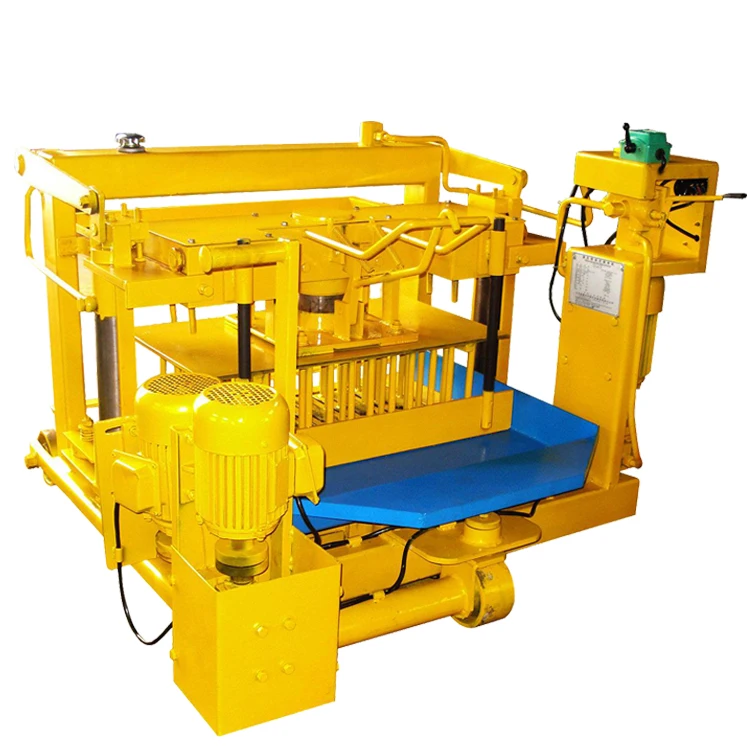
Matched System Design — every supporting station from the JQ350 mixer to the curing area is sized against the QMY4-30 press cycle so the mobile line runs without idle gaps.
Technical Specifications
| Parameter | Value |
|---|---|
| Model | QMY4-30 |
| Product Type | Mobile Cement Block Making Machine |
| Dimension of Host Machine | 1300 × 1500 × 1000 mm |
| Total Mass | 950–1000 kg |
| Rated Pressure | 6–8 MPa |
| Main Vibration Form | Moulding Vibration |
| Vibration Frequency | 4500 r/min |
| Vibration Force | 28.6 kN |
| Molding Cycle | 15–25 s (basis not stated in source — confirm block format / material / thickness) |
| Overall Power | 5.95 kW |
| Demolding Method | Hydraulic |
| Pallet Size | No needs (egg-laying / mobile type) |
| Mixer Model | JQ350 |
| Molding Area | 400 × 800 mm |
| Factory Area | 500 m² |
| General Water Consumption | 4 T/day |
| Control System | PLC (source value — verify against manufacturer catalog) |
| Voltage & Frequency | Configurable to target market standard (basis to be confirmed) |
| Assembly State | Fully assembled mobile unit |
| Warranty | 1 Year |
| Standards | ISO 9001, CE, SGS |
Application Suitability
| Application | Material or Output |
|---|---|
| On-site hollow and solid block production | Crushed stone, sand, cement, fly ash |
| Road paver and kerbstone forming on infrastructure sites | Gravel, slag, cement blends |
| Interlocking brick production for landscaping and gardens | Sand, dust, cement |
| Remote housing project block supply | Local aggregate with cement binder |
Why the Mixer-to-Press Match Decides Your Real Daily Output
A mobile block making machine production line only produces as fast as its slowest station feeds the press.
I have watched contractors arrive on a West African job site with a QMY4-30 ready to run, only to find the locally sourced mixer discharged a batch every four minutes while the press cycled through its hopper in under two. The press spent half the day waiting. [NEED_CITE: equipment synchronization in mobile concrete production setups] The mobile block making machine production line must be planned as a loop — mixer discharge rate, water metering, and block handling off the moulding area — not as a single press dropped onto bare ground.
How the No-Pallet Layout Reshapes the Supporting Line
Stationary presses need a pallet return conveyor, a pallet stacker, and a forklift circuit to move racked blocks into the curing yard. The QMY4-30 lays blocks directly onto the prepared ground, removing the entire pallet loop from the mobile block making machine production line. That simplification shifts the planning effort toward the curing area itself — a flat, level surface of roughly 500 m² that can accept blocks straight from the mould without intermediate handling.
Matching the JQ350 Mixer Output to the Press Hopper
The JQ350 pan mixer delivers a batch volume that must align with the QMY4-30 hopper capacity and the 15–25 second moulding cycle. If the mixer batch is too small, the press starves between discharges; if too large, mixed material sits and begins to set before the press can consume it. [NEED_CITE: concrete batch sizing for mobile block presses] Getting this ratio right is the difference between continuous production and a mobile block making machine production line that stutters through every shift.
Reading the Specs That Actually Shape Block Quality
The 6–8 MPa hydraulic pressure and 28.6 kN vibration force work together during each moulding cycle. Pressure compacts the mix from above while the 4500 r/min moulding vibration settles aggregate into the mould cavity from below. If the local aggregate is angular crushed stone rather than rounded river gravel, the vibration force must be sufficient to reorient particles — otherwise blocks leave the mould with honeycomb voids and low compressive strength. The 400 × 800 mm moulding area defines the maximum footprint of each block or the number of smaller units per cycle, and that dimension directly sets the curing space you must prepare before the first production run. The 5.95 kW overall power draw means the mobile unit can run from a standard site generator without a dedicated high-voltage supply, a practical advantage on remote infrastructure projects where grid power is absent.
The Cost of Skipping Line Integration Checks
When the mixer, water supply, and curing area are not confirmed before the mobile block making machine production line ships, the problems surface on day one. A mixer undersized for the press cycle turns a quoted moulding time into an academic figure. Uncured blocks placed on uneven ground crack before they reach handling strength. A voltage mismatch discovered after arrival means the unit sits idle while a transformer is sourced locally — and mobile units, arriving fully assembled, cannot be rewired as easily as a stationary press with a separate control cabinet. [NEED_CITE: on-site commissioning delays from unconfirmed electrical standards]
What Backs This Mobile Line Beyond the Press Itself
Block machinery is the single focus here, so the QMY4-30 and its JQ350 mixer are specified as one matched system rather than sourced from separate vendors and bolted together on site. Configuration is set against the buyer’s actual mix design and local aggregate, not a catalogue default — the hydraulic pressure and vibration force are validated with the specific crushed stone, sand, or fly ash available at the project location. Mould design covers the formats the buyer’s market actually sells, and custom mould drawings are available when standard formats do not match local building codes. The automation level is selectable, so a contractor can start with manual block handling and add supporting equipment later. Installation and commissioning support includes operator training at the job site, and a wear parts and mould list ships with every line so the first replacement cycle does not cause unplanned downtime.
Documentation & Verification
- Line layout showing mixer-to-press material flow for the QMY4-30 cycle
- Capacity calculation stating the block format the 15–25 s moulding cycle assumes
- Factory test record at the buyer’s target mix design before dispatch
- Hydraulic and electrical schematic with confirmed voltage and frequency
- Mould drawing and format list matching the buyer’s local building standards
- Operation and maintenance manual with PLC language options noted
Installation, Commissioning & Support
- Level ground preparation across the 500 m² curing area before the QMY4-30 arrives
- Power supply matching the 5.95 kW draw and confirmed voltage and frequency
- Unit ships fully assembled — no on-site press erection, only mixer and water connection
- First-run hydraulic pressure and vibration force calibration to the buyer’s mix
- Operator training covering mould change, cycle timing, and block handling off the moulding area
- Wear parts list identifying hydraulic seals and vibration components for first replacement
What to Prepare Before Requesting a Quote
To size the mobile block making machine production line accurately, share the target block format and dimensions, the local aggregate type and cement grade available, the daily output required, and the curing area dimensions at the project site. Confirm the local voltage and frequency standard and the preferred PLC display language so the control system is configured before the unit ships.
Frequently Asked Questions
Q: How is the QMY4-30 capacity verified, and which block format does the moulding cycle assume?
A: The 15–25 second moulding cycle must be reconciled with the specific block format, wall thickness, and mix design to calculate real daily output. We provide a capacity calculation sheet that states the assumed format so buyers can compare quoted figures against their actual product, avoiding the common gap between catalogue numbers and site results.
Q: What supporting equipment is required around the mobile press for continuous production?
A: Beyond the QMY4-30 press and JQ350 mixer, the line needs a water metering supply matched to the 4 T/day consumption, a level curing area of approximately 500 m², and manual or mechanical block handling off the moulding zone. We confirm each station’s cycle time against the press so no single point bottlenecks the mobile block making machine production line.
Q: How does the no-pallet egg-laying design change the line layout?
A: Without pallets, there is no pallet return conveyor, no pallet stacker, and no forklift circuit for racked blocks. Blocks are laid directly onto the prepared ground, which simplifies the supporting equipment list but requires the buyer to prepare a flat, level curing surface before the first production run begins on site.
Q: What electrical details must be confirmed before the mobile unit ships?
A: The QMY4-30 arrives as a fully assembled unit, so voltage, frequency, and PLC display language must be set before dispatch. Rewiring a mobile press on site is far more difficult than adjusting a stationary cabinet, making pre-shipment confirmation essential to avoid commissioning delays once the line reaches the project location.
Q: Which spare parts should be ordered with the initial mobile line?
A: Hydraulic seals, vibration motor components, and mould wear liners are the most common first-replacement items. We ship a wear parts list with every line so buyers can order spares alongside the initial machine and avoid unplanned downtime when the first replacement cycle arrives during continuous project production.


