
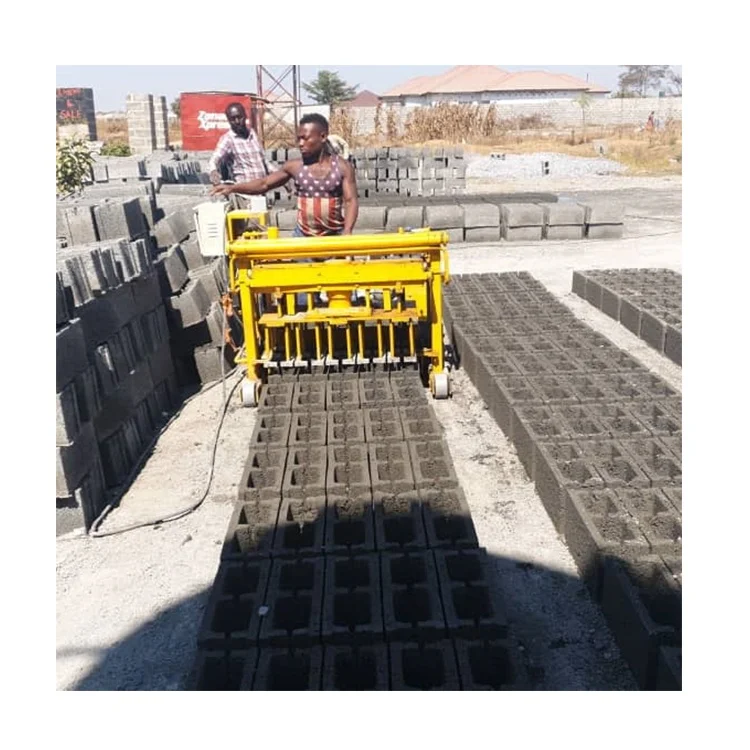
Matched line configuration — Every station from raw material feeding to curing area layout is specified around the QMY4-30 cycle time so the mobile block making machine production line never starves the press between cycles.
Technical Specifications
| Parameter | Value |
|---|---|
| Model | QMY4-30 |
| Product Type | Mobile Concrete Block Making Machine |
| Rated Power | 5 kW |
| Voltage & Frequency | Configurable to site supply (basis to be confirmed) |
| Control System | Manual or semi-automatic operation (basis to be confirmed) |
| Overall Dimensions (L×W×H) | 1200 × 1200 × 1100 mm |
| Net Weight | 950 kg |
| Mould Format | Hollow block and solid brick (changeable) |
| Cycle Time | 30 seconds |
| Output Capacity | 480 pcs/h based on 400×200×200mm hollow block (4 pcs/mould); 600 pcs/h based on 400×150×200mm block (5 pcs/mould); 840 pcs/h based on 400×100×200mm block (7 pcs/mould) |
| Output per 8-hour Shift | 3,840 pcs (400×200×200mm); 4,800 pcs (400×150×200mm); 6,720 pcs (400×100×200mm) |
| Raw Materials | Cement, sand, crushed stones, slag |
| Automation Level | Mobile / egg-laying (no fixed plant required) |
| Warranty | 5 years (scope and coverage to be confirmed) |
| Packing Volume | Approx. 3 m³ (plywood packing) |
Application Suitability
| Application | Material or Output |
|---|---|
| On-site hollow block production | Crushed stone, sand, and cement mix |
| Solid brick manufacturing for small projects | Cement and fine aggregate blend |
| Temporary construction site block making | Locally sourced slag and sand |
| Entrepreneur start-up block plant | Standard concrete mix with regional aggregate |
Why the Voltage Question Must Come Before the Shipment Date
A mobile block making machine production line that cannot connect to local power is a stationary weight until an electrician rewinds the motor or replaces the control panel.
When a machine arrives with a 380V/50Hz motor and the buyer’s site runs on 440V/60Hz, the result is not a minor adjustment. It is a multi-week delay while transformers are sourced, motor windings are replaced, or the entire control box is rebuilt. I have seen this happen on site, and the downtime cost far exceeds the price of confirming the supply standard before the machine enters production [NEED_CITE: voltage and frequency standards by export market]. The QMY4-30 draws only 5 kW, which makes it compatible with most site generators, but the exact voltage and frequency must be documented on the order.
Feeding, Mixing, and the 30-Second Window
A turnkey mobile block machine does not operate in isolation. The raw material feeder and mixer must deliver a fresh batch within the 30-second press cycle, or the operator stands idle waiting for the next load. Specifying the mixer capacity and discharge rate against the QMY4-30 output ensures continuous production rather than intermittent stoppages that erode the shift total.
Curing Area Layout and Machine Travel Path
Because the QMY4-30 is an egg-laying machine, it moves across the production floor leaving blocks on the ground or on pallets. The curing area must be laid out so that the machine’s travel path does not cross freshly laid blocks, and the space must accommodate the daily output of up to 6,720 pieces per shift based on 400×100×200mm format. Without a clear curing plan, the press runs out of room before the shift ends [NEED_CITE: block curing area requirements for mobile machines].
What the Power Rating and Footprint Mean on Site
At 5 kW rated power, the QMY4-30 can run from a portable generator, removing the dependency on a fixed grid connection. The 1200 × 1200 × 1100 mm footprint and 950 kg weight mean the machine can be moved between site locations without heavy lifting equipment. The changeable mould system covers hollow blocks and solid bricks within one machine, so a contractor can switch formats as the project demands without purchasing a second unit. The 30-second cycle time remains constant across formats, though output per hour varies with the number of cavities per mould.
When the Mixer Cannot Keep Up
If the mixing station is undersized for the QMY4-30 cycle rate, the press sits idle for seconds that accumulate into hours across a shift. The result is not a machine fault — it is a line design fault. Buyers who focus only on the press capacity and ignore the feeder and mixer throughput find their actual daily output falling well short of the quoted figure, and the mismatch is rarely obvious until production begins [NEED_CITE: block production line bottleneck analysis].
Why a Matched Line Matters Here
The QMY4-30 is specified as part of a complete mobile block making machine production line, not sold as a standalone press. Every supporting station — raw material feeding, mixing, curing layout — is matched to the 30-second cycle so the machine is never left waiting. Configuration is set against the buyer’s local aggregate and target block format, not a catalogue default. Mould options are confirmed for the formats the buyer’s market actually sells. Voltage, frequency, and control language are documented before production begins, not discovered at commissioning.
Documentation & Verification
- Line layout showing feeder, mixer, and curing area sized to QMY4-30 cycle time
- Capacity calculation sheet stating block format assumed for each output figure
- Voltage, frequency, and control language confirmation before production
- Mould drawing and format list matching buyer’s market requirements
- Factory test record on buyer’s specified block format before dispatch
- Operation and maintenance manual with wear parts list
Installation, Commissioning & Support
- Ground surface assessment for the QMY4-30 travel path and curing area load
- Electrical supply verification matching 5 kW rating at confirmed voltage and frequency
- Machine arrives assembled or CKD based on container loading plan
- First-run parameter setting for buyer’s specific cement and aggregate mix
- Operator training on mould change procedure and daily maintenance checks
- Wear parts and mould supply list with reorder references
What to Prepare Before Requesting a Quote
To configure the mobile block making machine production line correctly, share the target block format and daily output requirement, the local raw material type and source, the available site area and curing space dimensions, and the site voltage and frequency standard. If you have existing handling equipment such as forklifts or mixers, include those specifications so the line can be matched around them.
Frequently Asked Questions
Q: What is the realistic daily output per block format, and how should the mixer be sized?
A: The QMY4-30 produces 3,840 pieces per 8-hour shift based on 400×200×200mm hollow blocks, up to 6,720 pieces based on 400×100×200mm blocks. The mixer must discharge a fresh batch within the 30-second cycle to avoid idle time, so its capacity and discharge rate are specified against the target format output.
Q: What raw material mix does the QMY4-30 require?
A: The machine processes cement, sand, crushed stones, and slag. The mixing station is configured around the buyer’s local aggregate characteristics — particle size, moisture content, and grading — so that the 30-second cycle produces consistent block strength without requiring a material source change.
Q: How are voltage and frequency confirmed before shipment?
A: The buyer’s site supply standard is documented at the order stage. The QMY4-30 motor and control system are then built or configured to that exact voltage and frequency, with written confirmation before production begins, avoiding commissioning delays on arrival.
Q: What is included beyond the press itself?
A: The turnkey mobile block machine specification covers raw material feeding, mixing station sizing, curing area layout, and handling equipment matching. Each station is timed to the 30-second press cycle so no single point becomes a bottleneck during continuous production.


