
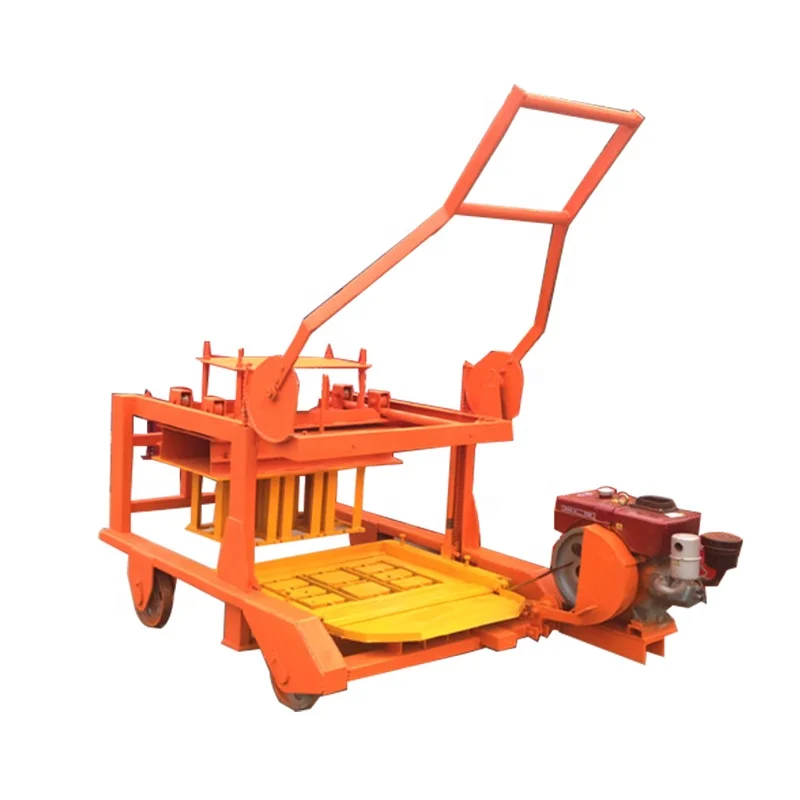
Matched Line Configuration — The QMR4-45 is quoted as a complete on-site production cluster with mixer, trolley, and press timed to the same cycle, so no station starves the next.
Technical Specifications
| Parameter | Value |
|---|---|
| Model | QMR4-45 |
| Product Type | Mobile Block Making Machine |
| Power Source | Diesel |
| Rated Power | 8 hp |
| Molding Cycle | 45s (basis not stated in source — confirm block format / material / thickness) |
| Molding Form | Vibration and Pressure |
| Vibration Force | 60 kN |
| Total Weight | 800 kg |
| Overall Dimensions (L×W×H) | 2420 × 1320 × 1650 mm |
| Pallet Requirement | No pallet required (egg-laying type) |
| Mobility | Mobile / movable on-site |
| Included Equipment | JZC350 or JQ350 Diesel Concrete Mixer; Trolley |
| Block Formats | Paver brick, hollow block, concrete block, solid brick, fly ash brick |
| Automation Level | Manual / semi-automatic (operator-dependent) |
Application Suitability
| Application | Material or Output |
|---|---|
| On-site housing project block production | Hollow and solid blocks from local crushed stone and cement |
| Remote infrastructure construction | Concrete blocks produced off-grid using diesel power |
| Small-scale block plant startup | Paver bricks and fly ash bricks without fixed curing racks |
| Contractor self-supply on development sites | Interlocking and kerb formats laid directly on prepared ground |
What "45-Second Cycle" Means When the Mixer Is Still Loading
A press cycle only holds if the station before it delivers on time.
Quotations that list a mobile block making machine production line as a single number often hide the fact that the mixer batch time and trolley travel were never checked against the press cycle. I once watched a line in Colombia sit idle because the river sand carried heavy clay, forcing longer mixing than the standard setting. The press waited. The daily tally dropped. The buyer blamed the press when the bottleneck was upstream [NEED_CITE: raw material variability and batch time impact on line throughput].
Stations That Keep Pace
The QMR4-45 pairs with either a JZC350 or JQ350 diesel mixer, both driven independently so the mobile block making machine production line does not depend on a single power take-off. The mixer discharges into a trolley that rolls to the press hopper. When the mixer batch size and discharge interval are set to match the 45-second press cycle, the hopper never runs dry and the operator never stands idle between strokes.
Removing Pallet Logistics From the Equation
An egg-laying press lays blocks directly onto the ground and moves forward, which eliminates pallet procurement, pallet return conveyors, and curing rack handling from the line entirely. For a contractor setting up on a cleared plot, this means the footprint shrinks to a mixing zone, a trolley path, and a curing area marked on the soil. No pallet inventory to track, no pallet damage to replace, no forklift traffic crossing the wet-block zone [NEED_CITE: egg-laying block machine site layout requirements].
Reading the Numbers That Matter
The 60 kN vibration force works together with mechanical pressure to compact the mix into the mould cavity. Higher vibration alone does not guarantee density; it must be matched to the aggregate gradation and cement content the buyer can actually source locally. The 8 hp diesel engine drives both vibration and hydraulic pressure, so fuel consumption tracks with stroke count rather than running at constant load. At 800 kg total weight, the machine is heavy enough to resist walking during vibration yet light enough to reposition with the trolley as the laying strip advances. Mould change is manual, so format flexibility depends on how many moulds the buyer orders upfront and how quickly the operator can swap and re-align them.
The Cost of Skipping the Line-Level Check
When the mixer is undersized for the press appetite, operators start shortening mixing time to keep up, and block strength drops below the local standard. When the trolley path is not planned before the curing area is poured, wet blocks end up stacked in uneven rows that crack during curing. These are not press failures — they are line-integration failures, and they surface only after the first week of production [NEED_CITE: block strength inconsistency from unmatched line stations].
Why Source the Full Cluster Here
Block machinery is the sole focus, so the press, mould, mixer, and trolley are specified as one matched system rather than assembled from separate suppliers. Configuration starts from the buyer’s actual mix design and local aggregate, not a catalogue default. Mould design covers the formats the buyer’s market actually sells, including custom drawings for non-standard pavers or interlocking profiles. Automation level is selectable, so a buyer can begin with the manual egg-laying setup and add pallet-based semi-automatic stations later. Installation support includes operator training on mould change and cycle pacing.
Documentation & Verification
- Line layout drawing stating which block format the 45-second cycle assumes
- Mixer batch-time calculation matched to press cycle for your target output
- Mould drawing and format list covering every profile in your quotation
- Voltage and frequency confirmation for the electric generating unit variant
- Factory test record on your specified aggregate before dispatch
- Packing photographs showing press, mixer, trolley, and moulds in one consignment
Installation, Commissioning & Support
- Ground must be level and compacted to accept the 800 kg machine without settling under vibration
- Diesel fuel supply and storage sized for continuous 8 hp press and mixer operation
- Machine ships dismantled; on-site reassembly covers vibration frame, hopper, and engine mounts
- First-run commissioning sets vibration duration and pressure against your local mix design
- Operator training covers mould swap procedure and trolley feeding rhythm
- Wear parts list identifies vibration springs and mould liners for first reorder
Before You Send the Inquiry
Share your target block format with dimensions, the daily output you need in that format, and a sample or description of your local aggregate so the mixer can be sized correctly. Confirm whether your site has any electrical supply at all or runs entirely on diesel, and state the control language your operators read. If you already own a forklift or have a fixed curing area, provide its dimensions so the egg-laying strip can be planned around it.
Frequently Asked Questions
Q: How is daily output calculated — which block format does the 45-second cycle assume?
A: The 45-second figure is a press cycle, not a daily tally. Daily output depends on which block format is in the mould, how many cavities that mould carries, and whether the mixer and trolley can sustain the pace. Ask for a capacity table that states pieces per hour for each format you intend to produce, with mixer batch time shown alongside.
Q: Does the quotation include the mixer, trolley, and moulds, or only the press?
A: A complete mobile block making machine production line quotation should list the press, the chosen diesel mixer model, the trolley, and every mould included. If any of these appear as optional extras, the line will not run on arrival without additional purchase orders and lead time.
Q: Can the line run on my local aggregate without material substitution?
A: Local crushed stone, river sand, or fly ash each demand different mixing times and vibration settings. Share your aggregate sieve analysis and cement grade so the mixer model and cycle parameters are set before production, avoiding costly material swaps after commissioning.
Q: What site preparation does an egg-laying line require?
A: You need a level, compacted ground strip long enough for a day’s laying, a mixing zone with diesel storage, and a curing area that does not interfere with the press travel path. No pallet racks or return conveyors are needed, but drainage and sun exposure must be planned for consistent curing.
Q: How are replacement moulds and wear parts supplied after the first run?
A: Moulds and wear parts such as vibration springs and liner plates are listed with drawings at the time of the original order. Reorder lead time depends on whether the format is standard or custom-drawn, so confirm first-replacement availability before the initial shipment leaves the factory.


