
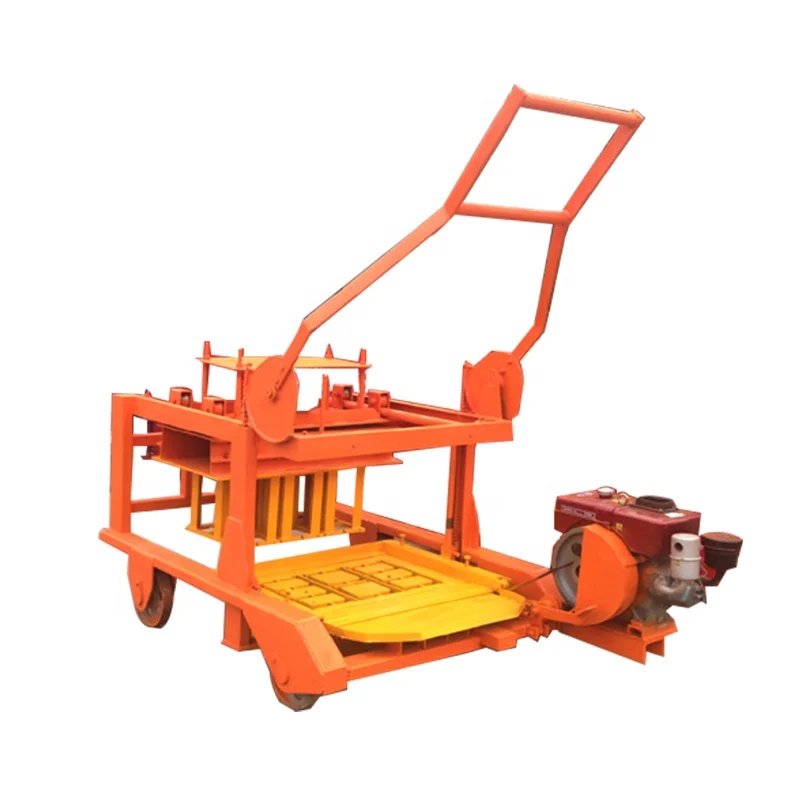
Matched Line Sizing — mixer batch, trolley loop and curing area are all scaled to the QMR4-45 molding cycle so no station sits idle while the press waits for material.
Technical Specifications
| Parameter | Value |
|---|---|
| Model | QMR4-45 |
| Product Type | Mobile Block Making Machine |
| Overall Dimensions | 1100 x 950 x 2100 mm |
| Net Weight | 810 kgs |
| Molding Cycle | 30–45 s |
| Power Source | Diesel / Petrol Engine / Electric (configurable) |
| Daily Capacity | 2560 pcs/day (basis not stated in source — confirm block format, material and thickness) |
| Pallet Requirement | No pallet needed (egg-laying design) |
| Mobility | Movable / portable on-site |
| Basic Equipment Included | JZC350 Diesel Concrete Mixer or JQ350 Diesel Concrete Mixer with Electric Generating Unit; Trolley |
| Compatible Brick Types | Paver brick, hollow block, concrete block, solid brick, fly ash brick |
| Automation Level | Manual / egg-laying type |
| Warranty | 1 Year |
Application Suitability
| Application | Material or Output |
|---|---|
| On-site housing project block production | Hollow blocks and solid blocks from crushed stone, sand and cement |
| Remote infrastructure masonry supply | Concrete blocks and paver bricks using locally sourced aggregate |
| First-operation entrepreneur block yard | Fly ash bricks and interlocking pavers with diesel-powered mixing |
| Rural construction without grid power | Solid and hollow blocks with diesel engine driving both mixer and press |
| Small-scale masonry contractor production | Paver bricks and kerbstones formed directly on the building site |
What "2560 Pieces per Day" Actually Means for Your Line Layout
A capacity figure without a block format attached is not a planning number — it is a marketing headline.
Quotations for mobile block making machine production line setups frequently list the press output in isolation. The mixer upstream may batch too slowly, the trolley may not cycle back in time, and the curing area may fill before the shift ends. I have stood in yards where crews hand-stacked wet blocks on the ground because the mobile machine outpaced every other station around it. The bottleneck simply moved downstream [NEED_CITE: typical on-site block production workflow bottlenecks]. When you evaluate a mobile block making machine production line, the question is never what the press can do alone — it is whether every handoff point keeps pace.
How the Mixer and Press Stay in Sync
The QMR4-45 completes a molding cycle every 30–45 seconds, which sets the tempo for the entire mobile block making machine production line. The included JZC350 diesel mixer or JQ350 electric mixer must deliver a fresh batch to the trolley before the press finishes its current cycle. If the mixer batch size is too small, the press idles. If it is too large, the mix begins to set in the hopper before it is used. Matching mixer drum capacity to the press hopper volume and trolley transport distance is the first step in line configuration.
Why the No-Pallet Design Simplifies Everything Downstream
Egg-laying machines lay blocks directly on the ground and move forward, eliminating the pallet return loop that fixed-plant lines require. This removes an entire station from the mobile block making machine production line — no pallet feeder, no pallet cleaner, no pallet stacking rack. The trade-off is that the curing area must be large enough to receive a full shift of output laid in rows. Planning the curing footprint against daily volume is where most on-site layouts fail [NEED_CITE: curing area sizing for egg-laying block machines].
Reading the Specs That Matter on Site
The 810 kg net weight keeps the machine portable by trolley yet heavy enough to resist vibration walk-off during the molding cycle. The 1100 x 950 mm footprint determines the minimum lane width the machine needs as it advances along the curing bed. Power source selection — diesel, petrol or electric — dictates whether the mixer shares a single fuel strategy with the press or requires a separate generator. The 30–45 second cycle range reflects the difference between a thin paver brick and a tall hollow block; thicker formats push toward the upper end and pull mixer demand higher per hour. Molding force comes from vibration and mechanical compaction rather than hydraulic pressure, which keeps the maintenance profile simple but means block strength depends heavily on mix design and local aggregate grading.
When Stations Are Sized Separately
A press quoted without its mixer and trolley leaves gaps that surface on day one. The crew discovers the generator is undersized for both machines running together, or the trolley cannot cover the distance between mixer and press within the molding cycle. I have seen on-site operations lose an entire morning recalculating batch sizes because the quoted mixer was one drum-size below what the press actually consumed. These mismatches compound — a slow mixer forces the press operator to rush, and rushed feeding produces inconsistent compaction across the batch [NEED_CITE: common mobile block line equipment mismatch failures].
Why Spec the Whole Line from One Source
Block machinery is our single focus, so the QMR4-45 is never shipped as a standalone press — the mixer, trolley and curing workflow are specified as one matched system. Configuration is set against your actual mix design and local aggregate, not a catalogue default. The included equipment list clearly separates what arrives in the base package from what must be added for continuous operation. Mould options cover the formats your market actually sells, with custom drawings available. Voltage, frequency and engine specifications are confirmed before production so commissioning is not delayed by a mismatch on arrival.
Documentation & Verification
- Line layout drawing showing mixer position, trolley path and curing area scaled to QMR4-45 cycle time
- Capacity calculation restated for your target block format, not a generic figure
- Equipment list distinguishing base-included mixer and trolley from optional additions
- Voltage and frequency confirmation sheet for electric option, or engine spec for diesel option
- Factory test record on your selected mould before dispatch
- Operation and maintenance manual with wear parts list for the QMR4-45
Installation, Commissioning & Support
- Site leveling guidance for the 1100 x 950 mm machine footprint and curing bed lane width
- Power source setup: generator sizing for diesel option or dedicated circuit for electric option
- Mixer-to-press distance and trolley route confirmed during commissioning to match the 30–45 s cycle
- First-run parameter setting on your selected mould with operator present for hands-on training
- Mould change procedure demonstrated on site so format switching does not consume a full shift
- Wear parts list for the QMR4-45 provided with reorder part numbers for local sourcing
What We Need to Configure Your Line
To size the mobile block making machine production line around your site, share your target block format and dimensions, the local aggregate and cement you plan to use, and your available curing area length and width. Let us know whether grid power is available or if the line must run entirely on diesel. If you have existing equipment such as a mixer or trolley already on site, tell us the model so we can confirm compatibility or adjust the base package.
Frequently Asked Questions
Q: How is the daily capacity recalculated for different block formats?
A: The 2560 pcs/day figure applies to a specific format not stated in the source data. We recalculate based on your target block dimensions, the 30–45 second molding cycle, and the number of effective production hours per shift. This gives you a realistic daily number tied to the product you actually sell, not a generic headline.
Q: What mixer batch size keeps the QMR4-45 continuously fed?
A: The included JZC350 or JQ350 mixer is matched to the press hopper volume so each batch covers approximately two to three molding cycles. The trolley transport distance and return time are factored in so the press does not idle between batches during a standard shift.
Q: Can the line be expanded with batching and conveyor stations later?
A: Yes. The QMR4-45 base line uses manual material handling, but the layout can accommodate a batching hopper, belt conveyor and expanded curing rack system as volume grows. The key is confirming that each added station matches the press cycle time so the line remains balanced.
Q: How do diesel and electric power options affect the rest of the line?
A: Choosing diesel means the mixer and press share a single fuel strategy, which is critical for off-grid sites. The electric option requires voltage and frequency confirmation for both the press motor and the JQ350 mixer motor. We specify the generator or circuit rating to cover simultaneous operation of both machines.
Q: What curing area layout is needed to avoid blocking the forming station?
A: The egg-laying design lays blocks directly on the ground as the machine advances. The curing lane must be long enough for one full shift of output without requiring the machine to double back. We calculate the required lane length from your block format, molding cycle and shift duration during line layout planning.


