
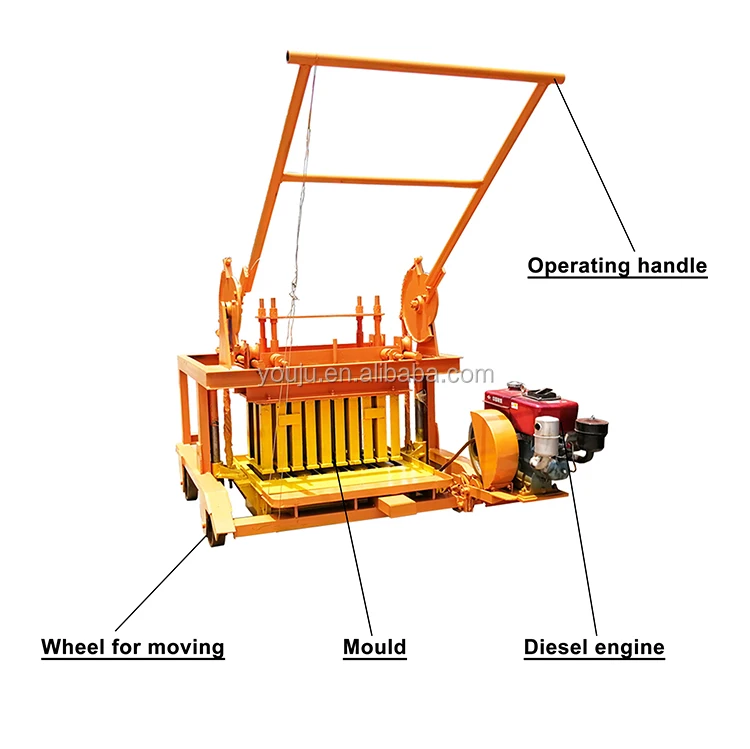
Matched System Design — the QMR4-45 diesel mobile block machine production line integrates raw material feeding, mixing, and curing handling around the egg-laying press to eliminate idle cycles and manual bottlenecks.
Technical Specifications
| Parameter | Value |
|---|---|
| Model | QMR4-45 |
| Product Type | Diesel Mobile Hollow Concrete Block Machine |
| Overall Dimensions (L×W×H) | 2420×1320×1650mm |
| Moulding Cycle | 40-45s |
| Pallet Size | No pallet required (egg-laying design) |
| Net Weight | 810kg |
| Rated Power | 6kW |
| Diesel Engine | 6kW or 6-8HP |
| Voltage | 220V or 380V or according to client local voltage |
| Output Capacity | 3000 pcs/day based on 400×200×200mm hollow block; 3500 pcs/day for 400×150×200mm; 4500 pcs/day for 400×120×200mm (basis to be confirmed for other formats) |
| Mould Formats | 400×200×200mm (4pcs/mould), 400×150×200mm (5pcs/mould), 400×120×200mm (6pcs/mould) |
| Automation Level | Manual egg-laying operation |
| Power Source | Diesel engine (no electric power required for press operation) |
| Assembly State | Fully assembled mobile unit |
| Warranty | One year guarantee for the whole machine |
| Certification | CE |
Application Suitability
| Application | Material or Output |
|---|---|
| Remote construction sites with no grid electricity | Hollow concrete blocks from local crushed stone, sand, and cement |
| On-site housing project production | Solid and hollow blocks laid directly on prepared ground |
| Small-scale cement brick manufacturing | Pavers and kerbstones using regional aggregate blends |
| Contractor self-production across build phases | Mobile block output relocating with project site progression |
Why "3000 Pieces per Day" Can Mislead Buyers
The daily output figure assumes a specific block format, and without that context, buyers plan shifts that never deliver.
When I was debugging a mobile block machine production line in Southeast Asia, the headline capacity looked perfect on paper. But once the crew started laying 400×150×200mm units instead of the standard 400×200×200mm format, the rhythm shifted — different mould cavity counts change how fast the operator clears and resets. A number without its format assumption creates false scheduling confidence. [NEED_CITE: block format impact on daily output calculation]
The mixer discharge rate, curing space turnover, and even how many workers walk the laying path all anchor to that cycle time. Miss one link and the press sits idle while the crew catches up.
Feeding Rhythm Against the 40-45s Press Cycle
The QMR4-45 completes a moulding cycle in 40-45 seconds across all listed hollow block formats. That tempo sets the heartbeat for every station upstream. If the mixer batch size is too small, the operator waits for the next discharge. If it is too large, the mix starts losing workability before it reaches the mould hopper. The mobile block machine production line only earns its capacity rating when the feeding loop locks into this cadence without drift.
Ground Preparation and Curing Footprint
An egg-laying press deposits blocks directly on the ground, which means the curing area is not a rack system but a flat, swept slab. The footprint expands with every shift. For a crew targeting the 400×200×200mm format, the daily curing spread can consume a considerable area, and that slab must be ready before the first mould drops. [NEED_CITE: curing area planning for egg-laying block machines]
Reading the Specs That Actually Matter
The 6kW diesel engine drives both vibration and hydraulic action without drawing from a site generator, which removes the most common line-stopping constraint on remote projects. The 2420×1320mm footprint keeps the unit narrow enough to pass through standard site gates while still holding a mould box that produces up to six 400×120×200mm units per cycle. Net weight at 810kg means the machine can be towed between zones but remains planted enough during vibration to avoid walking off its laid path. The 220V or 380V voltage option applies to auxiliary electric stations — mixer, conveyor, or water pump — even though the press itself runs on diesel, so confirming site supply before order prevents a mismatch when those peripherals arrive.
When the Line Around the Press Is Forgotten
The most common complaint I hear on site is not that the machine failed — it is that nobody planned what feeds it or what receives its output. A diesel mobile block machine production line without a specified mixer batch rate leaves the operator shovelling by hand, and hand-fed hoppers cannot sustain a 40-45s rhythm for a full shift. Downstream, if no one maps the curing slab dimensions, blocks get stacked on top of each other before the bottom layer has set, and breakage eats into the day’s count. [NEED_CITE: line integration failures in mobile block production]
Why the Supporting Equipment Defines the Outcome
Block machinery as a single focus means the QMR4-45 is not sold as a standalone press with the buyer left to source the rest. The mixer, feed hopper, and any conveyor sections are specified to match the 40-45s cycle so the press never starves. Configuration is set against the buyer’s actual mix design and local aggregate — a volcanic ash blend in one region demands different vibration duration than a clean river sand mix elsewhere. Mould drawings for all three formats ship with the order so the buyer can verify market fit before production starts. The automation level stays manual by design, keeping the line repairable on sites where PLC panels would just gather dust.
Documentation & Verification
- Line layout drawing with capacity calculation stated per block format
- Machine specification sheet covering diesel engine rating and voltage options
- Mould drawing and format list for all three hollow block sizes
- Voltage and auxiliary station confirmation before dispatch
- Factory test record on buyer’s specified block format
- Operation and maintenance manual with wear parts list
Installation, Commissioning & Support
- Level compacted gravel base sufficient for 810kg machine without concrete foundation
- Diesel engine pre-filled and tested, no electrical connection required for press operation
- Mixer and any electric peripherals wired to confirmed 220V or 380V site supply
- Mould change walkthrough on all three formats during first-day commissioning
- Operator training covering 40-45s cycle pacing and mix consistency reading
- Wear parts list with mould plate and vibration pad replacement intervals
What We Need From You to Build the Line
Share the block format your market actually buys, the daily volume you need to sustain, and the aggregate sources available within hauling distance of your site. Tell us your site voltage for any electric auxiliary stations and whether you already have a mixer or conveyor in place. If the project has a fixed deadline, give us the mobilization date so we can work back from dispatch.
Frequently Asked Questions
Q: What equipment surrounds the QMR4-45 in a complete mobile block machine production line?
A: The diesel press is the centre point. Around it, the line typically includes a pan mixer sized to discharge one batch per 40-45s cycle, a water dosing station, and a defined curing slab area. Pallets and pallet return conveyors are not needed because the egg-laying design deposits blocks on the ground, which simplifies the downstream handling significantly.
Q: How is daily output calculated for each block format?
A: Output depends on mould cavity count and cycle time. The 400×200×200mm format yields 4 pieces per cycle at 3000 pcs/day, while the 400×150×200mm yields 5 pieces per cycle at 3500 pcs/day, and the 400×120×200mm yields 6 pieces per cycle at 4500 pcs/day. Always confirm which format the quoted number assumes before planning labour and curing space.
Q: Does the diesel press still need electricity on site?
A: The press itself runs entirely on the diesel engine with no electrical connection. However, auxiliary stations like the mixer, water pump, or any conveyor belt typically require electric power. Confirm your site voltage — 220V or 380V — so those stations are built to match before shipment.
Q: How should the mixer batch size relate to the press cycle?
A: The mixer should discharge enough material for one mould cycle every 40-45 seconds to keep the press fed without waiting. If the batch is too small, the operator stands idle; if too large, the mix loses workability. We calculate the mixer drum volume against your chosen block format and local mix consistency.


