
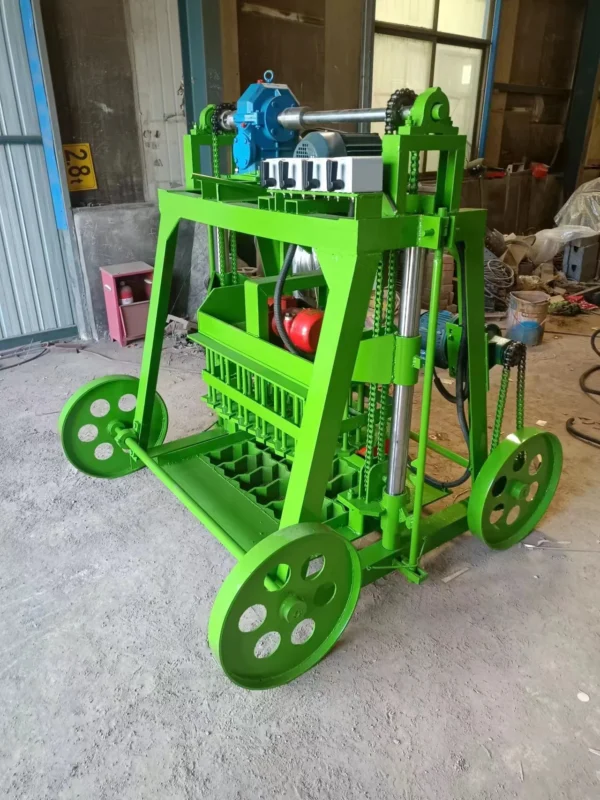
Diesel Egg-Laying Press — the QMR4-45 is specified as one matched system with mixer, feeder and curing layout, not quoted as a stand-alone island.
Technical Specifications
| Parameter | Value |
|---|---|
| Model | QMR4-45 |
| Product Type | Diesel Mobile Egg-Laying Block Making Machine |
| Overall Dimensions (L×W×H) | 2420×1320×1650 mm |
| Net Weight | 810 kg |
| Power Source | 6 kW Electric Motor or 6–8 HP Diesel Engine |
| Voltage | 220 V / 380 V / or according to client local voltage |
| Moulding Cycle | 40–45 s |
| Pallet Size | No need pallet (egg-laying type) |
| Output Capacity | 3000 pcs/day (based on 400×200×200 mm hollow block, 4 pcs/mould, 8 h) |
| Mould Format Options | 400×200×200 mm hollow block (4 pcs/mould), 400×150×200 mm hollow block (5 pcs/mould), 400×120×200 mm hollow block (6 pcs/mould) |
| Automation Level | Manual / semi-automatic |
| Assembly State | Stand-alone mobile unit |
| Warranty | 1 year |
| Standards | CE |
Application Suitability
| Application | Material or Output |
|---|---|
| On-site housing project block production | Hollow blocks from crushed stone, sand and cement laid directly on a prepared concrete floor |
| Rural and off-grid construction sites | Paving bricks and multicellular bricks using locally available aggregate with diesel engine drive |
| Start-up block plants with limited infrastructure | Standard bricks and hollow blocks without a fixed curing area or pallet inventory |
| Supplementary mobile production for existing manufacturers | On-site formats complementing a stationary plant, using the same mix design |
Why "3000 Blocks a Day" Rarely Matches the Site Reality
Stated output assumes a 400×200×200 mm hollow block at four cavities per mould across an eight-hour shift.
Buyers often receive a mobile block machine production line quotation that highlights a single daily figure without stating the block format, cavity count or shift length behind it. On a real site, the press may be set up for a 150 mm or 120 mm partition block that the local market actually buys, which changes the pieces-per-mould count and the realistic daily total. When the mixer and material feeder are not matched to the 40–45 second cycle, the press sits idle between charges, further eroding the quoted number [NEED_CITE: capacity calculation standards for mobile block presses].
Matching the Press to the Rest of the Line
An egg-laying press removes the pallet circuit entirely, which simplifies downstream handling but places more responsibility on the upstream stations. The mixer must deliver a batch every 40–45 seconds to keep the QMR4-45 cycling continuously. If the mixer is undersized, the mobile block machine production line stalls; if it is oversized, concrete begins to set in the hopper before the press can accept it.
Upstream and Downstream Station Sizing
Raw material feeding for this mobile block machine production line can range from a manual wheelbarrow charge to a small belt conveyor feeding a pan mixer. The choice depends on the daily output target and the labour available on site. Downstream, because the blocks are laid directly on the ground, no pallet return conveyor or stacking station is required, but a clear curing area must be marked out and kept level to prevent fresh blocks from tilting before initial set [NEED_CITE: on-site concrete curing practices for egg-laying machines].
Cycle Time, Mould Cavities and Real Daily Output
The 40–45 second moulding cycle applies across all listed formats, but the daily output changes with cavity count. At four cavities of 400×200×200 mm hollow block the press produces 3000 pieces in eight hours; switching to the five-cavity 400×150×200 mm mould raises that figure to 3500 pieces, while the six-cavity 400×120×200 mm mould yields 4500 pieces under the same cycle and shift assumptions. The diesel engine option maintains this cadence independently of grid stability, provided fuel supply is uninterrupted.
The Hidden Cost of Ignoring Voltage and Fuel Spec
One buyer shipped an electric-motor variant of this class to a region where the local grid runs at 415 V / 50 Hz while the machine was wired for 380 V. The motor overheated on the first test, and a step-down transformer had to be sourced locally, delaying commissioning by several weeks [NEED_CITE: voltage mismatch incidents in exported construction machinery]. For diesel variants, specifying the wrong fuel grade or failing to confirm ambient temperature can lead to cold-start failures or excessive smoke that violates local emission rules.
Why Procurement Starts with the Site, Not the Catalogue
The QMR4-45 is configured against the buyer’s actual mix design and local aggregate, not a catalogue default. Mould design covers the formats the buyer’s market sells, including custom drawings. The automation level is selectable, so a contractor can begin with manual charging and add a small belt feeder later. Installation support includes operator training on mould change and daily maintenance. Line layout drawings show how the press, mixer and curing area fit within the available site footprint [NEED_CITE: mobile block line layout guidelines].
Documentation & Verification
- Line layout drawing showing QMR4-45 placement, mixer position and curing area dimensions
- Capacity calculation sheet stating block format, mould cavity count and 40–45 s cycle assumption
- Mould drawing and format list for each ordered cavity set
- Voltage, frequency and plug type confirmation before production release
- Factory test record run on the buyer’s specified block format before dispatch
- Packing photographs and customs documentation support
Installation, Commissioning & Support
- Prepared concrete floor with maximum 3 mm deviation over the QMR4-45 travel path
- Electric variant requires a dedicated 6 kW circuit at the confirmed voltage and frequency
- Diesel variant requires fuel storage and a level refilling area adjacent to the work zone
- On-site commissioning covers first-cycle parameter setting and mould alignment check
- Operator training includes 40–45 s cycle pacing and manual mould change procedure
- Wear parts list provided for the first replacement cycle based on the ordered moulds
Before You Request a Quote
To size the supporting equipment accurately, please share the block format your market sells most, the target daily output, and the shift length you plan to run. We also need your site’s available floor area, the local voltage and frequency if the electric motor variant is preferred, and the type of aggregate you can source locally so the mix design can be matched before the line is configured.
Frequently Asked Questions
Q: How is daily output verified per block format, and what cycle time does each format assume?
A: The capacity calculation sheet lists each mould format with its cavity count and the 40–45 second cycle. For the 400×200×200 mm hollow block at four cavities, the verified output is 3000 pieces in an eight-hour shift. Other formats are recalculated on the same cycle assumption and stated per format in the proposal.
Q: How should the mixer and material feeder be sized so the press is not left waiting between cycles?
A: The mixer must discharge a batch every 40–45 seconds to match the QMR4-45 cadence. We size the pan mixer drum volume and the feeder belt speed to that interval. An undersized mixer causes idle time, while an oversized one lets concrete set in the hopper before the press can accept it.
Q: What pallet, stacking, or curing rack handling is needed upstream and downstream of an egg-laying press?
A: The egg-laying design eliminates pallets entirely. No pallet feeder, return conveyor or stacking station is required. The buyer must provide a level, cleared curing area where the press can travel and lay blocks directly on the ground. The area size is stated in the line layout drawing.
Q: How is the machine configured for the buyer’s local aggregate and mix design?
A: Before production, we request a sample of the local sand, crushed stone and cement. The mix proportions are adjusted so the 40–45 second cycle produces blocks at the required strength. The mould clearance and vibration force are then set to that mix, not to a generic catalogue default.
Q: What are the site preparation requirements for a mobile block line?
A: The floor must be flat within 3 mm over the machine travel path. For the electric variant, a dedicated circuit at the confirmed voltage and frequency is required. For the diesel variant, fuel storage and a level refilling area must be prepared. A curing zone clear of traffic is marked out according to the layout drawing.


