
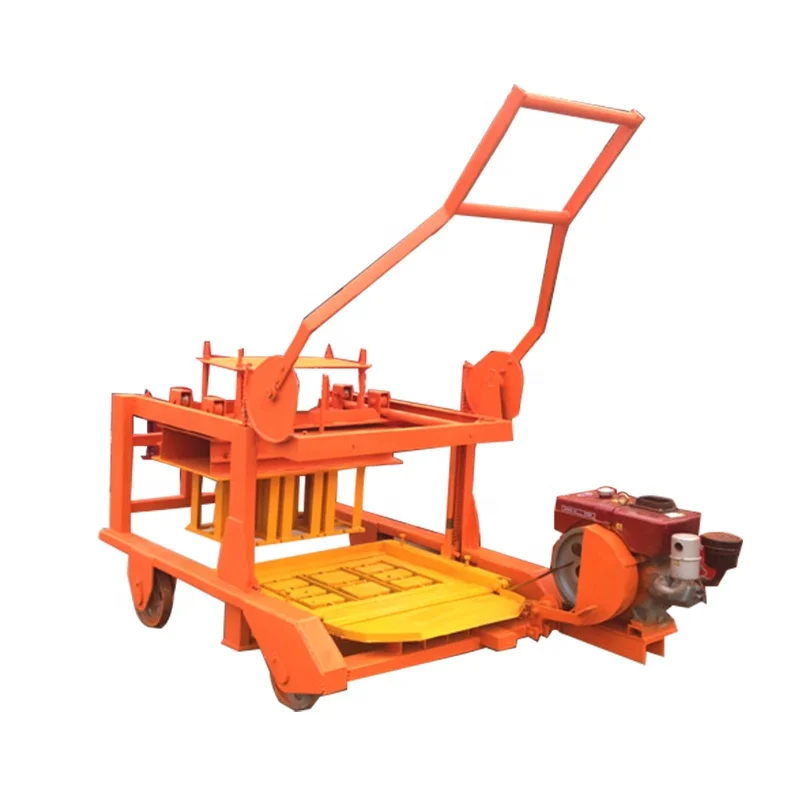
Single-focus block line engineering — the QMR4-45 mobile block machine is specified alongside its mixer, pallet circulation and curing layout as one matched system rather than a standalone press.
Technical Specifications
| Parameter | Value |
|---|---|
| Product Type | Mobile Diesel Engine Concrete Block Making Machine |
| Model | QMR4-45 |
| Power Source | Diesel Engine |
| Exciting Power | 28.6 KN |
| Excitation Frequency | 4500 r/min |
| Hydraulic Method | Mold Vibration |
| Molding Cycle | 30 s |
| Output Capacity | 3000 pcs/day (8 hours) (basis to be confirmed) |
| Overall Dimensions (L×W×H) | 1300 × 1500 × 1000 mm |
| Net Weight | 950 – 1000 kg |
| Transmission Type | Hydraulic, automatic, or manual transmission |
| Mould Compatibility | Customizable to buyer’s block size and design (interlock, paver, hollow block) |
| Assembly State | Mobile chassis with forward, backward and turning movement |
| Raw Materials | Concrete, sand, cement, fly ash, lime, gypsum, stone dust, stone nitrate, construction waste, slag, mine tailings, river sand, coal gangue, porcelain granule, carpolite, sandrock |
Application Suitability
| Application | Material or Output |
|---|---|
| On-site hollow block production at housing project locations | Crushed stone, river sand and cement mixes |
| Interlocking brick production for paving and retaining walls | Stone dust, fly ash and cement blends |
| Paver production for access roads and yards | Aggregate, sand and cement at varying thicknesses |
| Remote or off-grid block production | Locally sourced sand, mine tailings or construction waste |
| Contractor site production in mountainous, desert or coastal terrain | Adaptable to available regional aggregate |
Why the Supporting Line Matters More Than the Press Itself
A mobile concrete block making machine production line only reaches its cycle rate when the mixer, pallet flow and curing area are paced to the press.
Buyers who focus solely on the molding cycle often discover that hand-stacking finished blocks and manually feeding pallets consumes the very time the machine was supposed to save. On a contractor site in West Africa, I watched a mobile press sit idle because the diesel mixer could not discharge fast enough to match the 30-second cycle, and workers were carrying pallets from a curing area that was too far away [NEED_CITE: on-site block production workflow bottlenecks]. The press was capable, but the line around it was not.
Keeping the 30-Second Cycle Fed
The QMR4-45 completes a molding cycle in 30 seconds, which means the upstream mixer must discharge a fresh batch and the operator must have a pallet ready within that window. When planning a mobile concrete block making machine production line, the mixer drum capacity and discharge gate speed have to be calculated against this cycle time so the press never waits for material. A undersized mixer turns a 30-second cycle into a 50-second reality.
Diesel Power and Line Independence
Running on a diesel engine removes the dependency on a stable grid supply, which is the defining advantage for remote project sites. Fuel consumption, however, becomes a line-planning variable. The diesel engine on the press and the engine or PTO driving the mixer both draw from the same fuel logistics chain, and daily fuel cost must be factored into the operating budget before the first block is made [NEED_CITE: diesel fuel planning for off-grid construction equipment].
How Vibration Force and Pallet Flow Shape Block Density
The 28.6 KN exciting power at 4500 r/min compacts the concrete mix through mold vibration, and the resulting block density depends on matching that force to the specific aggregate gradation and cement ratio available locally. Denser blocks leave the press heavier, which in turn affects how many blocks a single pallet can carry and how quickly curing racks fill up. Pallet size must align with both the press platform dimensions and the forklift or hand cart used to move loaded pallets to the curing zone — a mismatch here forces double-handling and slows the entire line.
What Happens When the Line Is Not Balanced
When pallet handling and curing logistics are treated as an afterthought, the daily output of a mobile press drops noticeably below expectation. Workers end up stacking wet blocks by hand on uneven ground, which damages edges and introduces cracking before the curing process even begins. I have seen sites where the curing area was positioned uphill from the press, adding fatigue-induced delays to every pallet cycle [NEED_CITE: pallet handling impact on block curing quality]. These losses are invisible in the quotation but visible on the first production day.
Why Sourcing the Full Line From One Supplier Changes the Outcome
The QMR4-45 is specified as part of a complete mobile concrete block making machine production line, not as an isolated press. The mixer, pallet specification and curing rack layout are calculated together so that each station’s cycle time matches the press. Mould design is matched to the block formats the buyer’s market actually sells, including custom drawings when standard formats do not apply. Configuration is set against the buyer’s local aggregate and mix design rather than a catalogue default, preventing costly material substitutions after arrival. Automation level is selectable, so a contractor can start with manual pallet handling and add semi-automatic pallet feeding later without replacing the press. Installation support includes operator training on the specific mix and block format, not generic machine operation.
Documentation & Verification
- Line layout drawing showing mixer, press and curing area positioning for your site dimensions
- Capacity calculation stating the exact block format assumed for the daily output figure
- Mould drawing and format list matched to your local market requirements
- Hydraulic and electrical schematic for the diesel-driven vibration system
- Factory test record run on your specified raw material blend before dispatch
- Operation and maintenance manual in your preferred control language
Installation, Commissioning & Support
- Site leveling guidance for the 1300 × 1500 mm mobile chassis footprint on compacted ground
- Diesel engine break-in procedure and fuel filter maintenance schedule included at first startup
- Mould change instruction with alignment jig for switching between interlock, hollow and paver formats
- Pallet quantity and material recommendation sized to your curing area and forklift capacity
- Vibration frequency adjustment guidance tied to your local aggregate density and cement ratio
- Wear parts list covering mould liner, vibration springs and hydraulic seals for the first replacement cycle
Before You Send the Inquiry
Share the specific block formats you intend to produce, the daily volume your project requires, and the aggregate sources available near the site. Include the curing area dimensions you can allocate and any existing material handling equipment such as forklifts or wheelbarrows, so the pallet specification and line layout can be sized correctly from the start.
Frequently Asked Questions
Q: How is the 3000 pcs/day capacity figure determined, and which block format does it assume?
A: The stated daily capacity depends on the block format, wall thickness and mix design used. A hollow block takes longer to mold than a thinner paver, so the 30-second cycle applies to a specific reference format. Before ordering, request a capacity calculation that names the exact block size and mix assumed, so your daily output expectations match what the line actually produces on your material.
Q: What supporting equipment keeps the QMR4-45 running without idle time?
A: A diesel mixer with discharge speed matched to the 30-second cycle, sufficient pallets to cover the full curing rotation without pulling pallets from blocks that are not yet set, and a curing rack layout positioned close enough to the press for quick pallet transfer. Each of these stations must be included in the line plan, not sourced as an afterthought.
Q: How should the on-site layout be organized for continuous production flow?
A: Place the mixer within direct discharge reach of the press hopper, position the curing area downwind and on level ground adjacent to the press travel path, and keep a pallet return lane clear so empty pallets cycle back without crossing the wet block zone. The mobile chassis can move forward and turn, but the layout should minimize how far it needs to travel between molding positions.
Q: Can the diesel engine be replaced with an electric motor later if grid power arrives?
A: The press structure and vibration system can accommodate an electric motor conversion, but the mixer and any auxiliary stations must also be evaluated at the same time. Voltage, frequency and motor mounting specifications need confirmation before the swap to ensure the entire line transitions together rather than leaving one station diesel-powered.
Q: What pallet quantity prevents the press from stopping mid-shift?
A: Pallet quantity depends on the curing time required for your block format and climate conditions. In hot climates with faster initial set, fewer pallets may circulate. In cooler or humid conditions, blocks stay on pallets longer, so the total pallet count must cover a full rotation plus a buffer for damaged or warped pallets pulled from service.


