
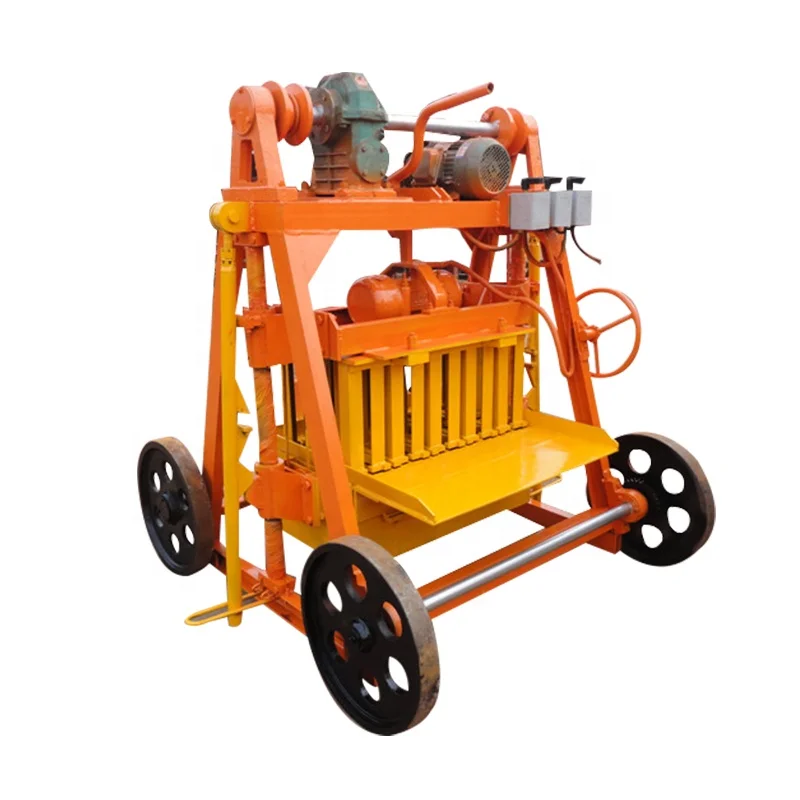
Matched Line Integration — feeding, mixing and block press cycle times are synchronized around the QMJ4-45’s 40–45 second molding window so the machine never waits for material.
Technical Specifications
| Parameter | Value |
|---|---|
| Model | QMJ4-45 |
| Product Type | Mobile Egg Laying Block Making Machine |
| Moulding Method | Twice-vibration of molding core |
| Molding Capacity | 4 pcs/mould (400×200×200mm hollow block) |
| Vibration Frequency | 2400 r/m |
| Molding Cycle | 45 s |
| Productivity (400×200×200mm) | 3000 pcs/day (8 h, 4 pcs/mould, 40–45 s cycle) |
| Productivity (400×150×200mm) | 3500 pcs/day (8 h, 5 pcs/mould, 40–45 s cycle) |
| Productivity (400×120×200mm) | 4500 pcs/day (8 h, 6 pcs/mould, 40–45 s cycle) |
| Demold Method | Manual |
| Turning Method | Manual |
| Total Power | 6 kW |
| Power Source | Diesel / petrol engine |
| Pallet Requirement | None (egg-laying operation) |
| Automation Level | Manual operation |
| Certification | CE |
Application Suitability
| Application | Material or Output |
|---|---|
| On-site hollow block production | Crushed stone, sand, cement and water mixes laid directly on cured concrete floors |
| Remote housing project supply | Multi-cellular and standard hollow blocks produced adjacent to the build site |
| Small-scale paver and brick runs | Interlocking paving bricks and solid standard bricks from locally sourced aggregate |
| Off-grid construction camps | Diesel-powered block output where grid electricity is unavailable |
Why the Press Alone Never Tells the Full Story
A mobile block machine production line is only as fast as the slowest station upstream.
Buyers often focus on the press cycle and overlook what happens before the mould closes. When the mixer batch is not ready, or the raw material feeder cannot keep up with the 40–45 second rhythm, the operator stands idle while the concrete in the hopper begins to set. I have walked onto sites where a QMJ4-45 was running at half its rated output simply because a single-bag mixer was feeding it. The block format, the mix design, and every piece of supporting equipment must be specified as one system [NEED_CITE: line balancing principles in small-scale concrete product manufacturing].
Feeding and Mixing Stations Sized to the Cycle
The QMJ4-45 completes a mould every 40–45 seconds. That means your mixer must deliver a fresh batch within the same window, or the mobile block machine production line loses rhythm. A pan mixer rated for one-bag batches, paired with a gravity-fed aggregate hopper, typically matches this tempo. Skipping the upstream calculation is the most common reason first-time buyers see output fall short of expectations.
Engine Power and Fuel Logistics on Remote Sites
Running a diesel or petrol engine removes dependence on grid voltage entirely, which matters on housing developments where power arrives late or not at all. The 6 kW total power requirement is modest, but fuel consumption still needs to be factored into daily running cost. Buyers in regions with inconsistent diesel supply chains should confirm local fuel grade compatibility before the engine is fitted [NEED_CITE: small diesel engine fuel grade specifications for tropical climates].
Twice-Vibration Core and Block Density
The twice-vibration molding core delivers two compaction pulses per cycle rather than one. The first pulse settles the mix into the mould cavity, and the second drives out remaining air pockets. For hollow blocks in the 400×200×200mm format, this produces noticeably higher wall density compared with single-vibration designs, which matters when blocks must meet local compressive strength requirements.
What Happens When Supporting Stations Are Left Out
A quotation that covers only the press leaves the buyer responsible for every station around it. Without a correctly sized mixer, raw material feeding becomes a manual shovel operation. Without a defined curing area layout, freshly laid blocks are moved by wheelbarrow to whatever flat ground is available. I have seen entire crews spent half a shift relocating blocks instead of producing them, because the line layout did not account for curing space and handling flow [NEED_CITE: typical labour allocation in manual egg-laying block production].
Why Buyers Source the Whole Line Here
Block machinery is the single focus of this operation, so the QMJ4-45 is never sold as a standalone press. Every supporting station — mixer, feeder, curing rack plan — is specified against the buyer’s actual block format and daily target. Moulds are designed for the formats the buyer’s market actually sells, not a default catalogue shape. Configuration starts from the buyer’s local aggregate and mix design, ensuring the vibration force and manual compaction produce consistent strength. Automation level is selectable, so a buyer starting with manual egg-laying can add pallet-based semi-automatic stations later without replacing the press.
Documentation & Verification
- Line layout drawing showing feeder, mixer and QMJ4-45 placement with curing area marked
- Capacity calculation sheet stating which hollow block format the daily output figure assumes
- Engine specification sheet confirming fuel grade and power output at rated RPM
- Factory test record with block samples produced using buyer-supplied mix proportions
- Wear parts list covering vibration core components, mould liners and manual demold linkages
Installation, Commissioning & Support
- Flat concrete floor minimum 150 mm thick required for egg-laying operation and curing area
- Diesel engine pre-start checklist and fuel line priming procedure provided at delivery
- First-day production run supervised with mix proportion adjustment to local aggregate
- Operator training covers mould change, manual demold technique and vibration core maintenance
- Spare moulds and vibration wear parts shipped with the machine to cover initial replacement cycle
What to Include in Your Inquiry
Send your target block format and daily output requirement so the feeding and mixing stations can be matched to the QMJ4-45’s cycle time. Confirm your local aggregate type and cement grade so the mix design and vibration setting are configured before dispatch. If you already have a mixer or curing area in place, share the details so the line layout avoids duplication.
Frequently Asked Questions
Q: How is the daily output figure verified and which block format does it assume?
A: Each output figure in the specification table is tied to a specific block size and mould cavity count, calculated over an eight-hour shift at the stated 40–45 second cycle. The 3000 pieces per day figure, for example, assumes 400×200×200mm hollow blocks at four per mould. Different formats change both the cavity count and the daily total accordingly.
Q: What feeding and mixing equipment is needed to keep the cycle uninterrupted?
A: A pan mixer capable of delivering one full batch within the 40–45 second molding window is the baseline. Upstream, a gravity-fed aggregate hopper with manual or belt-fed delivery ensures the mixer is never starved. The exact mixer capacity depends on your mix design and the block format you run most often.
Q: Can the engine be configured for local fuel availability?
A: The QMJ4-45 is available with either a diesel or petrol engine. Fuel grade compatibility should be confirmed before the engine is fitted, especially in tropical or high-altitude markets where standard fuel specifications differ. Engine documentation includes grade and viscosity requirements.
Q: Which supporting stations are included and which are buyer-supplied?
A: The standard quotation covers the press, mould, engine and basic feeding arrangement. Curing area layout, block handling equipment and any covered storage are buyer-supplied unless added to the line layout during the proposal stage. Every included and excluded station is itemised in the quotation.
Q: What is the lead time for replacement moulds and vibration components?
A: Moulds and vibration core wear parts are listed with the initial quotation, and a first replacement set can be shipped with the machine. Subsequent orders carry typical multi-week lead times depending on the format and cavity complexity. Confirming your full format range early avoids unplanned downtime.


