
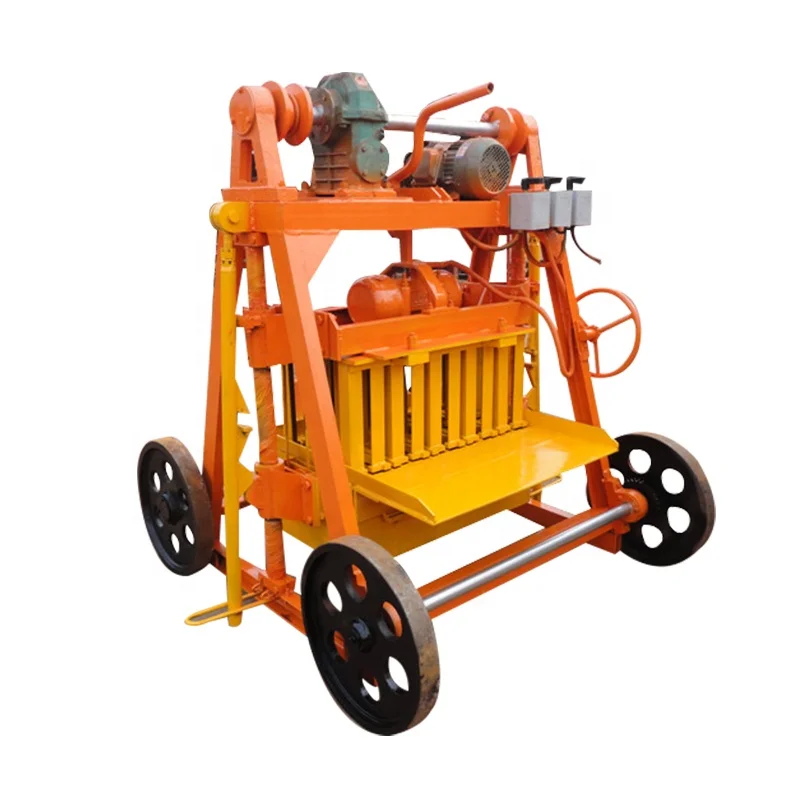
Matched System Configuration — The QMJ4-45 mobile block machine production line supporting equipment is specified alongside mixer capacity, feeder rate and curing layout to prevent the press from standing idle between cycles.
Technical Specifications
| Parameter | Value |
|---|---|
| Product Type | Mobile Egg Laying Block Making Machine |
| Model | QMJ4-45 |
| Molding Quantity | 4 pcs per cycle (400×200×200 mm hollow block) |
| Mould Formats Available | 400×200×200 mm (4 pcs), 400×150×200 mm (5 pcs), 400×120×200 mm (6 pcs) |
| Molding Cycle | 40–45 seconds |
| Productivity | 3,000 pcs/day (400×200×200 mm hollow block, 8-hour shift) |
| Productivity | 3,500 pcs/day (400×150×200 mm hollow block, 8-hour shift) |
| Productivity | 4,500 pcs/day (400×120×200 mm hollow block, 8-hour shift) |
| Forming Method | Mould vibration, twice-vibration of molding core |
| Demold Method | Manual |
| Turning Method | Manual |
| Vibration Frequency | 2,400 r/min |
| Total Power | 6 kW |
| Power Source | Diesel or petrol engine |
| Pallet Requirement | None — egg-laying type, blocks placed directly on ground |
| Assembly State | Skid-mounted, mobile on-site |
| Automation Level | Manual operation |
| Warranty | 1 year for whole machine |
Application Suitability
| Application | Material or Output |
|---|---|
| Housing project site block production | Cement, sand and crushed aggregate mixed to local availability |
| Remote construction camps without grid power | Engine-driven hollow blocks in 200 mm, 150 mm and 120 mm wall thickness |
| First-time block plant with minimal infrastructure | Egg-laying output cured on cleared ground, no fixed curing yard required |
| Contractor producing blocks across multiple locations | Skid-mounted unit relocated by forklift or crane between sites |
What "3,000 Pieces per Day" Actually Means on Your Site
Daily output figures assume a specific block format and an eight-hour shift — change the format and the number changes with it.
Catalogues often quote a single daily capacity without stating which block size that figure belongs to. A mobile block machine production line supporting equipment setup rated at 3,000 pieces per day on 400×200×200 mm blocks will produce noticeably more when switched to 120 mm wall thickness, but only if the mixer and material feed keep pace. I once saw a contractor in West Africa order based on the highest number in the table, then run only 200 mm blocks and wonder why his tally never matched. The gap between quoted capacity and actual site output almost always traces back to mismatched support equipment rather than the press itself [NEED_CITE: common causes of output shortfall in small-scale block plants].
How the Mixer and Feeder Set the Real Cycle Rhythm
A 40–45 second molding cycle means the QMJ4-45 demands a fresh batch of mix roughly every three-quarters of a minute. If the mixer takes longer than that to deliver the next load, the operator stands idle and daily output drops regardless of the press rating. Sizing the pan mixer to discharge within the cycle window is therefore the first step in planning a mobile block machine production line supporting equipment layout.
Curing Logistics When Blocks Sit on the Ground
Egg-laying production eliminates pallets, but it also means every block stays where it was formed until it cures enough to move. The site must be cleared, levelled and lightly dampened before each run. Forklift access around the curing rows is necessary once the blocks gain enough strength for handling. Planning the curing footprint prevents a situation where the press runs out of floor space halfway through a shift [NEED_CITE: curing area requirements for egg-laying block production].
Vibration, Power Source and Mould Change
The twice-vibration molding core concentrates energy into the block cavity, improving density without requiring a hydraulic press. Because the unit runs on a diesel or petrol engine, it can operate where grid power is absent, though fuel supply and noise limits must be factored into site planning. Switching between the 200 mm, 150 mm and 120 mm moulds is a manual task; the downtime this involves should be included in the shift schedule whenever multiple formats are run in one day.
When the Wrong Mixer Choice Cuts Output in Half
Pairing the QMJ4-45 with an undersized drum mixer forces the operator to wait for each batch, silently erasing the cycle-time advantage. Equally problematic is a mix design that assumes washed river sand when only crushed stone dust is available locally; the block may form but will lack adequate compressive strength. These mismatches show up only after production starts, and correcting them on site costs both time and material [NEED_CITE: mix design and aggregate influence on block strength].
Why Line Matching Matters More Than the Press Alone
The QMJ4-45 is engineered as one element of a wider workflow. Raw material feeding, mixing, and downstream curing are specified together so that no station becomes a bottleneck. Mixer discharge rate is aligned to the 40–45 second cycle, and curing area dimensions are calculated against the chosen block format. Engine-driven operation means batching station electrics can still run on a small generator, keeping the entire mobile block machine production line supporting equipment package viable on off-grid sites. Every mould drawing is produced against the buyer’s target format and wall thickness, not pulled from a generic library [NEED_CITE: documentation standards for block line exports].
Documentation & Verification
- Line layout drawing showing mixer position, feed path and curing rows scaled to your block format
- Capacity calculation sheet stating output per mould size and shift length
- Engine specification and fuel consumption data matched to your altitude and ambient temperature
- Mould drawing for each wall thickness confirming cavity dimensions and liner material
- Factory test record on your chosen aggregate before dispatch
Installation, Commissioning & Support
- Skid-mounted frame requires a level compacted gravel base, no poured foundation
- Engine oil, coolant and fuel filter checks scheduled around the first 50 operating hours
- Mould swap procedure documented with tool list specific to the QMJ4-45 bolt pattern
- Operator training covers manual demold timing to avoid surface cracking
- Wear part list with liner and vibration spring replacement intervals
Preparing Your Inquiry
Share the block formats your local market buys most, the aggregate and cement types you can source within a practical radius, and the curing space available on your site. If you already own a mixer or batching unit, include its batch volume and discharge time so the feed rate can be verified against the 40–45 second cycle. Noting whether grid power is available helps determine whether an auxiliary generator is needed for any supporting electric equipment.
Frequently Asked Questions
Q: How do I confirm which daily output figure applies to my block format?
A: Each capacity value in the specification table is tied to a specific block size and an eight-hour shift. State the exact wall thickness and dimensions you plan to run, and the corresponding output figure can be confirmed along with the mixer batch size required to sustain it.
Q: What mixer capacity keeps the QMJ4-45 running without idle cycles?
A: The press completes a cycle every 40–45 seconds, so the mixer must deliver a fresh batch within that window. A pan mixer sized to discharge the volume needed for one mould load in under forty seconds prevents the operator from waiting and maintains steady output.
Q: How much ground space does egg-laying curing require?
A: Because blocks remain on the ground until initial cure is achieved, the area must accommodate a full shift’s output plus walking and forklift lanes. The exact footprint depends on the block format selected and can be calculated from the daily output figure and block dimensions.
Q: Can I switch to a pallet-based stationary line later?
A: The QMJ4-45 is designed for mobile, pallet-free production. When volumes outgrow the site layout or curing space, the typical next step is a stationary press with pallet handling and automatic stacking, while the QMJ4-45 continues on smaller or remote jobs.


