
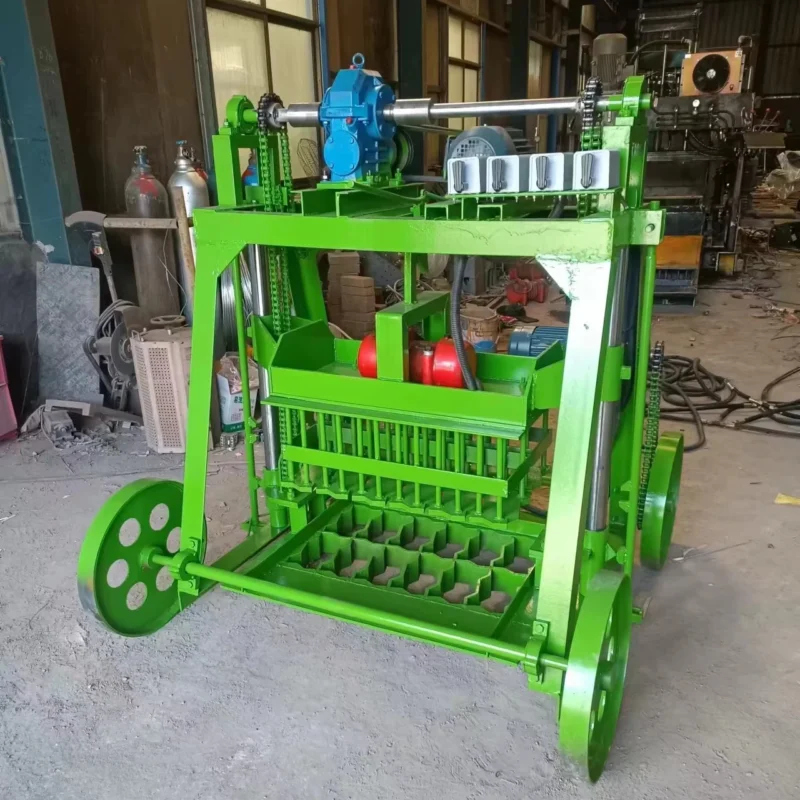
Matched system layout — The QMJ4-45 mobile block machine production line is specified as a complete on-site unit where the press, mixer and curing area are sized together so the cycle never waits for material or space.
Technical Specifications
| Parameter | Value |
|---|---|
| Model | QMJ4-45 |
| Product Type | Mobile Egg-Laying Block Making Machine |
| Brand | YOUJU |
| Molding Capacity | 4 pcs/mould (400×200×200mm hollow block) |
| Molding Cycle | 40–45 s |
| Productivity (400×200×200mm) | approx. 3000 pcs per 8-hour shift |
| Productivity (400×150×200mm) | approx. 3500 pcs per 8-hour shift |
| Productivity (400×120×200mm) | approx. 4500 pcs per 8-hour shift |
| Vibration Frequency | 2400 r/min |
| Vibration Method | Mould vibration (twice-vibration molding core) |
| Power Source | Diesel / Petrol engine |
| Total Power | 6 kW |
| Automation Level | Manual |
| Pallet Requirement | None (egg-laying on ground) |
| Demold / Turning Method | Manual |
| Voltage & Frequency | Not applicable (engine-driven) |
Application Suitability
| Application | Material or Output |
|---|---|
| On-site hollow block production | Crushed stone, sand, cement and local aggregate blends |
| Remote housing project supply | 400×200×200mm, 400×150×200mm, 400×120×200mm hollow blocks |
| Contractor yard block making | Engine-driven operation without grid power dependency |
| First-stage plant setup | Low supporting equipment footprint, no pallets required |
What "Daily Output" Means When No Pallets Are Used
An egg-laying machine removes the pallet loop, but the curing ground area becomes your real capacity ceiling.
When buyers review a mobile block machine production line, the conversation often stops at pieces per shift. In my site visits across West Africa, the press keeps running but the freshly laid blocks have nowhere to go because the curing yard was sized for a pallet-based system. Once the ground space fills, operators start stacking green blocks too close, and edges chip before hydration is complete [NEED_CITE: on-site curing space planning for egg-laying block machines]. Stating output per block format, as done in the table above, is the only way to plan the yard and the mixer feed rate together.
Removing the Pallet Loop from the Line Layout
The QMJ4-45 lays blocks directly on the prepared ground, which eliminates pallet feeding, pallet return conveyors and pallet storage racks from the mobile block machine production line. This simplification means the supporting equipment footprint shrinks to the mixer, the raw material feed and the water supply. For contractors moving between project sites, the line packs down to the press and a small batching station without the dead weight of hundreds of wooden or bamboo pallets.
Sizing the Mixer to the 40–45 Second Cycle
A twice-vibration molding core completes a mould every 40–45 seconds, so the mixer must deliver a fresh batch within that window to keep the press running continuously. If the mixer is undersized, the operator stands idle while the next batch blends, and the real daily output drops well below the quoted shift figure [NEED_CITE: mixer sizing for continuous block press cycles]. Planning the mixing station as part of the line, rather than sourcing it separately, keeps the cycle rhythm intact from raw material to finished block.
Reading the Vibration and Power Figures for Local Mixes
The 2400 r/min mould vibration frequency is paired with a 6 kW total power rating delivered through a diesel or petrol engine. Because the machine uses mould vibration rather than table vibration, the energy concentrates on the concrete inside the mould cavity, improving density for hollow formats. Engine-driven operation also removes the voltage and frequency confirmation step that delays commissioning on electric machines, though it introduces fuel supply and engine maintenance as new line variables that the site team must plan for.
When the Supporting Equipment Is Quoted Separately
A common pain point on site is discovering that pallet handling, stacking and curing were never included in the original quotation, leaving freshly pressed blocks to be moved by hand. The egg-laying configuration avoids the pallet issue entirely, but it shifts the planning burden to the curing area and the raw material feed station. If the mixer, water tank and aggregate bins are sourced locally without matching the press cycle, the mobile block machine production line still ends up bottlenecked — just at a different station [NEED_CITE: block line bottleneck analysis for egg-laying configurations].
Why Sourcing the Press and Line Together Matters
Block machinery as a single focus means the QMJ4-45 is quoted with a mixer capacity and curing area calculation that match its 40–45 second cycle, not a generic catalogue figure. The configuration is set against the buyer’s actual mix design and local aggregate, which is critical when red soil or shell sand replaces standard silica. Mould options cover the three hollow formats the local market actually buys, and wear parts for the vibration system are listed before shipment. Documentation includes a line layout showing the press, mixer and curing yard as one connected system.
Documentation & Verification
- Line layout drawing showing mixer, press and curing area sized for the selected hollow block format
- Capacity calculation sheet stating the block format assumed for each shift output figure
- Mould drawing and format list for 400×200×200mm, 400×150×200mm and 400×120×200mm hollow blocks
- Engine specification and fuel consumption record for diesel or petrol power source
- Operation manual covering manual demold, turning and twice-vibration molding core maintenance
Installation, Commissioning & Support
- Ground preparation and leveling for egg-laying operation across the planned curing area
- Engine start-up and vibration frequency verification at 2400 r/min before first production run
- Mixer feed rate adjustment to match the 40–45 second moulding cycle without idle gaps
- Operator training on manual demold and turning technique for consistent block density
- Wear parts list for vibration motor and mould liner with recommended first replacement intervals
What to Prepare Before Requesting a Quotation
Share the hollow block formats your market sells, the local aggregate and cement type available, and the daily volume you need from one shift. Confirm whether diesel or petrol fuel is easier to source on your project sites, and describe the ground conditions where the curing yard will be laid out. If you have an existing mixer or batching setup, send its capacity and discharge time so the line can be balanced around it.
Frequently Asked Questions
Q: Which block format does the daily output figure assume?
A: Shift output varies by format: approximately 3000 pieces for 400×200×200mm, 3500 for 400×150×200mm, and 4500 for 400×120×200mm hollow blocks. Each figure assumes continuous operation over an 8-hour shift with a 40–45 second moulding cycle. Switching to a different format changes both the pieces per mould and the daily total, so the line plan must state which format drives the capacity calculation.
Q: What mixer capacity keeps the press running without waiting?
A: The 40–45 second cycle means the mixer must discharge a fresh batch within that window. A pan mixer or drum mixer sized to deliver one mould volume every 40 seconds, accounting for loading and blending time, prevents the operator from standing idle. Undersized mixers are the most common cause of actual output falling short of the quoted shift figure on egg-laying lines.
Q: How much ground area does an 8-hour shift of egg-laid blocks occupy?
A: For 400×200×200mm hollow blocks at approximately 3000 pieces per shift, the curing yard must accommodate that many blocks laid flat with spacing for air circulation. The exact area depends on block dimensions and the spacing your curing method requires. Planning this area before installation prevents the situation where fresh blocks have nowhere to go and are stacked too early.
Q: What changes on site when the machine is engine-driven instead of electric?
A: Engine-driven operation removes the need for voltage and frequency confirmation, which simplifies commissioning in areas with unstable grid power. The trade-off is daily fuel supply, engine oil and filter maintenance, and higher noise levels on site. Fuel consumption and engine service intervals become part of the line’s operating cost and maintenance schedule.
Q: Which moulds and wear parts should be stocked for the first year?
A: The quotation should include moulds for the hollow formats your market sells, plus a wear parts list covering vibration motor components and mould liners. Having these on site before the first replacement is due prevents production stops while waiting for international shipping. Confirm the parts list against your planned daily output and the abrasiveness of your local aggregate.


