
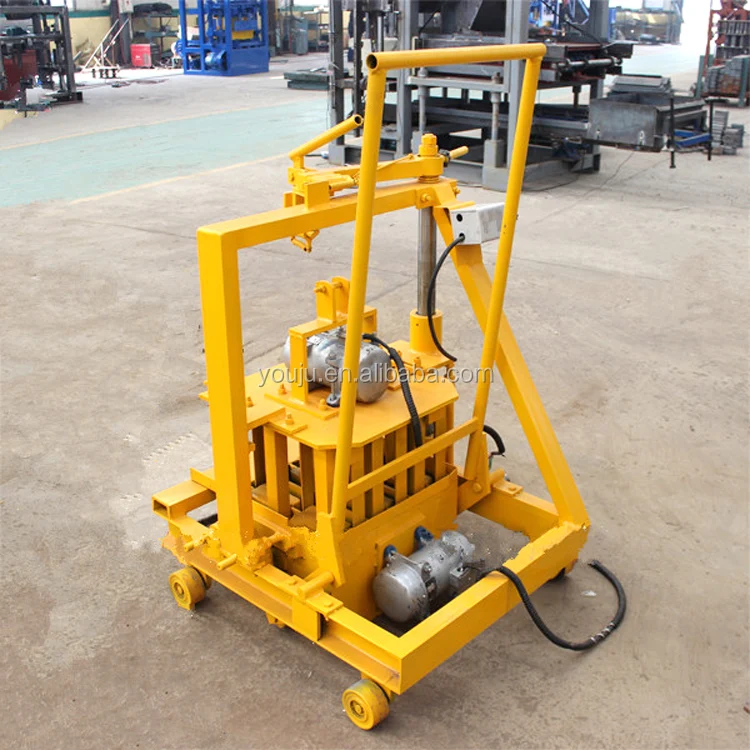
Line balance over brochure specs — the QMJ2-45 mobile egg-laying block making machine is positioned here not as a standalone press but as the cycle-time anchor around which your mixer, curing ground, and manual handling crew must be sized so throughput never collapses at the forming station.
Technical Specifications
| Parameter | Value |
|---|---|
| Model | QMJ2-45 |
| Product Type | Mobile Egg-Laying Block Making Machine |
| Forming Principle | Vibration with manual assist, no hydraulic static pressure active |
| Moulding Cycle | 25–30 s |
| Capacity (400×200×200 mm hollow block) | 2 pcs/mould, 160 pcs/h, 1280 pcs/8 hr |
| Capacity (400×150×200 mm hollow block) | 3 pcs/mould, rated at ~360–480 pcs/h based on 25–30 s cycle (source value — verify against manufacturer catalog) |
| Capacity (400×100×200 mm hollow block) | 4 pcs/mould, 320 pcs/h, 2560 pcs/8 hr |
| Power Source | Electric engine (motor kW rating to confirm before order) |
| Voltage & Frequency | Configurable to site supply, to confirm before shipment |
| Control System | Manual operation |
| Labour Requirement | 1–3 workers for full line |
| Pallet Requirement | None — egg-laying directly on ground |
| Mould Change | Interchangeable moulds, change time to confirm |
| Assembly State | Fully assembled, mobile |
| Certification | ISO 9001:2000, CE |
Application Suitability
| Application | Material or Output |
|---|---|
| On-site hollow block production for housing contractors | Cement, crushed stone, sand, water |
| Small block yard expanding format range | 400×200×200, 400×150×200, 400×100×200 mm hollow blocks |
| First block plant with minimal infrastructure | Local aggregate mixed with Portland cement |
| Remote project sites without pallet logistics | Ground-cured blocks on leveled concrete slab |
What "160 Pieces per Hour" Leaves Out About a Mobile Block Making Machine Production Line
The press cycle is only the starting point — your mixer output and curing ground must keep pace or the QMJ2-45 sits idle.
Capacity figures quoted for egg-laying block machine supporting equipment rarely mention that a 25–30 s moulding cycle demands a mixer delivering a fresh batch every half minute. When the mixer falls behind, workers stand around the press waiting for material, and the headline throughput collapses in practice. [NEED_CITE: typical mixer-to-press cycle matching in small block plants] The curing area must also absorb eight hours of continuous output without forcing the machine to stop because there is nowhere to lay the next row.
How the Egg-Laying Design Reshapes the Entire Line Layout
A mobile block making machine production line built around an egg-laying press eliminates pallet circulation entirely. Instead of budgeting for pallet return conveyors, stacking racks, and pallet cleaning stations, the layout centres on a flat curing slab large enough to receive blocks directly from the press. This simplifies the equipment list but shifts the planning burden to ground preparation and curing zone management.
Mixer Sizing and Material Feed Rhythm
Matching a mixer to the QMJ2-45 means calculating batch volume against the 25–30 s cycle across all three hollow block formats. When the machine switches from 400×200×200 mm blocks (2 pcs per mould) to 400×100×200 mm blocks (4 pcs per mould), material consumption roughly doubles per cycle. [NEED_CITE: mixer batch sizing for egg-laying block machines] The mixer must be sized for the highest-consumption format, not the average, or the press starves during the smaller-format production run.
Reading the Specs That Actually Matter for Line Balance
The moulding cycle of 25–30 s sets the heartbeat of the entire mobile block making machine production line. Every upstream and downstream station must sync to this rhythm. The electric drive removes diesel logistics from the site but requires confirmed voltage and frequency before the motor is wound at the factory — a mismatch discovered after arrival delays commissioning by weeks. The 1–3 worker labour specification covers the press itself; add one worker at the mixer and one managing the curing area and you have the real crew size. Mould interchangeability across three hollow block formats means the line must handle variable material draw rates without manual batching adjustments mid-shift.
The Cost of Leaving Supporting Equipment to Chance
When the quotation covers only the press, buyers discover too late that material feeding, mixing, and curing handling were never specified. A mixer with insufficient batch capacity creates a bottleneck that no amount of press speed can overcome. Voltage and frequency assumptions made at the factory without buyer confirmation lead to motor rewinding or transformer purchases on site. [NEED_CITE: electrical specification mismatches in exported block machinery] Without a curing area plan, freshly laid blocks get stepped on or moved prematurely, producing breakage that erases the throughput the machine was bought to deliver.
Why Sourcing the Full Line Matters Here
Our line configuration starts from your target block format and local aggregate, not from a catalogue default, so the mixer and curing area are specified against your actual daily output. The QMJ2-45 is treated as one station in a matched system — material feed path, mixer batch size, and curing ground dimensions are calculated together before the quotation is issued. Mould options are confirmed against the hollow block sizes your market actually buys, not a generic set. Voltage, frequency, and motor rating are locked in during the proposal stage so the machine arrives ready to connect. Installation support includes operator training on mould change procedure and cycle rhythm management across all three formats.
Documentation & Verification
- Line layout drawing showing mixer, feed path, forming zone, and curing area dimensions
- Capacity calculation stated separately for each of the three hollow block formats
- Voltage, frequency, and motor kW confirmation sheet signed before production
- Mould drawing and format list matching your local block sizes
- Factory test record on your specified aggregate mix before dispatch
- Operation manual covering mould change and daily maintenance intervals
Installation, Commissioning & Support
- Curing slab must be level and sized to absorb full 8-hour output of the QMJ2-45
- Electrical supply confirmed for the specified electric engine voltage and frequency before wiring
- Machine arrives fully assembled — site needs only leveled ground and power connection
- First-day commissioning covers mould change practice across all three hollow block formats
- Operator training on maintaining 25–30 s cycle rhythm with manual material feed
- Wear parts list and mould maintenance schedule provided at handover
What We Need From You to Build the Line Layout
Share your target hollow block format and daily output goal so we can size the mixer and curing area around the QMJ2-45 cycle. Tell us your site voltage, frequency, and available power capacity so the electric engine is configured correctly before shipment. Let us know your local aggregate type and cement source so the mix design aligns with what the machine will actually receive on site.
Frequently Asked Questions
Q: How do I match mixer batch size to the QMJ2-45 moulding cycle?
A: Calculate the material volume per mould across your largest format — 400×100×200 mm at 4 pcs per cycle — then size the mixer to deliver that volume within 25–30 s. Undersizing for the average format causes the press to idle whenever you switch to smaller blocks that consume material faster per unit of time.
Q: How much curing ground area absorbs a full shift of output?
A: Eight hours at 160 pcs/h of 400×200×200 mm blocks means 1280 blocks on the ground simultaneously. Each block footprint plus spacing for air circulation determines the slab area required. If the curing zone fills before the shift ends, the machine must stop regardless of its cycle capability.
Q: What voltage and frequency does the electric engine need?
A: The motor must be wound to match your site supply exactly. Confirm voltage, frequency, and phase before the order enters production — correcting a mismatch after arrival requires rewinding or an external transformer, both of which delay commissioning and add cost.
Q: Is hydraulic static pressure active on this machine?
A: Despite the model designation, the QMJ2-45 forms blocks through vibration and manual assist rather than active hydraulic pressure. This affects the mix design and block density you can achieve — confirm your strength requirement so the forming principle is appropriate for your application.


