
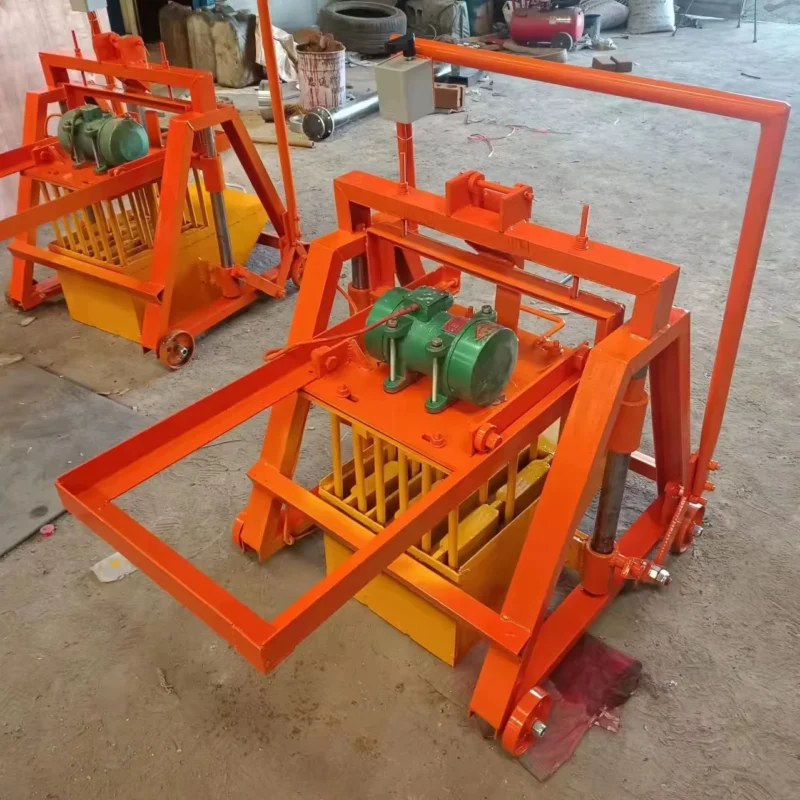
Line-matched throughput — every station around the QMJ2-45 is sized so the 25–30 s moulding cycle is never starved by mixing or curing bottlenecks.
Technical Specifications
| Parameter | Value |
|---|---|
| Model | QMJ2-45 |
| Product Type | Mobile Concrete Hollow Block Making Machine |
| Machine Type | Motorized hand-pushed mobile block machine |
| Moulding Cycle | 25–30 s |
| Automation Level | Manual mobile operation |
| Pallet Requirement | No pallets required |
| Power Source | Electric motor |
| Labor Requirement | 1 to 3 workers |
| Interlocking Capability | Yes |
| Mould Change | Supported for different hollow brick formats |
| Output Capacity (400×200×200 mm) | 160 pcs/h, 1 280 pcs/8 h, 2 pcs/mould |
| Output Capacity (400×150×200 mm) | 240 pcs/h, 4 800 pcs/8 h, 3 pcs/mould |
| Output Capacity (400×100×200 mm) | 320 pcs/h, 2 560 pcs/8 h, 4 pcs/mould |
| Standards | ISO 9001:2000, CE |
Application Suitability
| Application | Material or Output |
|---|---|
| Small-scale on-site hollow block production | Crushed stone, sand, cement without a fixed plant |
| Interlocking brick manufacturing | Local aggregate blends via mould change |
| Contractor self-supply on housing projects | Various hollow brick formats on limited footprint |
| First block plant with minimal investment | Entry-level line from mixing through curing |
What "160 Blocks per Hour" Leaves Out of Your Line Plan
A mobile block making machine production line only holds its cycle when every upstream and downstream station is matched to the press cadence.
I once watched a QMJ2-45 sit idle for nearly half a shift on a site in the Gulf region. The press itself was capable, but the pan mixer could not deliver a fresh batch within the 25–30 s window and there was no curing-rack plan for wet output. Workers stood around while the hopper ran empty, and daily throughput collapsed to roughly half of the quoted figure. [NEED_CITE: idle-time losses in small block plants when line stations are mismatched] A mobile block making machine production line that ignores the mixer, raw material feed, and curing area will always under-perform the press nameplate.
Keeping the Press Fed Without a Fixed Conveyor Network
Because the QMJ2-45 is hand-pushed and pallet-free, the line layout looks nothing like a stationary plant. Raw material must be mixed close to where the machine will lay blocks, and the mixed concrete needs to reach the hopper before the previous charge is spent. In practice that means positioning a pan mixer or small drum mixer within one wheelbarrow run of the machine travel path, and batching small enough loads to match the 25–30 s moulding cycle. The mobile block making machine production line therefore trades belt conveyors for disciplined batch sizing.
Curing and Stacking When There Are No Pallets to Return
The pallet-free design removes an entire loop — no pallet feeder, no return conveyor, no pallet brushing station — but it introduces a different planning task. Freshly extruded hollow blocks must cure in place on the ground or on a prepared slab until they gain enough green strength to be moved. A mobile block making machine production line must therefore reserve enough flat, shaded curing area to hold at least one full shift of output before any block is relocated [NEED_CITE: green-strength handling windows for cement-bonded hollow blocks].
How Mould Change and Cycle Time Shape Daily Throughput
The moulding cycle stays within 25–30 s regardless of whether the mould produces two, three, or four cavities. What changes is the pieces-per-mould count and therefore the hourly figure: 160 pcs/h on 400×200×200 mm, 240 pcs/h on the 150 mm width, and 320 pcs/h on the 100 mm width. Mould change itself is manual, so the line plan should group production runs by format to minimise changeovers within a single shift. Interlocking brick moulds share the same press, letting one mobile block making machine production line cover hollow blocks and pavers without a second capital outlay.
Reading the Specs That Actually Govern Output
The electric motor eliminates diesel fuel logistics on sites where a generator is already running other equipment, but it also fixes the machine to whatever voltage and frequency the site supply provides — a detail often confirmed only after the crate arrives. Moulding cycle consistency depends on the operator maintaining steady forward speed while the vibration compacts the mix, so worker training matters more than on a fully automatic press. Because no hydraulic pressure or vibration force rating is published for this model, buyers should request a factory test on their own mix design before shipment to confirm that block density meets local standards [NEED_CITE: relationship between vibration force and compressive strength in hollow blocks]. Labour requirement of one to three workers assumes the line already has material batched and curing space prepared.
When a Missing Station Costs a Full Shift
If the mixer is undersized, the press starves. If the curing slab is too small, blocks must be stacked green and crack before they leave the production area. If the local aggregate has a different moisture profile than the default mix, blocks may look right on day one but fail a seven-day crush test. Every one of these failures shows up as idle press time, and none of them appear on the machine quotation [NEED_CITE: aggregate moisture variation and its effect on block consistency]. Planning the mobile block making machine production line around the QMJ2-45 means specifying the mixer capacity, the curing slab area, and the mix validation test before the press order is signed.
Why Sourcing the Whole Line from One Spec Sheet Matters
Block machinery is the sole product focus here, so the QMJ2-45 is never quoted in isolation — the mixer type, batch size, and curing rack layout are written into the same line proposal. Configuration is set against the buyer’s actual aggregate and target block format, not a catalogue default, which means the capacity calculation states the format assumed. Moulds for every listed hollow brick dimension are designed and supplied in-house, and custom mould drawings are accepted when the local market sells a non-standard format. Automation level is selectable: a buyer can start with manual mobile operation and later add a semi-automatic batching station without replacing the press.
Documentation & Verification
- Line layout drawing showing mixer placement and curing area sized to QMJ2-45 output
- Capacity calculation sheet stating block format and moulding cycle for each throughput figure
- Mould drawing pack listing every hollow and interlocking format included
- Voltage and frequency confirmation form completed before production starts
- Factory test record run on buyer-supplied mix design and aggregate sample
- Operation and maintenance manual with mould change procedure for each format
Installation, Commissioning & Support
- Prepared flat slab required; QMJ2-45 hand-pushed design eliminates fixed foundation work
- Site voltage and frequency verified against electric motor nameplate before first start
- Machine arrives assembled; only mould and hopper need mounting on-site
- First-day commissioning includes mix adjustment to local aggregate and moisture content
- Operator training covers mould change sequence for every supplied format
- Wear parts list provided for mould liners and vibration components with reorder codes
Before You Request a Quote, Prepare These Details
To size the mobile block making machine production line correctly, please share the block formats your market sells most, the local aggregate type and its typical moisture range, and the daily output target per format. Confirm the site voltage and frequency, the available curing area in square metres, and whether an existing mixer will be reused. If the project has a fixed commissioning date, include that so lead time and container loading can be scheduled back from the deadline.
Frequently Asked Questions
Q: How is daily output calculated when the moulding cycle and block format both vary?
A: The 25–30 s cycle is constant, but pieces per mould differ: two for 200 mm width, three for 150 mm, four for 100 mm. Daily output is the hourly figure multiplied by effective running hours, which in turn depends on how fast the mixer can replenish the hopper and how much curing area is available to receive fresh blocks.
Q: Which supporting stations keep the QMJ2-45 running without idle gaps?
A: A pan or drum mixer sized to deliver a fresh batch every cycle, a raw material feed point within one wheelbarow run, and a shaded curing slab large enough to hold a full shift of output. Missing any one of these stations forces the press to wait and cuts actual throughput.
Q: How does the pallet-free design reshape the curing and stacking section?
A: Without pallets there is no return conveyor, so blocks cure in place on a prepared slab until green strength is sufficient for handling. The line plan must therefore allocate more flat curing area rather than investing in pallet racks and forklifts for wet blocks.
Q: What electrical details must be confirmed before the machine leaves the factory?
A: Site voltage, frequency, and the motor nameplate language must all be agreed before production. Late confirmation can delay commissioning because rewinding or replacing the motor after arrival adds weeks of downtime on site.
Q: Can the line be expanded from manual to semi-automatic later?
A: Yes. The QMJ2-45 accepts a semi-automatic batching and mixing upgrade without replacing the press. Pallet-free operation remains, but a small conveyor can be added to move mixed concrete from the mixer to the hopper, reducing the labour count while keeping the same moulding cycle.


