
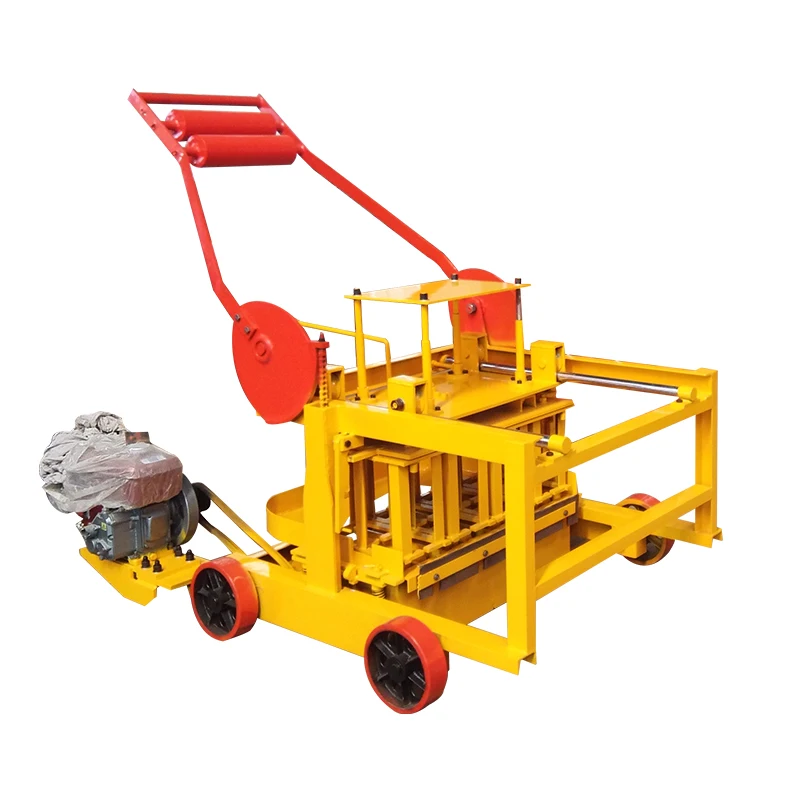
Single-Focus Line Design — every station from raw material feed through curing is matched to the QMR4-45 press cycle so no equipment sits idle waiting for the next step.
Technical Specifications
| Parameter | Value |
|---|---|
| Model | QMR4-45 |
| Product Type | Diesel Powered Mobile Egglaying Block Making Machine |
| Power Source | Diesel engine |
| Machine Type | Mobile / Egglaying |
| Automation Level | Manual operation |
| Pallet Requirement | Not required (egglaying design) |
| Control System | Manual operation |
| Hydraulic Pressure | Not applicable |
| Assembly State | Fully assembled, mobile unit |
| Block Format | (basis to be confirmed) |
| Output Capacity | (basis to be confirmed) |
| Cycle Time | (basis to be confirmed) |
| Vibration Force | (source value — verify against manufacturer catalog) |
| Overall Dimensions | (source value — verify against manufacturer catalog) |
| Net Weight | (source value — verify against manufacturer catalog) |
Application Suitability
| Application | Material or Output |
|---|---|
| On-site production for building contractors | Concrete blocks laid directly on prepared ground without pallets |
| Remote project sites without grid power | Diesel-powered operation independent of electrical infrastructure |
| First block plant for entrepreneurs | Low-investment entry with auxiliary mixer and curing racks added as volume grows |
| Housing project local production | Blocks manufactured adjacent to the construction area, reducing transport |
Why the Upstream Mixer Matters More Than the Press Itself
A mobile block making machine production line is only as fast as the slowest station feeding it.
I spent years troubleshooting block sites across Latin America where the press was rated for a certain cycle time but the mixer could not deliver fresh batch fast enough. The QMR4-45 sits at the center of a material flow that starts with aggregate storage, moves through batching and mixing, and ends at the curing area. If any one of those stations is undersized or electrically mismatched, the entire mobile block making machine production line stalls. On a site in Peru, I once watched a brand-new diesel press sit idle for three weeks because the auxiliary mixer and conveyor were wired for a voltage the site did not have [NEED_CITE: common voltage mismatches on remote construction sites]. The press was fine. The line around it was not.
Mapping Every Station Around the Press
The QMR4-45 operates as an egglaying unit, which means it deposits blocks directly onto the ground and moves forward. This design removes pallets from the material flow entirely, simplifying one major logistics chain. However, the stations upstream — raw material feeding, batching, and mixing — must still deliver a consistent supply of fresh concrete at a rate that matches the press cycle. A mixer that batches too slowly leaves the operator standing between cycles. A mixer that batches too quickly causes the mix to lose workability before it reaches the mould.
Connecting Curing Capacity to Daily Output
Downstream, the curing area must be sized to hold every block the press lays in a full shift. With an egglaying mobile block making machine production line, blocks cure in place on the ground, so the required floor area grows with daily volume. If the curing footprint is too small, the press must stop before the shift ends because there is nowhere left to lay fresh blocks. Planning the curing zone, water supply for moist curing, and protection from direct sun are all part of the line design, not afterthoughts [NEED_CITE: curing area planning for egglaying block production].
What the Specification Sheet Does Not Tell You
The diesel engine on the QMR4-45 removes dependence on grid electricity, which is a genuine advantage on remote sites. But the auxiliary equipment — mixer, water pump, conveyor — may still require electrical power. Before the line ships, every piece of supporting equipment must be checked against the actual voltage and phase available on site. The vibration force generated by the press determines how densely the concrete is compacted in the mould, and that force must be matched to the buyer’s specific mix design and local aggregate. A mix with too little fine aggregate will produce weak blocks regardless of how well the press vibrates. The manual operation level keeps the press simple and repairable in the field, but it also means the operator controls cycle timing directly, making consistent training essential.
The Cost of Leaving Stations Unspecified
When a quotation lists only the press and nothing else, the buyer inherits every integration decision. The mixer may arrive with the wrong voltage. The curing racks may not fit the available floor space. The raw material feeder may deliver aggregate at a rate that overwhelms or starves the mixer. These mismatches do not show up in a factory test — they appear on the first day of production, when the line is supposed to be running [NEED_CITE: integration failures in block production lines]. I have seen contractors lose entire project timelines because the line around the press was never specified as a system.
Why Source the Full Line from One Supplier
The QMR4-45 is configured alongside its supporting equipment so the mixer batch size, conveyor rate, and curing rack dimensions all align with the press cycle for the buyer’s chosen block format. Configuration is set against the buyer’s actual mix design and local aggregate, not pulled from a default catalog. Mould options cover the block formats the buyer’s market actually sells, with custom design available. The line ships as a matched set, meaning electrical specifications, mechanical connections, and material flow rates are verified together before dispatch. Installation support covers the full line, not just the press in isolation.
Documentation & Verification
- Line layout showing material flow from aggregate feed through curing for the QMR4-45
- Capacity calculation stating the exact block format and cycle assumptions
- Machine specification sheet with diesel engine and manual control details
- Mould drawing and available format list for the QMR4-45
- Factory test record on the buyer’s specified block format before dispatch
- Operation and maintenance manual covering press and auxiliary stations
Installation, Commissioning & Support
- Ground preparation and leveling requirements for the egglaying QMR4-45 travel path
- Diesel engine commissioning and fuel system check before first production run
- Electrical verification for every auxiliary station against site voltage and phase
- Mixer batch size calibration matched to the QMR4-45 cycle timing
- Operator training on manual press cycle control and mix consistency checks
- Wear parts list with mould and vibration component replacement intervals
What to Include in Your Inquiry
To configure the mobile block making machine production line around the QMR4-45 accurately, specify the block format and dimensions you intend to produce, your target daily output, and the raw materials available locally including aggregate type and cement grade. Confirm the electrical supply on site — voltage, phase, and frequency — for every auxiliary station. State the total curing area available and whether you need supporting equipment such as a mixer, conveyor, or curing racks included in the scope.
Frequently Asked Questions
Q: How does the QMR4-45 press cycle time match the upstream mixer batch output?
A: The mixer must deliver one complete batch within or slightly before the press cycle so the operator is never waiting for fresh concrete. We calculate the required mixer capacity based on the block format, mould cavity count, and cycle time to ensure continuous material flow without the mix losing workability between batches.
Q: What auxiliary equipment completes the line around this press?
A: A complete mobile block making machine production line typically includes a raw material feeder, a pan or drum mixer sized to the press cycle, a water supply system, and a defined curing area with protection. Each station is specified to match the QMR4-45 output rate and the buyer’s site conditions.
Q: What block format is assumed in the capacity calculation?
A: Capacity varies significantly depending on whether the mould produces hollow blocks, solid blocks, or pavers. We state the assumed format, dimensions, and cycle time explicitly in every proposal so the buyer can evaluate daily output against their actual market demand rather than a generic figure.
Q: Can the line be upgraded later from manual egglaying to a pallet-based press?
A: Upstream stations like the mixer, raw material feeder, and batching system can often be retained when upgrading to a pallet-based automatic press. The curing area would shift from ground curing to rack-based handling. We design the initial line layout with this migration path in mind.
Q: What site preparation does the full line require?
A: The QMR4-45 needs a firm, level surface for the egglaying travel path, adequate curing area sized to daily output, fuel storage for the diesel engine, and electrical supply points for auxiliary equipment. We provide a site preparation guide covering ground bearing requirements and utility connections.


