
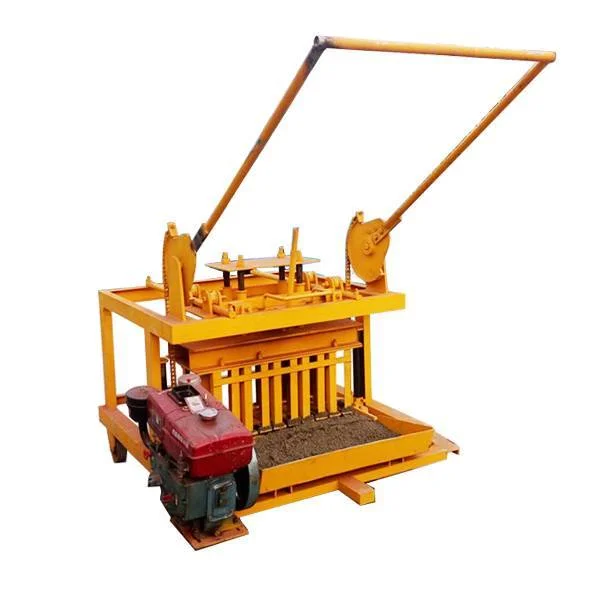
Matched System Lineup — the QMR4-45 is specified alongside its mixer, water supply and curing footprint so the press never waits on upstream feeding.
Technical Specifications
| Parameter | Value |
|---|---|
| Model | QMR4-45 |
| Product Type | Mobile Egg Laying Block Making Machine |
| Power Source | Diesel Engine |
| Automation Level | Manual / Portable |
| Mould Format | Interchangeable |
| Pallet Requirement | Not applicable (lays directly on ground) |
| Control System | Manual operation |
| Voltage & Frequency | Not applicable (diesel driven) |
| Assembly State | Fully assembled, portable |
| Certification | CE, ISO 9001 |
Application Suitability
| Application | Material or Output |
|---|---|
| On-site residential building | Solid and hollow blocks from local crushed stone and cement |
| Remote housing project | Paving blocks and kerbstones produced where grid power is absent |
| First-time block entrepreneur | Small daily runs of interlocking bricks with minimal infrastructure |
| Contractor self-supply | Masonry blocks cured directly on the project ground |
Why "Cycles Per Hour" Is Not a Capacity Figure
The real output of a mobile egg laying block making machine production line depends on which block format is being laid, how fast the mixer feeds, and how much ground curing space is available.
A catalogue number quoting cycles per hour without naming the assumed block format will mislead every time. On a remote site where the QMR4-45 operates, I have watched crews lose entire afternoons because the mixer could not keep pace with the press, or because the curing area filled up and the machine had nowhere to lay. Those stalls never appear in a headline capacity figure [NEED_CITE: typical causes of output shortfall on mobile block sites].
How the Press, Mixer and Curing Ground Connect
The QMR4-45 lays blocks directly onto the ground and moves forward after each cycle. That means the mobile egg laying block making machine production line has no pallet conveyor to buffer output — the mixer, water supply and worker pacing must all match the press cycle in real time. If the mixer batch is late, the operator stands idle; if the curing ground is full, the machine stops.
Where Diesel Power Changes the Site Layout
Running a diesel engine instead of an electric motor removes the dependency on a grid connection, which opens up remote housing projects and road-side kerbstone work. The trade-off is fuel logistics: the engine needs clean diesel at the altitude and ambient temperature of the job site, and the exhaust path must be considered when the machine operates inside a semi-enclosed curing yard [NEED_CITE: diesel engine performance at altitude for construction equipment].
Reading the Specs That Actually Matter
The interchangeable mould design lets one QMR4-45 produce solid blocks, hollow blocks and paving formats, but each format carries a different cycle time and a different ground-space requirement. A hollow block takes longer to fill and vibrate than a thin paving block, so daily output shifts accordingly. The manual control system keeps the machine simple and field-serviceable, though it places the pace entirely in the operator’s hands. Diesel engine rating must be checked against local fuel quality and elevation to avoid power loss mid-shift.
The Hidden Cost of Treating the Press as a Standalone Purchase
Buying the QMR4-45 without specifying the supporting line leads to predictable failures. A mixer that is too small forces the operator to wait between batches, cutting real daily output well below the quoted cycle rate. Without a planned curing area, freshly laid blocks get stepped on or moved too early, cracking before they gain strength. I have seen contractors blame the machine when the actual bottleneck was a wheelbarrow and a shovel [NEED_CITE: common line imbalance failures in small-scale block production].
Why Source the Line as One Package
Block machinery is our single focus, so the QMR4-45 is never quoted as a bare press. Configuration is set against your actual mix design and local aggregate, not a catalogue default. Mould formats are chosen for the blocks your market actually buys, and custom drawings are available when a standard mould does not fit. The automation level stays manual and portable, but the line layout — mixer capacity, water tank size, curing ground dimensions — is calculated so every station keeps pace. Documentation covers the full matched system, not just the machine.
Documentation & Verification
- Line layout drawing showing mixer, feeding path and curing area sized for your chosen block format
- Machine specification sheet confirming diesel engine rating and included mould list
- Capacity calculation stated per block format with cycle assumptions noted
- Factory test record run on your specified mix before dispatch
- Operation and maintenance manual with wear parts list
- CE declaration included where applicable
Installation, Commissioning & Support
- QMR4-45 ships fully assembled; only the mould and hopper need bolting on arrival
- Diesel engine checked for fuel grade and altitude match before commissioning starts
- Curing ground prepared and levelled according to the line layout drawing provided
- Mixer positioned so batch discharge aligns with the QMR4-45 hopper feed height
- Operator trained on mould change sequence and daily greasing points
- Wear parts and mould inventory list supplied for the first replacement cycle
What to Include in Your Inquiry
Tell us which block formats your market sells, the daily volume you need for each, and what raw materials you can source locally. Describe your site conditions — available curing ground area, ambient temperature range, and whether diesel fuel quality is consistent. That information lets us calculate a line layout where the QMR4-45 is never left waiting between cycles.
Frequently Asked Questions
Q: How do I confirm the daily output for the block format I actually produce?
A: Ask for a capacity calculation that states the block format, mix design and cycle time assumed. A single cycles-per-hour figure without these details is not a reliable basis for planning your curing area, labour shift or mixer size.
Q: What supporting equipment must be ready before the machine arrives?
A: You need a mixer matched to the QMR4-45 batch size, a reliable water supply at the production rate, and a levelled curing ground large enough to hold one full day of output without the blocks being disturbed or moved early.
Q: How does the egg-laying cycle interact with ground curing space?
A: The machine moves forward after each lay, so the curing ground must extend ahead of it. If the area fills up, production stops until blocks gain enough strength to be cleared — planning the ground length against daily output is essential.
Q: Will the diesel engine perform at my site altitude and temperature?
A: Diesel engines lose power at higher elevations and extreme heat. Share your site altitude and typical temperature range so the engine rating can be verified against actual operating conditions before the machine ships.
Q: How should I plan mould inventory to keep format changeover practical?
A: Order only the moulds your market demands now, and specify the bolt pattern so future moulds fit the same press. Changing a mould takes labour and downtime, so stocking formats that do not sell cancels out the flexibility you paid for.


