
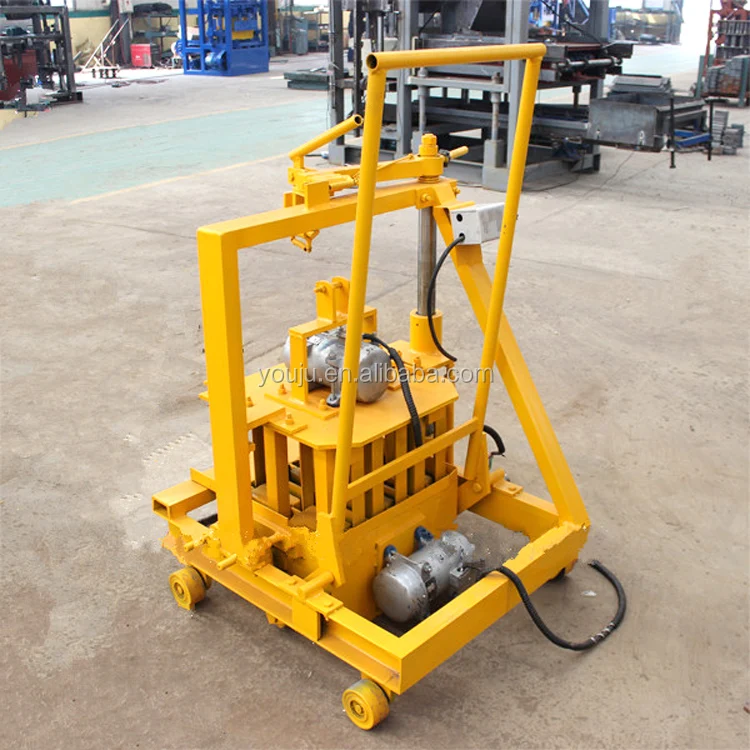
Matched line configuration — Every station from raw material feeding through curing is paced to the QMJ2-45 cycle time, so the press is never left waiting for the next batch.
Technical Specifications
| Parameter | Value |
|---|---|
| Model | QMJ2-45 |
| Product Type | Mobile Concrete Block Making Machine |
| Machine Type | Mobile egg-laying block making machine |
| Automation Level | Manual / semi-manual operation |
| Pallet Requirement | No pallets required (egg-laying type) |
| Power Source | Electric engine |
| Labor Requirement | 1 to 3 workers |
| Cycle Time | 25–30s per mould |
| Output Capacity | 2 pcs/mould, 160 pcs/h, 1280 pcs/8hr (basis: 400×200×200mm hollow brick) |
| Output Capacity | 4 pcs/mould, 320 pcs/h, 2560 pcs/8hr (basis: 400×100×200mm hollow brick) |
| Mould Format | Hollow brick (multiple sizes via mould change) |
| Operating Space | Small space compatible |
| Stacking Method | Manual |
| Certification | ISO9001:2000, CE |
Application Suitability
| Application | Material or Output |
|---|---|
| On-site construction block supply | Hollow blocks laid directly on the ground without pallet investment |
| First block plant for entrepreneurs | Small-scale production using locally sourced sand, stone dust, and cement |
| Housing project block manufacturing | Continuous egg-laying output matched to a project timeline |
| Remote site production | Manual operation with minimal infrastructure and no fixed plant requirement |
Why the Supporting Line Matters More Than the Press Itself
A mobile block making machine production line is only as fast as its slowest upstream station.
Buyers often focus entirely on the cycle time of the press, assuming that a 25–30 second mould cycle automatically translates into steady daily output. In practice, I have watched mobile egg-laying machines sit idle for minutes at a time because the mixer batch was too small, the raw material feed was inconsistent, or the curing area was not planned to receive continuous output. The turnkey mobile block machine concept only works when feeding, mixing, and ground-level curing logistics are specified as one connected workflow rather than afterthoughts [NEED_CITE: line synchronization principles for small-scale block plants].
Sizing the Mixer to the Egg-Laying Cycle
The QMJ2-45 completes a mould every 25 to 30 seconds, which sets a hard pacing requirement for everything upstream. If the mixer produces a batch that only feeds three mould cycles, the press operator will be standing idle while the next batch mixes. For a mobile block making machine production line at this scale, the mixer batch size and mixing time must be calculated against the press cycle so that fresh material is always available at the hopper. This is where most small-scale lines lose their theoretical output — not at the press, but in the gap between batches.
Pallet-Free Logic and Curing Area Planning
Because the QMJ2-45 lays blocks directly onto the ground, there is no pallet return loop, no pallet investment, and no curing rack handling system to specify. That simplicity is a major advantage for first-time block producers, but it shifts the planning burden to the curing area. The ground surface must be level, compacted, and large enough to receive continuous output over an eight-hour shift before blocks can be moved. A turnkey mobile block machine setup at this output tier requires a curing footprint that matches daily production volume, with clear paths for manual or wheelbarrow transport once blocks have set [NEED_CITE: ground curing space requirements for egg-laying block machines].
Reading the Specs That Actually Shape Your Line
The electric engine power source means voltage and frequency confirmation must happen before shipment — arriving on a site with the wrong supply specification will stall commissioning entirely. The labor requirement of one to three workers defines the line layout: manual material feeding to the mixer, manual mould change when switching between hollow brick formats, and hand stacking once blocks have cured. The mould interchangeability across 400×200×200mm, 400×150×200mm, and 400×100×200mm hollow brick formats gives one press flexibility across product lines, but each format change requires the operator to stop production, swap the mould, and verify the new cycle time. Understanding these parameters is how you build a realistic line layout rather than an optimistic one.
The Cost of Treating the Press as a Standalone Purchase
When a mobile block machine is quoted without its supporting feeding and mixing stations, the buyer is left to source those separately and hope the cycle times align. I have seen lines where the mixer was undersized, causing the press to wait between every few moulds, cutting actual daily output well below expectation. Similarly, when the curing area is not planned in advance, freshly laid blocks get stepped on or moved too early, damaging output that the press produced perfectly [NEED_CITE: common causes of output loss in small-scale mobile block lines]. These are not machine failures — they are line design failures.
Why Buyers Source the Full Line Here
Block machinery is our single focus, which means the QMJ2-45 is never treated as a standalone press but as the center of a matched system. Raw material feeding and mixer configuration are selected against your local aggregate and mix design, not pulled from a catalogue default. Mould design covers the hollow brick formats your market actually sells, including custom drawings when standard formats do not match local demand. Automation level is selectable — you can start with manual operation and add semi-automatic feeding as volume grows. Installation support includes on-site line layout verification so every station connects before the first production run.
Documentation & Verification
- Line layout showing feeding, mixing, and curing stations paced to the QMJ2-45 cycle time
- Capacity calculation stating the hollow brick format assumed for daily output figures
- Mould drawing and format list covering all interchangeable hollow brick sizes
- Voltage and frequency confirmation sheet signed off before dispatch
- Factory test record on your specified block format before shipment
- Operation manual covering mould change procedure and daily maintenance schedule
Installation, Commissioning & Support
- Ground surface must be level and compacted to receive egg-laying output directly from the QMJ2-45
- Electric engine requires confirmed voltage and frequency matching the site supply before arrival
- Mixer batch size verified against the 25–30 second mould cycle to prevent press idle time
- Mould change procedure trained on-site so operators can switch hollow brick formats within a shift
- Wear parts list provided with initial spare mould components for first replacement cycle
- Daily maintenance schedule covering vibration components and electric engine inspection points
What to Include in Your Inquiry
To configure a mobile block making machine production line around the QMJ2-45 that actually matches your site conditions, share your target hollow brick format and the daily output you need to meet. Confirm the voltage and frequency available at your production site, along with the local raw materials you plan to use — sand type, aggregate size, and cement grade all affect mixer and feed configuration. If you have an existing curing area or ground space limitation, include those dimensions so the line layout can be planned around them.
Frequently Asked Questions
Q: How do I verify the realistic daily output of the QMJ2-45 for my block format?
A: Daily output depends entirely on which hollow brick format you will produce. The 1280 pieces per eight-hour figure assumes 400×200×200mm blocks at two per mould. Request a capacity calculation that states your specific target format so the number reflects what you will actually manufacture, not a best-case scenario based on a different size.
Q: What supporting equipment do I need to build a complete line around this mobile machine?
A: At minimum, you need a mixer sized to keep pace with the 25–30 second mould cycle, a raw material feeding method to keep the mixer supplied, and a prepared ground-level curing area large enough to receive a full shift of output. Each station must be specified together so cycle times align.
Q: How should I plan the curing area when no pallets are used?
A: Since the QMJ2-45 lays blocks directly on the ground, the curing surface must be level, compacted, and extensive enough to hold daily output until blocks are strong enough to move. Plan the area dimensions based on your target format and daily volume before the machine arrives.
Q: What electrical specifications must I confirm before the machine ships?
A: Voltage, frequency, and phase must match your site supply exactly. The QMJ2-45 uses an electric engine, and arriving with the wrong electrical configuration will delay commissioning. Confirm these values with your supplier and have them documented before dispatch.


