
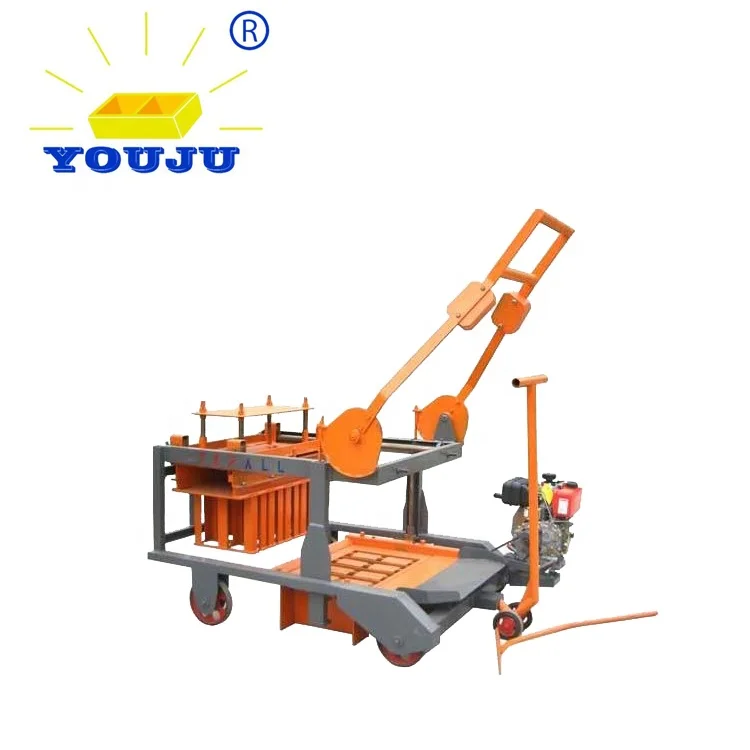
Matched System Engineering — we scope the mixer, feeding station, and curing rack handling around the QMR4-45 press cycle time so the line never bottlenecks at one station.
Technical Specifications
| Parameter | Value |
|---|---|
| Model | QMR4-45 |
| Product Type | Mobile Egg-Laying Block Making Machine |
| Overall Dimensions (L×W×H) | 2420×1320×1650mm |
| Net Weight | 810kg |
| Rated Power | 6kW |
| Diesel Engine Option | 6kW or 6-8HP |
| Voltage & Frequency | 220V / 380V or configured to local supply |
| Control System | Manual with hydraulic assist via diesel engine |
| Moulding Cycle | 40-45s per cycle |
| Pallet Requirement | No pallet required (egg-laying design) |
| Output — 400×200×200mm Hollow Block | 3000 pcs/day (4 pcs/mould, 8-hour shift) |
| Output — 400×150×200mm Hollow Block | 3500 pcs/day (5 pcs/mould, 8-hour shift) |
| Output — 400×120×200mm Hollow Block | 4500 pcs/day (6 pcs/mould, 8-hour shift) |
| Standard Mould Formats | 400×200×200 / 400×150×200 / 400×120×200mm hollow block |
| Hydraulic System | Diesel engine driven |
| Assembly State | Fully assembled, mobile on-site |
| Warranty | One year for the whole machine |
| Certification | CE referenced |
Application Suitability
| Application | Material or Output |
|---|---|
| On-site hollow block production for building contractors | Crushed stone, river sand, cement blends laid directly on compacted ground |
| Housing development block supply across multiple phases | Hollow blocks in 200mm, 150mm, and 120mm wall thicknesses |
| First block operation for entrepreneurs with minimal infrastructure | Low-capital egg-laying production without pallet or fixed plant investment |
| Remote construction sites with no grid electricity | Diesel-powered hydraulic pressing independent of mains supply |
Why the Mixer Sizing Question Comes Before the Machine Price
A press that waits on the mixer is a press producing nothing.
The QMR4-45 completes a moulding cycle every 40-45 seconds. If your upstream raw material feeding and mixing station cannot deliver a fresh batch within that window, the entire mobile block machine production line stalls. I have stood on sites where the contractor invested in a capable press but paired it with an undersized pan mixer, and the crew spent half the shift watching an empty hopper. The daily output number you were quoted evaporates before lunch [NEED_CITE: line station cycle matching principles in block production].
The same logic runs downstream. Egg-laying machines deposit wet blocks directly on the ground, which means curing rack handling and stacking must follow a cadence that keeps pace without disturbing freshly pressed units. When the stations around the press are not scoped together, output gets stacked by hand and breakage climbs.
Feeding and Mixing Stations Timed to the Press
The raw material feed configuration for this mobile block machine production line must match the 40-45 second moulding cycle. A belt feeder or screw conveyor sized to the mixer volume ensures continuous material flow without overloading the hopper. The mixer itself should discharge a full batch within the press cycle so the operator never idles between loads. We specify the feeding rate and mixer capacity against the exact block format you plan to run, because a 400×200×200mm hollow block draws a different batch volume than a 400×120×200mm unit.
Curing Rack Handling and the No-Pallet Advantage
Egg-laying design removes pallets entirely — no purchase cost, no storage footprint, no pallet return loop slowing the line. The trade-off is that wet blocks sit on the ground until they gain enough green strength to move. Curing rack handling equipment must therefore stage around the production zone, allowing blocks to cure in place before transfer to a stacking area. We scope the downstream handling as part of the line so nothing is left to manual workarounds.
Reading the Specs That Actually Matter
The 6kW rated power and optional 6-8HP diesel engine define where this machine can operate. On a remote site with no grid connection, the diesel hydraulic system keeps production running independently. Voltage configuration — 220V, 380V, or matched to your local supply — must be confirmed before the machine leaves the factory, because a rewound motor on arrival delays commissioning by weeks [NEED_CITE: voltage and frequency standards by export market]. The 810kg net weight means the QMR4-45 can be towed or loaded onto a flatbed between job sites without a crane, keeping relocation practical across multi-phase projects. Moulding cycle consistency at 40-45 seconds across all three standard hollow block formats depends on the hydraulic pressure and vibration force being matched to your specific mix design — a parameter we set against the aggregate sample you provide, not a catalogue default.
When Stations Are Quoted Separately
I have seen contractors receive a block press quotation that ends at the machine frame. Pallet handling, stacking, and curing are not included, so the crew hauls wet blocks by hand to wherever ground space is available. With an egg-laying machine the pallet problem disappears, but the upstream gap remains: if the mixer is undersized or the feeding station runs manually, your actual throughput falls well below the calculated daily capacity [NEED_CITE: hidden costs of incomplete line scope in block production]. The result is a line that technically works but never reaches the output the buyer planned their project timeline around.
Why Scope the Line Here
Block machinery is our single focus, which means the press, mould, and handling stations are specified as one matched system rather than assembled from separate suppliers. We configure the mobile block machine production line against your actual mix design and local aggregate, not a catalogue default. Mould design covers the formats your market sells, including custom drawings if your region runs a non-standard dimension. The automation level is selectable, so you can start with manual pallet handling and add automatic stacking later. Installation support includes operator training on your site so the crew understands the cycle rhythm from day one.
Documentation & Verification
- Line layout and capacity calculation stating the block format assumed for daily output figures
- Machine specification sheet with diesel hydraulic system parameters and voltage confirmation
- Mould drawing and format list covering all three standard hollow block dimensions
- Hydraulic and electrical schematic for on-site troubleshooting and spare part identification
- Factory test record on your target block format before dispatch
- Operation and maintenance manual with wear parts list and mould change procedure
Installation, Commissioning & Support
- Compacted ground surface required; the 2420×1320mm footprint needs a level area clear of debris for egg-laying operation
- Diesel engine eliminates grid dependency; electric motor option requires dedicated 6kW circuit at confirmed voltage
- Machine ships fully assembled at 810kg; forklift or flatbed sufficient for unloading and site relocation
- First-run commissioning includes hydraulic pressure and vibration adjustment matched to your aggregate sample
- Operator training covers mould change procedure and cycle timing to keep upstream mixing synchronized
- Wear parts and mould list supplied at delivery for first replacement planning
- One-year warranty covers the complete machine including diesel hydraulic system
Before You Send an Inquiry
To size the mobile block machine production line correctly, we need your target block format and the daily volume your project demands. Send a sample of your local sand or aggregate so the mix design and hydraulic settings are matched before the machine ships. Confirm your site voltage and whether you need the diesel engine or electric motor configuration.
Frequently Asked Questions
Q: What daily output can I expect, and which block format is that figure based on?
A: Output depends on the block format. At 3000 pieces per day based on 400×200×200mm hollow blocks with 4 pieces per mould over an 8-hour shift, switching to the 400×120×200mm format at 6 pieces per mould raises capacity to 4500 pieces per day under the same shift conditions. We state the format assumption with every output figure so your project planning starts from a real number.
Q: How do raw material feeding and mixing stations connect to the QMR4-45?
A: The upstream mixer must discharge a full batch within the 40-45 second moulding cycle so the press hopper never runs empty. We specify feeder type and mixer volume against your chosen block format, then confirm the discharge sequence keeps the line continuous. If the mixer is too small, the press idles and your daily output drops.
Q: What curing rack handling equipment completes the line around this press?
A: Since the egg-laying design deposits blocks directly on the ground, curing racks and transfer equipment must stage around the production zone. We scope the downstream handling so that freshly pressed blocks cure in place before being moved to a stacking area, eliminating manual hauling and reducing green-stage breakage.
Q: Can the diesel hydraulic system be swapped to electric if grid power becomes available later?
A: The machine can be configured for 220V or 380V electric operation, or matched to your local supply, instead of the diesel engine. If your site gains grid access after initial deployment, a motor swap is possible. We confirm voltage, frequency, and control language before dispatch so commissioning is not delayed.
Q: What mould formats are available beyond hollow block, and how does each affect line throughput?
A: Beyond the three standard hollow block formats, moulds for solid block, paving block, and other shapes are available via mould change. Each format draws a different batch volume and may shift the cycle time slightly, which means the upstream mixer and downstream handling must be re-checked to keep the line balanced at the new throughput.


