
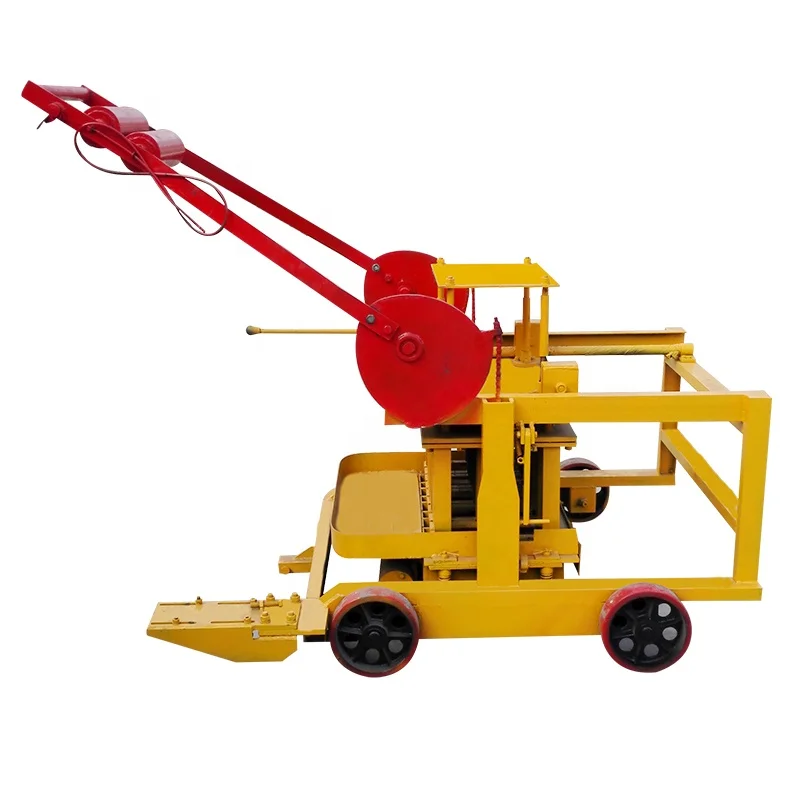
Pallet-Free System Integration — Every station around the QMR4-45 is matched by cycle time, so the mixer, trolley and curing layout never leave the press waiting for material or clear floor space.
Technical Specifications
| Parameter | Value |
|---|---|
| Model | QMR4-45 |
| Product Type | Mobile Concrete Block Making Machine |
| Power Source | Diesel / Petrol Engine / Electric (site-selectable) |
| Overall Dimensions (L×W×H) | 1100 x 950 x 2100 mm |
| Net Weight | 810 kgs |
| Molding Cycle | 30–45 s |
| Output Capacity | 2,560 pcs/day (basis not stated in source — confirm block format, material and thickness) |
| Pallet Requirement | No pallet required (egg-laying operation) |
| Included Basic Equipment | JZC350 Diesel Concrete Mixer or JQ350 Diesel Concrete Mixer; Trolley |
| Compatible Block Formats | Paver brick, hollow block, concrete block, solid brick, fly ash brick |
| Warranty | 1 Year |
Application Suitability
| Application | Material or Output |
|---|---|
| On-site housing project block production | Hollow and solid concrete blocks laid directly on prepared ground |
| Remote construction sites without grid power | Diesel-driven mixer and press producing masonry units locally |
| Small-scale paver and brick manufacturing | Interlocking paver bricks and fly ash bricks for local sale |
| Contractor-owned mobile production | Solid and hollow blocks moved between job sites via trolley |
Why the Mixer Matters More Than the Press Rating
A mobile block machine production line stands or falls on whether the mixer can keep pace with the press cycle.
Many buyers focus entirely on the press when evaluating a mobile block machine production line, only to discover that the mixer batches too slowly or too small, forcing the press operator to wait between cycles. In my years planning block lines across Shandong workshops, I have watched entire shifts lose meaningful output because a half-sized mixer was paired with a press that could have run continuously. The gap between quoted capacity and actual daily throughput almost always traces back to one station starving another [NEED_CITE: common causes of throughput loss in small block plants]. When the QMR4-45 is specified with its matched JZC350 or JQ350 mixer, the batch volume and mixing time are sized so that fresh concrete arrives at the press hopper before the current cycle finishes, keeping the 30–45 second molding rhythm unbroken.
Eliminating the Pallet Loop
Pallet-free egg-laying operation removes the entire pallet return and curing-rack circuit from the line. On a conventional static press, pallets must be fed, collected, racked, cured and returned — a loop that demands extra labour, floor space and handling equipment. The QMR4-45 lays each block directly onto a prepared ground surface, so the mobile block machine production line reduces to three stations: mixer, press and trolley. This simplification is the reason contractors choose mobile lines for housing projects where a curing yard can be graded beside the building footprint.
Sizing the Line to the Curing Area
Because blocks are laid in rows on the ground, the trolley routing and daily output are governed by the curing area available. Before a mobile block machine production line is dispatched, the buyer’s site dimensions must be reviewed so that trolley paths do not cross freshly laid rows and the press always has clear ground ahead. On tight sites, production may need to be scheduled in zones, with curing completed in one section before the press returns to it the following day [NEED_CITE: curing space requirements for egg-laying block machines].
Reading the Specs That Actually Move the Needle
The 810 kg net weight of the QMR4-45 matters directly for block density and consistency. A heavier press frame resists vibration walk-off, keeping the machine stable on uneven ground as it lays each course. The 30–45 second molding cycle determines how fast the trolley must move and how quickly the mixer must deliver the next batch — this cycle time assumes a standard concrete mix, and local aggregate with high clay or silt content will extend it while reducing block strength. Power source selection between diesel, petrol and electric motors must match what the site can actually supply; I once saw a line shipped to a region with only 50 Hz grid power while the motor was wound for 60 Hz, and the press ran at reduced vibration force until a replacement motor arrived weeks later. The overall dimensions of 1100 x 950 x 2100 mm define the minimum operating corridor and the turning radius the trolley needs to feed the hopper without interrupting the laying sequence.
What Happens When Stations Are Mismatched
When a buyer sources the mixer locally to save on the quotation, the batch volume rarely matches the press consumption rate. The result is a pattern of short runs followed by idle waits, and the daily output drops noticeably below expectation. Worse, if the trolley cannot navigate the curing area layout, operators end up carrying blocks by hand, defeating the reason for buying a mechanised line in the first place [NEED_CITE: material flow bottlenecks in mobile block production]. These hidden costs surface only after commissioning, when it is too late to resize the line without ordering additional equipment.
Why Procure the Line as One Package
The QMR4-45 is configured with its mixer and trolley as a matched system rather than assembled from separate suppliers, so cycle times are balanced before the line ships. Configuration is set against the buyer’s actual mix design and local aggregate, not a catalogue default, which prevents the strength and cycle-time surprises that arise when a standard setting meets unfamiliar raw materials. The included mixer — JZC350 for diesel or JQ350 for sites with electric generating units — is selected to match the press consumption rate for the target block format. Voltage, frequency and engine specification are confirmed against site conditions before production begins, avoiding the commissioning delays I have seen when these details are left until the container arrives. A line layout drawing shows mixer placement, trolley path and curing area so that nothing is left to improvisation on site.
Documentation & Verification
- Line layout drawing showing mixer position, trolley path and curing zone dimensions
- Capacity calculation stating which block format and mix design the output figure assumes
- Mixer batch volume and cycle time matched against QMR4-45 molding cycle in writing
- Voltage, frequency or engine specification confirmation sheet signed before production
- Factory test record run on buyer’s target block format with measured cycle times
- Packing list covering press, mixer, trolley and all connectors for commissioning
Installation, Commissioning & Support
- Site must provide a level, compacted ground surface for egg-laying operation within the 1100 x 950 mm press footprint
- Diesel variant requires fuel supply and routine engine maintenance per JZC350 or JQ350 service schedule
- Electric variant needs confirmed voltage and frequency on a dedicated circuit before the press is energised
- Trolley track or path cleared and curing area marked before first production run
- Operator training covers mold change procedure and mixer-to-press material flow coordination
- Wear parts list provided with recommended first-order quantities for screens, mold liners and trolley wheels
What We Need to Configure Your Line
Send us the block format you intend to produce, including dimensions and target daily volume. Tell us whether your site has stable grid electricity or whether a diesel-driven line is required. Share the curing area dimensions and ground conditions so we can plan the trolley routing and confirm that the QMR4-45 will have uninterrupted floor space to lay each course.
Frequently Asked Questions
Q: How is daily output calculated and which block format does the 2,560 pcs/day figure assume?
A: That figure is listed in the product data without a stated block format, mix design or operating hours. Before we quote, we calculate realistic daily output based on your target block dimensions, local aggregate and the number of shifts you plan to run, so the figure you receive reflects your actual production conditions.
Q: How do I match the mixer batch size to the press cycle so material flow is continuous?
A: The included JZC350 or JQ350 mixer is selected so that one mixed batch arrives at the press hopper within the 30–45 second molding cycle. We confirm this match in the line layout, accounting for your specific block format and mix water content.
Q: What curing area and trolley routing do I need for pallet-free egg-laying production?
A: The curing area must be large enough for the day’s output laid in rows, with trolley access between rows and clear turning space at each end. We plan the layout from your site dimensions before the line ships.
Q: Diesel versus electric — how do I choose the right power source for my site?
A: If your site lacks stable grid power or you move between locations, the diesel variant with JZC350 mixer keeps the line self-sufficient. Where a reliable electric supply or generating unit exists, the JQ350 electric mixer reduces noise and running costs.


