
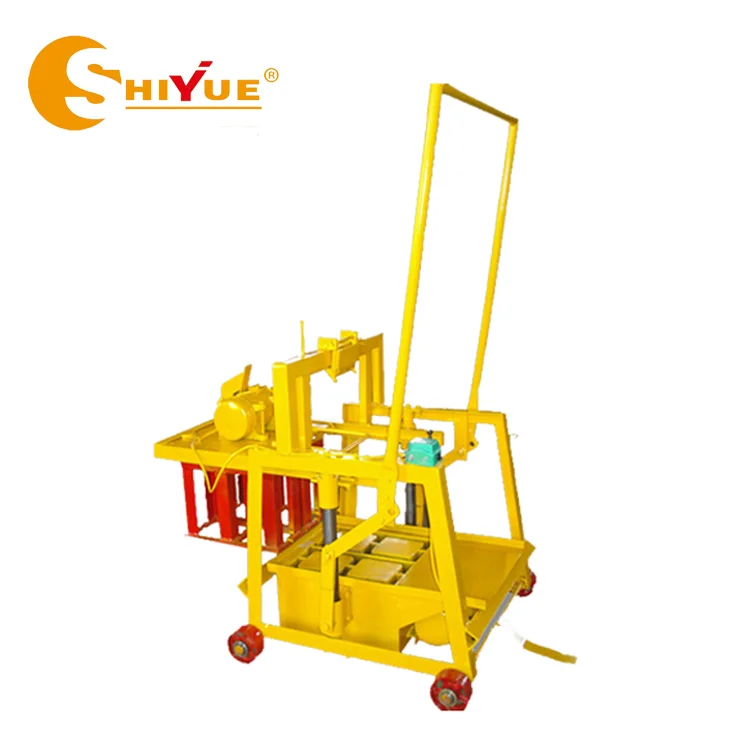
Complete Line Synchronization — every station from raw material feeding to open-air curing is timed against the QMJ2-45’s 25-30 second mould cycle so the press never waits for upstream or downstream handling.
Technical Specifications
| Parameter | Value |
|---|---|
| Model | QMJ2-45 |
| Product Type | Mobile Manual Block Making Machine |
| Operation Type | Manual |
| Power Source | No diesel engine or external power required |
| Labor Requirement | 1 to 3 workers |
| Pallet Requirement | No pallets required |
| Mobility | Mobile / free-moving on site |
| Mould Change | Quick mould exchange for different hollow brick formats |
| Output Capacity | 160 pcs/h (based on 400×200×200mm hollow brick, 2 pcs/mould, 25-30s cycle) |
| Output Capacity | 240 pcs/h (based on 400×150×200mm hollow brick, 3 pcs/mould, 25-30s cycle) |
| Output Capacity | 320 pcs/h (based on 400×100×200mm hollow brick, 4 pcs/mould, 25-30s cycle) |
| 8-Hour Output | 1280 pcs (based on 400×200×200mm hollow brick) |
| 8-Hour Output | 2560 pcs (based on 400×100×200mm hollow brick) |
| Cycle Time | 25-30 seconds per mould |
| Mould Format Options | 400×200×200mm / 400×150×200mm / 400×100×200mm hollow brick |
| Automation Level | Manual |
| Space Requirement | Small space compatible |
Application Suitability
| Application | Material or Output |
|---|---|
| On-site hollow block production | Crushed stone, sand, cement and water mix |
| Remote construction sites | Off-grid locations without power supply or pallet infrastructure |
| Small-scale contractor plants | Entrepreneurs establishing a first block production line |
| Housing project block supply | Local production where transport of purchased blocks is costly |
When the Mixer Cannot Keep Up With the Press
Raw material feeding and mixing must match the QMJ2-45 cycle, or the mobile block machine production line stalls every few minutes.
I spent years on the assembly floor before moving into technical sales, and the most common failure I see in small block plants is not the press itself — it is the station before it. A contractor once imported a small mobile machine and paired it with a batch mixer sized for a much larger plant. The mixer took three times longer to discharge than the press needed to consume a batch, leaving workers standing idle while fresh concrete sat stiffening in the trough. The rated hourly output became irrelevant because the upstream station dictated the real pace [NEED_CITE: line balancing principles for small block plants]. With the QMJ2-45 running a 25-30 second cycle per mould and requiring only manual feeding, the mixer, wheelbarrows and workers must be planned as one continuous loop.
Removing the Pallet Station Entirely
Most block machines depend on pallets to carry wet blocks from the press to the curing area, which means a pallet return conveyor, pallet racks and a forklift become mandatory parts of the line. The QMJ2-45 eliminates that station. Blocks are formed directly on the ground and the machine moves forward, so the mobile block machine production line needs only a flat, compacted surface and an open curing zone. This simplification cuts both capital outlay and the number of mechanical points where a breakdown can halt production.
Matching Output to Curing Space
Producing blocks faster than you can cure them is a hidden bottleneck. The QMJ2-45 offers three hollow brick formats — 400×200×200mm, 400×150×200mm and 400×100×200mm — each with a different hourly output. Choosing the larger format reduces the number of pieces produced per shift, giving a smaller curing area time to accommodate the output. This flexibility lets a first-time plant owner scale production to the space available rather than investing in curing racks before the market demand justifies them [NEED_CITE: curing area planning for egg-laying block machines].
Cycle Time, Mould Count and Real Daily Figures
Understanding why the three format outputs differ starts with mould cavity count. The 400×200×200mm mould has two cavities, so each 25-30 second cycle produces two blocks, yielding 160 pieces per hour. The 400×150×200mm mould has three cavities at 240 per hour, and the 400×100×200mm mould has four cavities at 320 per hour. Because the cycle time stays the same across formats, the only variable is cavity count. Buyers planning daily targets should base calculations on the specific format they intend to run most, not on the highest headline number. A small shift in format choice changes the eight-hour output from 1280 to 2560 blocks, which also changes how much raw material the upstream mixer must supply each hour.
The Hidden Cost of Ignoring Line Balance
When a buyer focuses only on the press price and treats upstream feeding and downstream curing as afterthoughts, the gaps show up within the first week. Workers end up hand-moving blocks that should flow mechanically, or they wait for a mixer that cannot discharge fast enough. In remote sites with no power, these problems compound because there is no electric conveyor to fall back on [NEED_CITE: common causes of output shortfall in manual block lines]. The result is a plant that technically runs but never reaches the daily volume the buyer used to justify the investment.
Why Source the QMJ2-45 Through a Line-First Approach
Block machinery is our single focus, which means the QMJ2-45 is never quoted as a standalone press disconnected from the rest of the line. We configure raw material feeding, mixing capacity and curing area layout around the buyer’s chosen block format and local aggregate. Mould design covers the hollow brick sizes that actually sell in the buyer’s market, including custom drawings when standard formats do not match. Automation level is selectable, so a plant can start with manual operation and add pallet handling or stacking later as demand grows. Installation support includes operator training on cycle timing and mould change procedures, and wear parts lists are provided before the first replacement is due.
Documentation & Verification
- Line layout drawing showing manual feeding flow and curing area sized to your chosen hollow brick format
- Capacity calculation sheet stating output per format with cycle time assumptions clearly noted
- Mould drawing and format list confirming cavity count for each hollow brick size you will produce
- Operation manual covering mould change steps, daily maintenance points and safe worker positioning
- Factory test record run on your specified mix design before the machine leaves the workshop
Installation, Commissioning & Support
- Flat compacted ground preparation sized to accommodate the QMJ2-45 travel path and turning radius
- No electrical supply needed, eliminating voltage confirmation and dedicated circuit requirements
- Machine arrives as a single compact unit, reducing on-site assembly to mould fitting and test runs
- Operator training covers the 25-30 second cycle rhythm and coordination with manual material feeders
- Mould change instruction included for all three hollow brick formats with hand tool requirements listed
- Wear parts list supplied with the machine so first replacements can be ordered before stock runs out
Request a Line Configuration Proposal
To size a mobile block machine production line around your actual site conditions, we need your target hollow brick format, estimated daily volume, and the dimensions of the area available for production and curing. Share your local aggregate type and whether any upstream mixing equipment is already on site. With that information we can confirm mixer capacity, worker count and curing layout before a quotation is issued.
Frequently Asked Questions
Q: How does a pallet-free mobile machine integrate with the rest of the block production line?
A: The QMJ2-45 forms blocks directly on the ground and moves forward after each cycle, so no pallet conveyor or return system is needed. Upstream, a manual or small mechanical mixer feeds concrete by wheelbarrow. Downstream, blocks cure in place on the same surface, removing an entire material handling station from the line layout.
Q: What raw material feeding and mixing setup is needed upstream of the QMJ2-45?
A: A mixer that can discharge a batch within or below the press cycle window prevents idle time. For the 25-30 second mould cycle, we typically recommend a pan mixer sized to supply enough concrete for continuous operation across the chosen hollow brick format, with manual transport closing the gap between mixer and press.
Q: How does cycle time vary across the three hollow brick formats and what does that mean for daily output?
A: The cycle time stays at 25-30 seconds regardless of format. Output differs because cavity count changes: two cavities for 400×200×200mm, three for 400×150×200mm and four for 400×100×200mm. Daily targets should be based on the format you will run most, not the highest available figure.
Q: What curing area size and layout should I prepare to match the machine output?
A: Curing area must hold at least one full shift of production before blocks can be moved. For the 400×100×200mm format producing 2560 pieces in eight hours, the area needs to be larger than for the 400×200×200mm format at 1280 pieces. We confirm dimensions during the line layout stage based on your chosen format.
Q: Can I add semi-automatic pallet handling or stacking later as the plant grows?
A: Yes. The QMJ2-45 serves as an entry point for a first block plant with minimal infrastructure. As volume and capital allow, a buyer can transition to a semi-automatic stationary press with pallet feeding, stacking and curing rack systems, using the QMJ2-45 for overflow or remote site production.


