
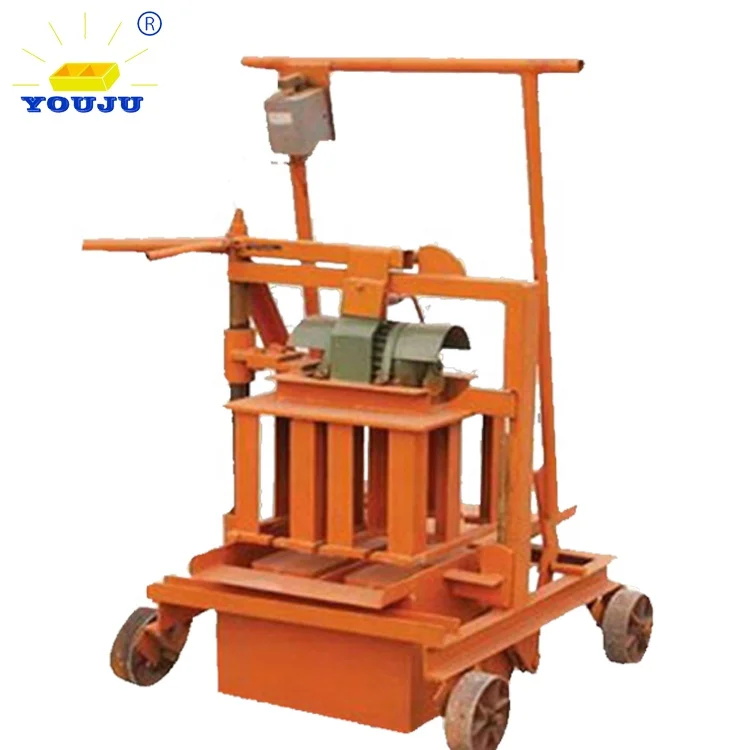
Line-Matched Throughput — the QMJ2-45 cycle time is calculated against the mixer and feeder output so the press never waits idle between batches.
Technical Specifications
| Parameter | Value |
|---|---|
| Model | QMJ2-45 |
| Product Type | Mobile Egg-Laying Block Making Machine |
| Pallet Requirement | No pallets required |
| Power Source | Diesel engine |
| Labor Requirement | 1 to 3 workers |
| Mould Change | Manual |
| Cycle Time | 25–30s per mould |
| Output Capacity | 160 pcs/h based on 400×200×200mm hollow brick (2 pcs/mould) |
| Output Capacity | 320 pcs/h based on 400×100×200mm hollow brick (4 pcs/mould) |
| Mould Format | Hollow brick (400×200×200mm, 400×150×200mm, 400×100×200mm) |
| Automation Level | Manual |
| Mobility | Free-moving, no fixed plant required |
| Space Requirement | Small space operation |
| Assembly State | Fully assembled, mobile unit |
| Standards | ISO9001:2000, CE |
| Color Options | (basis not stated in source) |
| Overall Dimensions | (basis not stated in source) |
| Net Weight | (basis not stated in source) |
Application Suitability
| Application | Material or Output |
|---|---|
| On-site hollow block production without a fixed plant | Cement, crushed stone, sand, and water mix |
| Small-scale block production for construction contractors | 400×200×200mm, 400×150×200mm, 400×100×200mm hollow bricks |
| Remote or off-grid project sites with no reliable electrical supply | Diesel-powered operation independent of grid voltage |
| First block plant setups by entrepreneurs | Low-investment manual operation with 1 to 3 workers |
What "320 Pieces per Hour" Actually Means for Your Line
A mobile block making machine production line only reaches its rated cycle time when the mixer and material feeder deliver batches at the exact rhythm the press consumes them.
I have seen mobile egg-laying machines sit idle for half a shift because the upstream mixer was undersized, turning a rated output into a fraction of the expectation. When the QMJ2-45 completes a mould every 25 to 30 seconds, the mixing station must supply fresh material at that same interval. If the mixer takes longer, the press waits, labor stands around, and daily output collapses. Sizing the entire mobile block making machine production line around the press cycle time — not just the press alone — is where realistic capacity begins [NEED_CITE: line balancing principles for small-scale block production].
Upstream Station Synchronization
The QMJ2-45 operates on a 25 to 30-second cycle per mould, which sets the tempo for every other station in the mobile block making machine production line. The raw material feeder must deliver measured batches into the mixer, and the mixer must discharge a finished batch before the next cycle begins. When any upstream station falls behind, the press becomes the bottleneck in reverse — it has capacity the rest of the line cannot fill. Matching mixer drum volume and discharge speed to the press consumption rate is the first configuration step we calculate before confirming a quotation.
Downstream Curing Without Pallets
Because the QMJ2-45 lays blocks directly on the ground, the curing stage does not involve pallet return loops or rack handling systems. This simplifies the line but shifts planning to ground preparation and curing area layout. Blocks cure in place, so the curing zone must be level, accessible for water spraying, and large enough to hold multiple days of output before blocks are moved. Forklift access paths around the curing area need to be confirmed separately, as no pallets means blocks are handled individually or in stacks once cured [NEED_CITE: ground curing practices for egg-laying block machines].
Reading the Specs That Matter
The diesel engine power source removes electrical grid dependency from the press station entirely, which is significant for remote project sites where voltage and frequency may not be confirmed. However, if the mixer or feeder in the mobile block making machine production line is electrically powered, those units still require voltage and frequency confirmation before shipment. The manual mould change system supports three hollow brick formats, but change time depends on operator familiarity — a factor worth discussing during commissioning. The 1 to 3 worker requirement covers press operation; additional labor may be needed for material handling and curing supervision depending on site conditions.
The Cost of Ignoring Line Rhythm
When a buyer purchases a mobile press as a standalone unit without specifying upstream and downstream stations, the result is often a machine that runs intermittently rather than continuously. Material arrives late, workers wait, and daily output never approaches the rated figure. The frustration is usually directed at the press, but the root cause sits in the stations around it. A mobile block making machine production line quoted as a matched set — with mixer capacity, feeder speed, and curing area all calculated against the press cycle — avoids this mismatch [NEED_CITE: common causes of underperformance in small block plants].
Why Specify the Full Line Here
Block machinery is our single focus, so the QMJ2-45 is never quoted as an isolated press. The machine, mould, and supporting handling stations are specified as one system with matched cycle times. Configuration is set against the buyer’s actual mix design and local aggregate, not a catalogue default. Mould design covers the hollow brick formats the buyer’s market sells, including custom drawings when standard sizes do not match. Automation level is selectable, so a buyer can start with the manual QMJ2-45 and add supporting equipment later. Installation support includes operator training on mould change and cycle rhythm management.
Documentation & Verification
- Line layout and capacity calculation stating which hollow brick format the hourly output assumes
- Machine specification sheet with diesel engine rating and cycle time per mould
- Mould drawing and format list for all three hollow brick sizes included
- Hydraulic and mechanical schematic for maintenance reference
- Factory test record on buyer’s specified block format before dispatch
- CE declaration and ISO9001:2000 documentation where applicable
Installation, Commissioning & Support
- Ground leveling and curing area preparation guidance for pallet-free block laying
- Diesel engine commissioning and fuel specification confirmation on site
- Mould change training covering all three hollow brick formats and manual change procedure
- Mixer and feeder sizing recommendation matched to the 25–30 second press cycle time
- Operator training for 1 to 3 worker crews covering press operation and material flow
- Wear parts and mould replacement list with lead times for first reorder
What We Need to Size Your Line
Before confirming a quotation, we need to know which hollow brick format your market sells and what daily output you are targeting. Share your local raw material type and aggregate grading so the mix design can be matched to the QMJ2-45 mould configuration. If you already have a mixer or feeder on site, provide their specifications so we can verify rhythm compatibility with the press cycle time.
Frequently Asked Questions
Q: How does output change if I request a block size outside the three standard hollow brick formats?
A: The 160 to 320 pieces per hour figures are based on specific 400mm-length hollow brick formats. A different block size changes the number of pieces per mould and the cycle rhythm. We calculate realistic hourly output against your requested format and confirm it in the capacity proposal before quotation.
Q: How do I size the mixer so it keeps up with the QMJ2-45 cycle time?
A: The press completes a mould every 25 to 30 seconds, so the mixer must discharge a finished batch within that window. We match mixer drum volume and discharge rate to the press consumption rhythm and include this calculation in the line layout document.
Q: What ground preparation is needed when blocks are laid directly on soil?
A: The curing area must be level and compacted to prevent block deformation. Concrete or packed gravel surfaces are preferred. Blocks cure in place without pallets, so the area must be accessible for water spraying and protected from vehicle traffic until curing is complete.
Q: Are custom mould formats available beyond the three standard hollow brick sizes?
A: Custom mould design is available to buyer drawings. Standard hollow brick moulds are stocked for the three listed formats. For a custom format, provide the block drawing and target dimensions so we can confirm mould compatibility with the QMJ2-45 press and quote lead time accordingly.
Q: Does the quotation include the mixer and material feeder, or only the press?
A: The QMJ2-45 can be quoted as a standalone press or as part of a matched line with mixer, feeder, and curing guidance. Specifying the full mobile block making machine production line ensures upstream stations are sized to the press cycle time and daily output expectations are realistic.


