
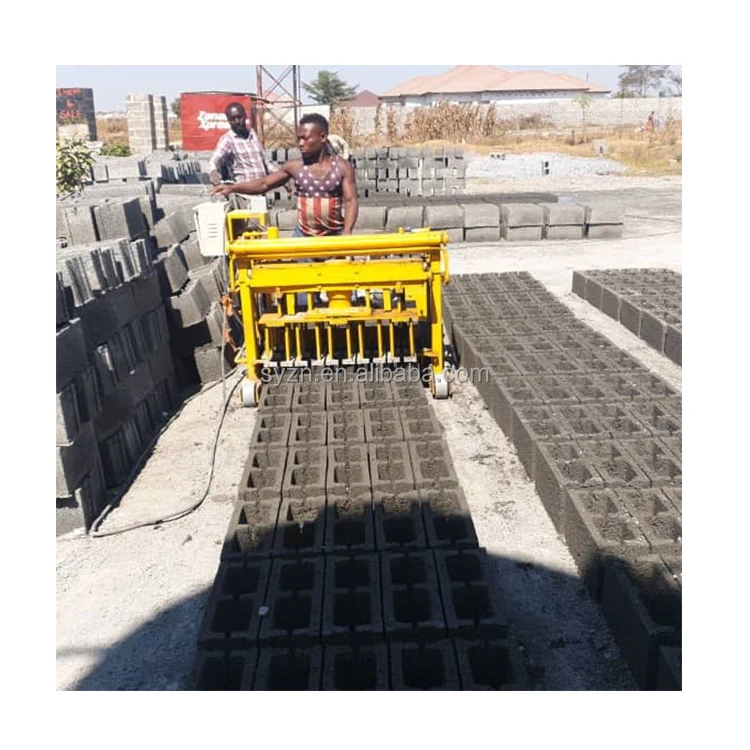
Matched System Design — The QMY4-30 is specified as one station within a complete mobile block production workflow, where upstream mixing capacity and downstream curing logistics are balanced to its 25–30 second molding cycle so the press never waits for material or space.
Technical Specifications
| Parameter | Value |
|---|---|
| Model | QMY4-30 |
| Product Type | Mobile Concrete Block Making Machine |
| Machine Type | Mobile / Egg-laying (palletless) |
| Hydraulic Method | Mould vibration |
| Demold Method | Hydraulic |
| Molding Cycle | 25–30 seconds |
| Total Power | 5.95 kW |
| Voltage & Frequency | To be confirmed before shipment |
| Control System | To be confirmed (PLC or relay logic) |
| PLC Display Language | To be confirmed |
| Overall Dimensions (L×W×H) | Not stated in source — confirm with supplier |
| Net Weight | Not stated in source — confirm with supplier |
| Pallet Size | N/A (palletless mobile operation) |
| Mould Formats Available | 400×200×200 mm / 400×150×200 mm / 400×100×200 mm |
| Mould Change Time | Not stated in source |
| Automation Level | Manual mobile operation |
| Stacking Method | On-ground egg-laying, no pallet handling |
| Output Capacity (400×200×200 mm hollow block) | 4 pcs/mould, ~480 pcs/h, ~3,840 pcs/8hr (basis: 25–30s cycle, stated by source) |
| Output Capacity (400×150×200 mm hollow block) | 5 pcs/mould, ~600 pcs/h, ~4,800 pcs/8hr (basis: 25–30s cycle, stated by source) |
| Output Capacity (400×100×200 mm hollow block) | 7 pcs/mould, ~840 pcs/h, ~6,720 pcs/8hr (basis: 25–30s cycle, stated by source) |
| Hydraulic Pressure | Not stated in source |
| Vibration Force | Not stated in source |
| Raw Material Compatibility | Cement, sand, aggregate, fly ash |
| Operating Environment | Mountainous, hilly, industrial/mining, desert and coastal areas |
| Certification | ISO9001:2000, CE (verify current validity) |
Application Suitability
| Application | Material or Output |
|---|---|
| On-site hollow block production for housing projects | Cement, sand, crushed stone, fly ash blends |
| Remote terrain block output (mountainous, desert, coastal) | Locally sourced aggregate with cement binder |
| Small-scale contractor block production | Standard concrete mix for 400×200×200 mm and 400×150×200 mm hollow blocks |
| Decentralized infrastructure projects | Concrete hollow blocks in 400×100×200 mm partition format |
What "Pieces per Hour" Hides About Your Mobile Block Machine Production Line Supporting Equipment
A mobile press only delivers its quoted cycle rate if the mixer, conveyor, and curing ground area are sized to match it — otherwise the bottleneck shifts, not disappears.
When a mobile block machine production line supporting equipment package is not balanced, the press sits idle waiting for wet mix or the operator runs out of flat curing ground before the shift ends. I once watched a contractor in a coastal project lose nearly half a shift because the mixer could not feed the press fast enough, and the curing area was a slope with no leveling work done beforehand [NEED_CITE: typical output losses from line imbalance in mobile block operations]. The QMY4-30 completes a molding cycle every 25–30 seconds, which means the supporting stations upstream and downstream must sustain that rhythm continuously across all three listed hollow block formats.
How Upstream Mixing Must Keep Pace with the Press
The QMY4-30 draws a fresh batch of concrete every 25–30 seconds. If the mixer requires longer to deliver a consistent batch, the press operator will either short-fill the mould or stand idle. A mobile block machine production line supporting equipment setup must therefore include a mixer whose discharge rate matches or exceeds the press consumption rate at the chosen block format. For the 400×100×200 mm partition block — where seven pieces leave the mould each cycle — the concrete demand per hour is noticeably higher than for the larger 400×200×200 mm hollow block at four pieces per cycle. This difference must be reflected in the mixer capacity specification, not assumed to be the same across formats.
Why Curing Ground Area Defines Real Daily Output
Egg-laying machines like the QMY4-30 leave blocks directly on the ground, which eliminates pallet handling entirely but shifts the constraint to available flat surface. The blocks must cure in place for a minimum period before they can be moved, so the curing footprint grows with every hour of production. On a site where ground leveling or space preparation was not planned, the operator runs out of usable area well before the shift ends [NEED_CITE: curing space requirements for palletless egg-laying block production]. Line capacity planning for the QMY4-30 must therefore include a calculated curing area based on the target block format, the number of shifts per day, and the minimum cure-before-move duration.
Reading the Specifications That Actually Matter
The total power rating of 5.95 kW defines the minimum electrical supply the entire mobile production setup must provide — including the mixer, any conveyor belt feeding the hopper, and lighting for extended shifts. Voltage and frequency remain unconfirmed in the available documentation, and these must be locked in before dispatch because a mismatch on a remote site means the machine cannot start commissioning at all. The hydraulic demould method paired with mould vibration shapes the block density and surface finish, but the actual hydraulic pressure and vibration force values are not stated in the source specifications — these should be confirmed to verify they suit the buyer’s local aggregate and mix design. The three listed mould formats (400×200×200 mm, 400×150×200 mm, and 400×100×200 mm) each carry different per-cycle piece counts, and the stated output figures are based on a 25–30 second cycle across all three, which provides a realistic baseline for shift planning rather than a single inflated number.
The Cost of Skipping Line Balance Verification
When the mixer is undersized relative to the press cycle, operators compensate by rushing mixes — resulting in inconsistent block density and surface cracking after curing. When curing ground is insufficient, partially cured blocks get moved too early, causing edge damage that increases scrap rates. These failures are not press faults; they are line balance failures [NEED_CITE: common causes of block quality rejection in mobile production sites]. I have seen project schedules delayed because the supporting equipment was an afterthought rather than a specified part of the mobile block machine production line supporting equipment package.
Why Buyers Specify the Full Line Here
The QMY4-30 is treated as one node in a production workflow rather than a standalone catalogue item — the machine, moulds, and handling requirements are specified together against the buyer’s actual block format and site conditions. Configuration is set against the buyer’s local aggregate and target product mix, not a default setting. Mould design covers the formats the buyer’s market actually sells, and custom drawings are available. The automation level is manual mobile operation by design, keeping the supporting equipment scope simple and the operator skill requirement manageable. Installation support includes on-site commissioning with parameter adjustment for local materials.
Documentation & Verification
- Line layout showing mixer-to-press material flow with capacity calculated per block format
- Machine specification sheet confirming voltage, frequency, and control language before dispatch
- Mould drawing and format list covering all three hollow block sizes
- Factory test record run on the buyer’s target block format before shipment
- Wear parts and mould list with replacement intervals noted
- Packing photographs for condition verification at arrival
Installation, Commissioning & Support
- Ground leveling across the curing area sized to the QMY4-30 daily output before the machine arrives
- Electrical supply confirmed at the voltage and frequency specified for the 5.95 kW total power draw
- Mixer positioned and tested for discharge rate matching the 25–30 second molding cycle
- First-run commissioning with parameter adjustment for the buyer’s local aggregate and mix
- Operator training covering mould change procedure across all three hollow block formats
- Spare wear parts inventory established before the first mould replacement is due
What We Need from You to Size the Line
To build a balanced mobile block machine production line supporting equipment proposal around the QMY4-30, provide the target block format and daily volume you need to hit, your local aggregate type and cement source, and the available ground area for curing. Confirm the site voltage and frequency so the electrical configuration is set before the machine leaves the factory.
Frequently Asked Questions
Q: How is the QMY4-30 daily output verified per block format?
A: The stated output figures are based on a 25–30 second molding cycle for each of the three listed hollow block formats. Real daily output depends on the mixer keeping pace with that cycle and sufficient curing ground being available. Line capacity is calculated per format, not as a single generic number.
Q: What supporting equipment does the QMY4-30 require?
A: The QMY4-30 needs a mixer sized to discharge concrete faster than the 25–30 second press cycle consumes it, a method to deliver wet mix to the machine hopper, and a leveled curing area large enough to hold one shift’s output. Because it is palletless, no pallet feeding, return, or cleaning stations are required.
Q: How should voltage and control language be confirmed before dispatch?
A: Voltage, frequency, and PLC display language must be confirmed against the buyer’s site electrical supply and operator requirements before the machine enters production. These are not stated as defaults in the source documentation and should be locked in during the quotation stage to avoid commissioning delays on arrival.
Q: What mix design validation is needed before the machine arrives?
A: The buyer should provide a sample or description of local aggregate, including particle size and clay content, so the vibration parameters can be adjusted accordingly. Running the machine on a mix it was not set up for can cause cracking and low block strength, requiring an on-site service visit to correct.
Q: How does palletless egg-laying operation change curing logistics?
A: Palletless operation removes the need for pallet handling equipment but requires a large, flat curing area where blocks remain until they gain enough strength to move. This shifts the planning focus from pallet inventory and return systems to ground preparation and space management around the mobile block machine production line supporting equipment layout.


