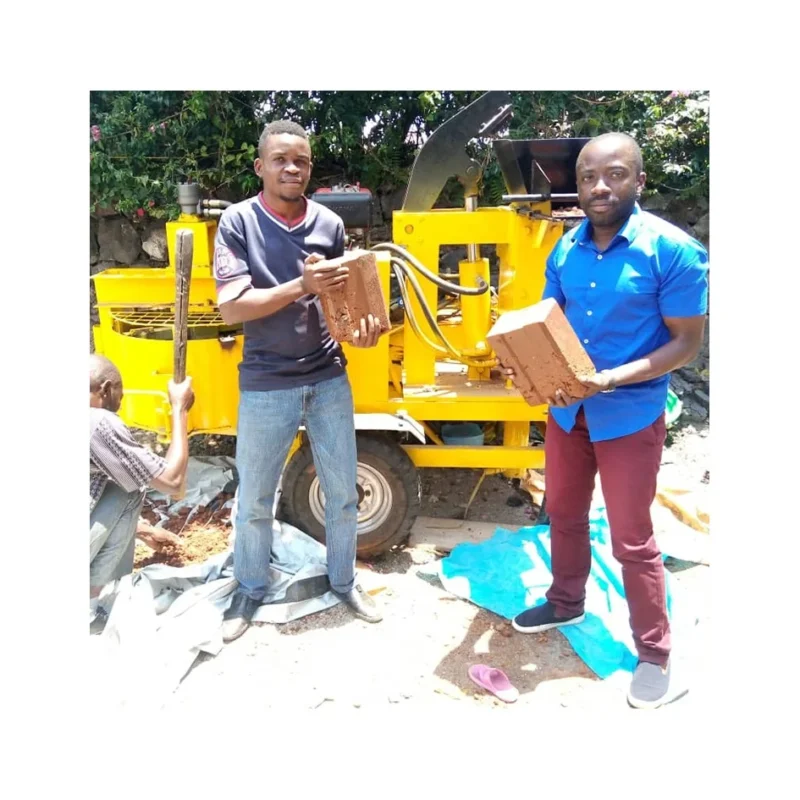
Technical Specifications
| Parameter | Value |
|---|---|
| Model | M7MI |
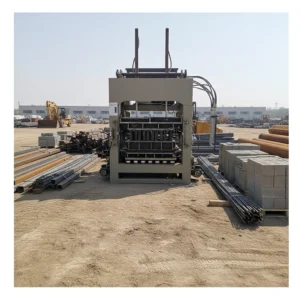
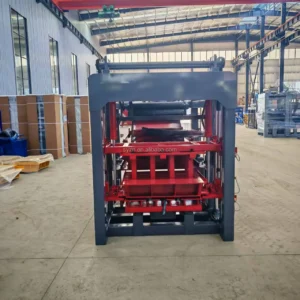
| Product Type | Hydraulic Interlocking Clay Block Machine |
| Engine | Diesel Engine |
| Hydraulic Pressure | 16 MPa |
| Overall Dimensions (L×W×H) | 3200 × 1100 × 1500 mm |
| Net Weight | 1100 kg |
| Molding Cycle | 15–20 s |
| Capacity per Format | 1600 pcs/8 hr based on 300×150×100 mm interlocking block, 1 pc/mould, 20 s cycle |
| Qty per Mould | 1 pc |
| Block Format | Interlocking block |
| Raw Material | Clay, soil, concrete |
| Automation Level | Semi-automatic / manual pallet handling |
| Mould Change | Interchangeable moulds for different interlocking block types |
| Voltage & Frequency | N/A (diesel powered) |
Application Suitability
| Application | Material or Output |
|---|---|
| On-site interlocking block production for housing projects | Clay or soil mixed with minimal cement binder |
| Off-grid rural construction without reliable electricity | Diesel-powered operation independent of grid supply |
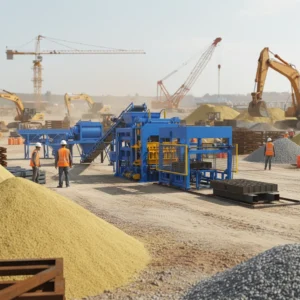
| Small-scale block plants in East and Southern Africa | Local clay, laterite soil, or concrete mixes |
| Development contractors producing blocks at project location | Interlocking formats for mortarless wall assembly |
What "2200 Pieces per Day" Leaves Out About Your Line
Quoted capacity assumes a cycle time and block format — if upstream mixing and downstream pallet handling cannot match that tempo, the press sits idle.
I once mapped a line where the M7MI interlocking clay block machine production line was rated at a specific cycle, but the pan mixer feeding it could only deliver half the required batch volume per cycle. The operator spent half the shift waiting. When we talk about output, the number on the quotation sheet only holds true when every station — from raw material feeding through mixing, pallet supply, and curing rack capacity — is balanced to the press rhythm. [NEED_CITE: line balancing principles for block production]
Matching the Mixer to the Press Cycle
The M7MI completes a molding cycle in 15 to 20 seconds, producing one 300×150×100 mm interlocking block per stroke. That means the mixer upstream must deliver a fresh batch of clay or soil mix to the hopper within that same window. A mixer that takes 45 seconds per batch creates a bottleneck that no amount of press speed can overcome. For a complete interlocking clay block machine production line, the feeding station must be specified against the press cycle, not purchased as an afterthought.
Pallet Handling and Curing Space Downstream
With manual pallet handling, each finished block must be carried to the curing area by hand. If the curing rack space is insufficient or the distance too great, pallets pile up at the press exit and the operator cannot keep pace. The interlocking clay block machine production line only reaches its stated capacity when pallet return, curing rack layout, and available labour are all calculated before the press is ordered. [NEED_CITE: curing requirements for hydraulic compressed earth blocks]
Reading the Numbers That Matter
The 16 MPa hydraulic pressure directly influences block density when working with local clay or soil. Higher pressure compresses the mix more tightly, producing a denser block with greater compressive strength — but only if the mix moisture content and particle size distribution are compatible. A clay mix that is too wet will deform under pressure rather than compact. The 15–20 second molding cycle is achievable with a well-graded soil; a sticky or poorly graded material may require longer dwell times, reducing the realistic hourly output below the calculated 200 pcs/h figure. The diesel engine removes grid dependency but introduces fuel supply and maintenance considerations that must be factored into daily operating costs alongside the block format being produced.
When Line Stations Are Specified Separately
Purchasing the press from one supplier and the mixer, pallet system, and curing racks from others often leads to interface mismatches. The mixer discharge height may not align with the press hopper. Pallet dimensions sourced locally may not match the mould cavity, causing jamming or uneven compaction. These gaps surface during commissioning, adding weeks of on-site modification to a project that was already behind schedule. [NEED_CITE: common integration failures in block production lines]
Why Specifying the Full Line Matters Here
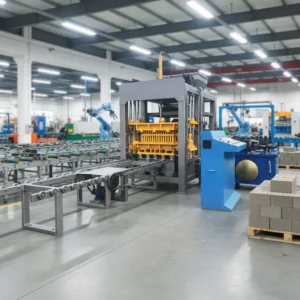
The M7MI is configured as one station within a broader production layout. Raw material feeding, mixing capacity, pallet circulation, and curing rack handling are mapped against the press cycle before quotation, so each station is sized to keep the press running. Mould options are selected based on the interlocking profiles the buyer’s market actually demands, not a catalogue default. The diesel power source is confirmed against site conditions, and the semi-automatic pallet handling level is matched to available labour. Line layout documentation states the block format and cycle time assumed for every capacity figure. Documentation includes factory test records run on the buyer’s specified block format before dispatch.
Documentation & Verification
- Line layout showing each station from feeding to curing with cycle time alignment for the M7MI
- Capacity calculation sheet stating 300×150×100 mm block format and 20 s cycle assumption
- Mould drawing and format list confirming included interlocking profiles
- Hydraulic schematic with 16 MPa system pressure and component specification
- Factory test record on buyer’s confirmed block format before shipment
- Operation manual covering diesel engine maintenance and mould change procedure
Installation, Commissioning & Support
- Foundation pad sized to 3200 × 1100 mm footprint with level tolerance for stable press operation
- Diesel engine fuel supply and exhaust routing confirmed before machine placement
- Mould installed and first production run supervised to verify cycle time and block dimensions
- Operator trained on manual pallet handling sequence matched to 15–20 s molding cycle
- Interchangeable mould change procedure demonstrated with included format set
- Wear parts list provided with recommended replacement intervals for hydraulic seals and mould liners
Preparing Your Line Inquiry
To move from a standalone press quotation to a balanced line proposal, share the interlocking block format your market requires, the daily volume you need to sustain, and the characteristics of your local clay or soil. Include details on available curing area, whether any upstream mixing equipment is already on site, and the project timeline driving the purchase.
Frequently Asked Questions
Q: How is the daily capacity calculated and which block format does it assume?
A: The 1600 pcs/8 hr figure is based on producing a 300×150×100 mm interlocking block at a 20 second cycle with one block per mould stroke. A different block size, thicker profile, or slower cycle due to material characteristics will change the actual output. We state the format and cycle assumption on every capacity calculation.
Q: What supporting equipment keeps the M7MI running at its stated cycle?
A: A mixer that can deliver a full batch within the 15–20 second press cycle, sufficient pallets for continuous rotation, and curing rack space that absorbs a full shift’s output without blocking pallet return. Each station must be sized to the press tempo.
Q: Can the M7MI integrate into an existing block line?
A: Yes, provided the existing mixer output rate, pallet dimensions, and curing area can match the M7MI cycle and block format. We review the current line layout before confirming integration feasibility.
Q: How do I verify my local soil is compatible with this machine?
A: Send a sample of your local clay or soil along with your target block strength requirement. We test compatibility with the 16 MPa hydraulic pressure and confirm whether the mix design will compact properly within the stated cycle time.
Q: Does the quotation include pallet handling and curing equipment?
A: The scope is defined in the line layout proposal. Pallet handling, stacking, and curing rack equipment can be included or excluded based on what the buyer already has on site. Every item is listed separately so the scope is clear before order.