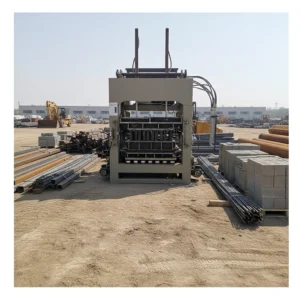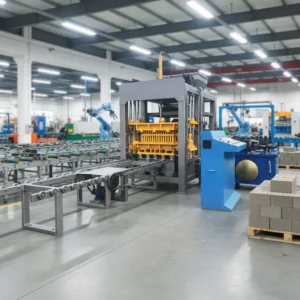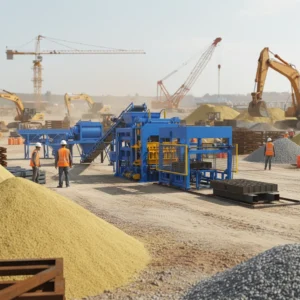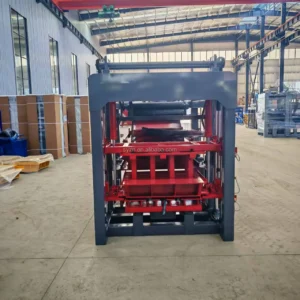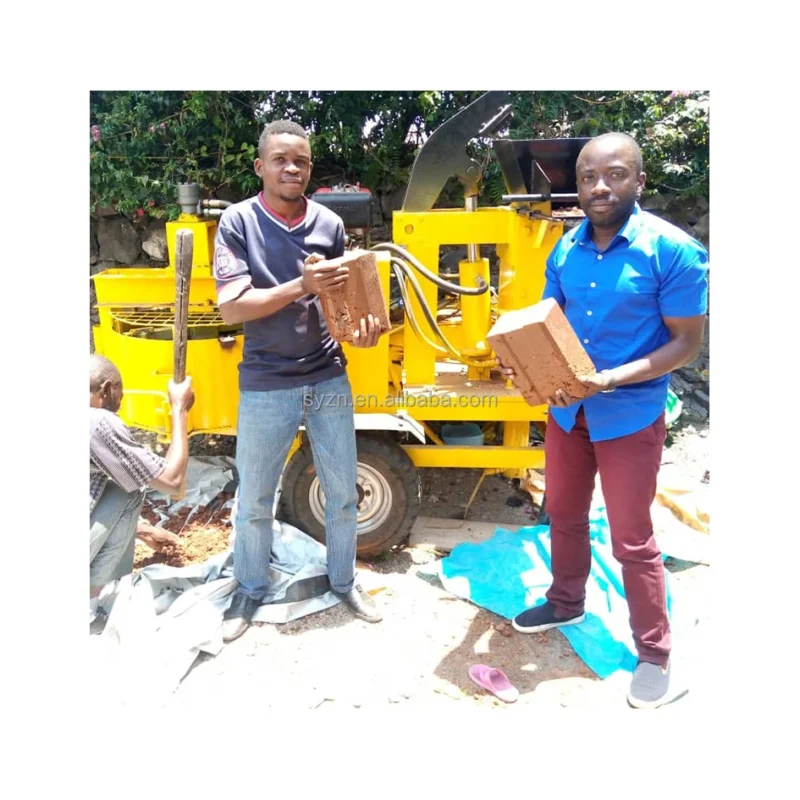
Mould-Paced Line Balancing — Every station from mixer to curing rack is timed around the M7MI’s 15–20 s press cycle, so throughput stays constant across the block production line supporting equipment.
Technical Specifications
| Parameter | Value |
|---|---|
| Model | M7MI |
| Product Type | Hydraulic Clay Interlocking Block Making Machine |
| Overall Dimensions (L×W×H) | 3200 × 1100 × 1500 mm |
| Net Weight | 1100 kg |
| Power Source | Diesel Engine |
| Hydraulic Pressure | 16 MPa |
| Molding Cycle | 15–20 s |
| Capacity per Format | 1600 pcs/8 hr (based on 300×150×100 mm interlocking block, 20 s cycle, 1 pc/mould) |
| Hourly Output | 200 pcs/h (based on 300×150×100 mm interlocking block) |
| Qty per Mould | 1 pc (based on 300×150×100 mm interlocking block) |
| Raw Materials | Clay, soil, concrete |
| Mould Change | Interchangeable moulds for different interlocking block formats |
| Block Joining Method | Interlocking (dry-stack, no mortar) |
| Key Features | Off-grid operation, multi-format capability, mobile deployment |
Application Suitability
| Application | Material or Output |
|---|---|
| On-site housing project production | Local clay and soil interlocking blocks |
| Off-grid construction sites | Diesel-powered block line without grid electricity |
| Small-to-medium development contractors | Multi-format interlocking blocks from clay or concrete |
| First-time block plant entrepreneurs | Complete line from raw material feeding through curing |
Why "Pieces per Day" Means Nothing Without the Rest of the Line
A press is only as fast as the slowest station feeding or clearing it.
When a buyer sees a capacity figure for block line and supporting equipment, that number usually assumes a perfect upstream feed and an empty downstream path. In reality, a mixer that takes 45 seconds per batch will starve a press cycling every 15 seconds. Pallet return that lags behind the moulding cycle forces the operator to wait, and curing racks that fill up faster than they can be moved create a backlog that stops the entire line. I have watched contractors lose half a shift because the quotation covered the press and nothing else [NEED_CITE: common block line bottlenecks in small-scale production]. The M7MI configuration starts with the 15–20 s cycle as the pacing heartbeat and sizes every surrounding station to match.
Feeding and Mixing Synchronized to Press Cadence
The raw material feeding system must deliver a consistent charge of clay, soil, or concrete to the mixer in time for the next moulding cycle. With the M7MI cycling at 15–20 seconds, the mixer batch volume is calculated so that a fresh mix is ready before the press completes its current stroke. Undersized mixers cause idle press time; oversized ones waste floor space and energy. The block production line supporting equipment around the M7MI is specified so the mixer output rate, feeder conveyor speed, and hopper capacity all align with the press demand.
Pallet Circulation and Curing Rack Timing
After the press releases a formed interlocking block, the pallet carrying it must travel to the stacking or curing station and return empty before the next cycle begins. If the pallet return loop is longer than the moulding cycle, the press sits idle. The block production line supporting equipment specification includes pallet dimensions matched to the curing rack spacing and the forklift the buyer already operates on-site. This prevents the common situation where pallets arrive at the curing area but cannot be loaded because the rack slots are a different width [NEED_CITE: pallet and curing rack dimension mismatches in block plants].
Block Format Throughput Realities
The capacity figures of 1600 pieces per 8-hour shift and 200 pieces per hour are based on a 300×150×100 mm interlocking block at a 20-second cycle with one piece per mould. Switching to a larger or thicker interlocking profile changes the mould charge volume, which may extend the cycle and alter the daily total. The line layout document states the assumed format so buyers can verify output against the block their market actually demands. Every format change also means the upstream feeder gate and mixer water ratio need adjustment to suit the new mould cavity.
Pressure, Cycle, and Material Matching
The 16 MPa hydraulic pressure is the force that compacts the clay or soil charge into a dense interlocking block. Pressure alone does not guarantee strength; it must be paired with the correct moisture content and particle gradation of the local aggregate. A clay-heavy mix may need lower pressure and a slightly longer dwell to avoid lamination, while a sandy soil may require the full 16 MPa and a shorter hold. The machine configuration is set against the buyer’s actual material sample, not a default catalogue setting. Mould interchangeability then lets the same press produce multiple interlocking profiles without dismantling the hydraulic circuit.
When the Line Around the Press Is an Afterthought
A buyer who purchases only the M7MI press without specifying the surrounding block production line supporting equipment often ends up hand-stacking wet blocks onto makeshift racks. Manual pallet handling slows the return loop, the mixer runs in uncontrolled batches, and curing becomes a bottleneck because blocks are piled unevenly. The result is a line that produces far below its rated cycle and wears components prematurely from inconsistent loading [NEED_CITE: manual pallet handling impact on block machine wear]. These costs do not appear on the original quotation but show up within the first production month.
Why Specify the Whole Line Here
The M7MI is configured as the centre of a matched system, not a standalone catalogue item. Raw material feeding, mixing, pallet supply, stacking, and curing rack handling are each sized to the 15–20 s press cycle. Capacity calculations state the exact block format assumed, so there is no gap between quoted and achievable output. Mould design covers the interlocking profiles the buyer’s market sells, including custom drawings. Diesel engine operation removes grid electricity as a commissioning prerequisite. The automation level is selectable, allowing a buyer to start with manual pallet handling and add automatic stacking later.
Documentation & Verification
- Line layout drawing with cycle times stated per station from feeder to curing rack
- Capacity calculation sheet stating the exact 300×150×100 mm interlocking block format assumed
- Hydraulic and electrical schematic matched to diesel engine power source configuration
- Machine specification sheet confirming 16 MPa pressure setting against buyer’s mix design
- Factory test record on buyer’s specified clay or soil sample before dispatch
- Operation and maintenance manual with mould change procedure per interlocking format
Installation, Commissioning & Support
- Foundation pad sized to the 3200 × 1100 mm machine footprint with drainage slope for clay slurry
- Diesel engine fuel supply and exhaust routing confirmed before machine positioning
- Pallet return conveyor aligned to curing rack height and existing forklift mast clearance
- First-run cycle timing verified against 15–20 s target with buyer’s local clay or soil charge
- Operator training on mould interchange procedure for each interlocking block format
- Wear parts list covering hydraulic seals and mould liner dimensions for local sourcing
What to Share With Your Inquiry
To configure the M7MI within a balanced line, provide the interlocking block format your market demands, the daily volume you need to hit, and a sample or description of the local clay, soil, or concrete aggregate available. Include your site’s curing area dimensions and the pallet size your existing forklift handles. If grid electricity is absent, confirm that diesel operation is the preferred power source so the automation level is set accordingly.
Frequently Asked Questions
Q: How is daily output calculated and which block format does it assume?
A: The stated capacity of 1600 pieces per 8-hour shift is based on a 300×150×100 mm interlocking block produced at a 20-second cycle with one piece per mould. If your target format is larger or thicker, the cycle may extend and daily output will change accordingly. Every quotation includes a capacity calculation sheet that names the exact format assumed.
Q: What happens if my site has no electricity?
A: The M7MI is powered by a diesel engine, so it operates independently of grid supply. This configuration affects the automation level available — fully automatic stacking and cubing require electrical control, so off-grid sites typically run with semi-automatic pallet handling and manual stacking until a generator or grid connection is installed.
Q: How do upstream mixer batch size and downstream pallet return match the press cycle?
A: The mixer is sized so a complete batch of clay or soil is ready within the 15–20 s moulding cycle. The pallet return conveyor is timed so an empty pallet reaches the press before the next stroke. If either station is slower, the press idles and throughput drops below the rated figure.
Q: Can the M7MI line integrate with my existing curing racks and forklifts?
A: Pallet dimensions are selected to match your curing rack slot width and your forklift’s fork spacing and mast height. Provide the rack and forklift specifications during inquiry so the pallet size is confirmed before production, avoiding a mismatch on arrival.
Q: What supporting equipment is included and what is optional?
A: The standard line quotation covers raw material feeding, mixing, pallet feeding, the M7MI press, and mould supply. Automatic stacking, curing rack handling, and cubing are configurable additions. Each option is listed separately so you can see exactly which stations are automated and which remain manual.