
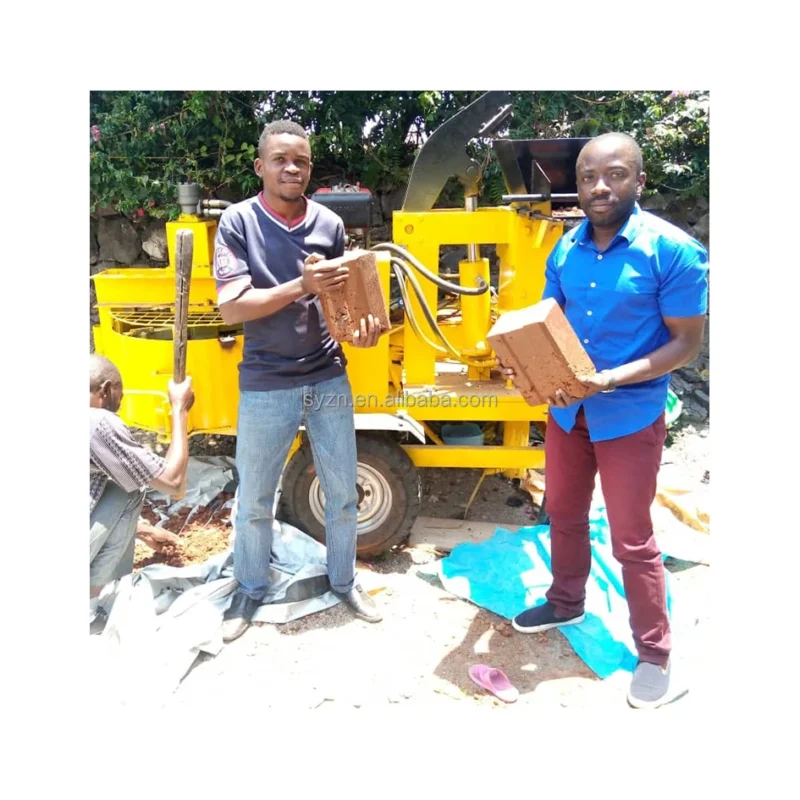
Integrated Line Synchronization — Raw material feeding, mixing and block output stations are configured so the M7MI press is never left waiting between cycles.
Technical Specifications
| Parameter | Value |
|---|---|
| Model | M7MI |
| Product Type | Mobile Hydraulic Interlocking Clay Block Making Machine |
| Hydraulic Pressure | 16 MPa |
| Moulding Cycle | 15–20 s |
| Engine | Diesel Engine |
| Output Capacity | 1600 pcs / 8 hr (based on 300×150×100 mm interlocking block, 1 pc per mould, 20 s cycle) |
| Overall Dimensions (L×W×H) | 3200 × 1100 × 1500 mm |
| Net Weight | 1100 kg |
| Automation Level | Mobile / Manual-type |
| Raw Materials | Clay, soil, or concrete |
| Assembly State | Mobile unit (no fixed plant required) |
| Voltage & Frequency | Not applicable (diesel engine driven) |
Application Suitability
| Application | Material or Output |
|---|---|
| On-site housing project walling | Locally sourced clay or soil |
| Remote rural construction without grid power | Compressed earth or cement-stabilized soil |
| Small-scale building material supply | Interlocking clay or concrete blocks |
What "2200 Pieces per Day" Leaves Out About Mobile Block Production
Capacity is only real when the block format and cycle time are stated together.
Buyers reviewing a mobile interlocking clay block making machine production line often see a single daily output number with no reference to the block size being pressed. A 300×150×100 mm interlocking block pressed at a 20-second cycle yields a different daily count than a thinner paver format run at 15 seconds. Without that context, the output figure cannot be used to plan curing area, material feed rates, or project timelines [NEED_CITE: block format and cycle time assumptions in capacity quoting]. This machine’s capacity is therefore stated as 1600 pieces per 8-hour shift based on a 300×150×100 mm interlocking block at a 20-second cycle.
Feeding and Mixing Stations Sized to the Press Cycle
A mobile interlocking clay block making machine production line only works when the mixer discharges a fresh batch before the press completes its current moulding cycle. The 15–20 second cycle of the M7MI means the feeding station must deliver prepared material continuously, not in large intermittent batches that sit and dry out before pressing. Matching the mixer drum capacity to the press hopper volume prevents both starvation and material waste at the feed point.
Arranging the Line Around a Mobile Press
Unlike a fixed plant where conveyors dictate the flow, a mobile setup allows the raw material pile, mixer, and curing area to be positioned around the M7MI in whatever layout the site permits. The 3200 × 1100 mm footprint leaves room for a loader to feed the mixer on one side while finished blocks are carried to a nearby curing rack on the other. This flexibility matters on constrained housing project sites where a linear conveyor arrangement is not feasible [NEED_CITE: mobile block press site layout constraints in remote construction].
Hydraulic Pressure and Mix Design Matching
The 16 MPa hydraulic pressure on the M7MI must be evaluated against the actual clay or soil mix the buyer intends to use. A high-clay mix with natural binding properties responds differently to pressure than a lean soil requiring cement stabilization. The vibration and pressure settings need to align with the moisture content and aggregate gradation available locally, otherwise block density varies across the production run. The diesel engine configuration removes the dependency on grid electricity, which is critical for remote sites where voltage fluctuation would otherwise damage an electric motor [NEED_CITE: diesel versus electric drive selection for off-grid block production].
The Cost of Undersizing the Mixer
When the mixing station cannot keep pace with the press cycle, the M7MI sits idle between batches. This idle time accumulates across a shift, turning a rated 1600-piece day into a significantly lower actual output. The press itself is not the bottleneck — the material supply is. Buyers who invest in the press alone without specifying the feeder and mixer as part of the line discover this mismatch only after commissioning, when daily tallies fall short of projections and the project schedule slips [NEED_CITE: production line bottleneck analysis in block manufacturing].
Why Procurement Here Covers the Full Line
The M7MI is specified alongside its feeding, mixing, and handling stations as a single matched system, not assembled from separate suppliers after the press is already ordered. Line layout and capacity calculations state the exact block format assumed, so buyers can verify output against their project requirements before purchase. Mould options cover the interlocking profiles that sell in the buyer’s local market, including custom designs when standard formats do not match regional building codes. Diesel engine configuration is confirmed against site conditions, and voltage questions are irrelevant since the M7MI runs independently of the grid.
Documentation & Verification
- Line layout drawing showing feeder, mixer, and M7MI press positions with material flow direction
- Capacity calculation sheet stating 300×150×100 mm block format and 20-second cycle assumption
- Mould drawing and interlocking profile list for the formats your market requires
- Diesel engine specification sheet with rated power and fuel consumption data
- Hydraulic schematic showing 16 MPa circuit and valve arrangement
Installation, Commissioning & Support
- Site leveling and compacted ground preparation for the 3200 × 1100 mm machine footprint without a concrete foundation
- Diesel fuel supply and engine servicing schedule established before first production run
- Moulder commissioning with local clay or soil sample to verify 16 MPa pressure produces target block density
- Operator training on 15–20 second cycle pacing and material feed coordination with the mixer
- Mould change procedure and interchangeability check across all interlocking formats supplied
What to Include in Your Inquiry
A useful inquiry for this mobile interlocking clay block making machine production line should state the block format your local market sells, the daily volume your project requires, and the characteristics of the clay or soil available on site. Note whether grid power exists at the project location or if diesel operation is the only option. Include the dimensions of your curing area so that pallet and rack handling can be sized to match the press output.
Frequently Asked Questions
Q: How is the 1600 pieces per 8-hour shift figure calculated for the M7MI?
A: This capacity is based on pressing one 300×150×100 mm interlocking block per mould at a 20-second cycle, running continuously for an 8-hour shift. Different block sizes or faster cycle times will change the daily total. Always confirm which format the output figure assumes before comparing machines.
Q: How should the mixer be sized so the M7MI press does not sit idle?
A: The mixer must discharge a fresh batch within the 15–20 second moulding cycle so material is always available at the feed hopper. Undersized mixers cause the press to wait between cycles, reducing actual daily output below the rated capacity.
Q: What curing area setup is needed around a mobile press without conveyors?
A: Finished blocks must be carried manually or by wheelbarrow from the press to a nearby curing rack. The curing area should be sized to hold at least one full shift of output, and the ground must be level to prevent wet blocks from shifting before initial set.
Q: Can the diesel engine be replaced with an electric motor if grid power arrives later?
A: The M7MI is configured for diesel operation and does not include an electric motor mount or control panel as standard. A conversion would require sourcing a compatible motor, drive coupling, and electrical controls separately, which is not covered under the original machine specification.
Q: What interlocking block formats are available, and how long does a mould change take?
A: Multiple interlocking profiles can be supplied to match regional building practices. The exact format list and mould change procedure should be confirmed during the quotation stage so that changeover time can be factored into your daily production schedule.



