
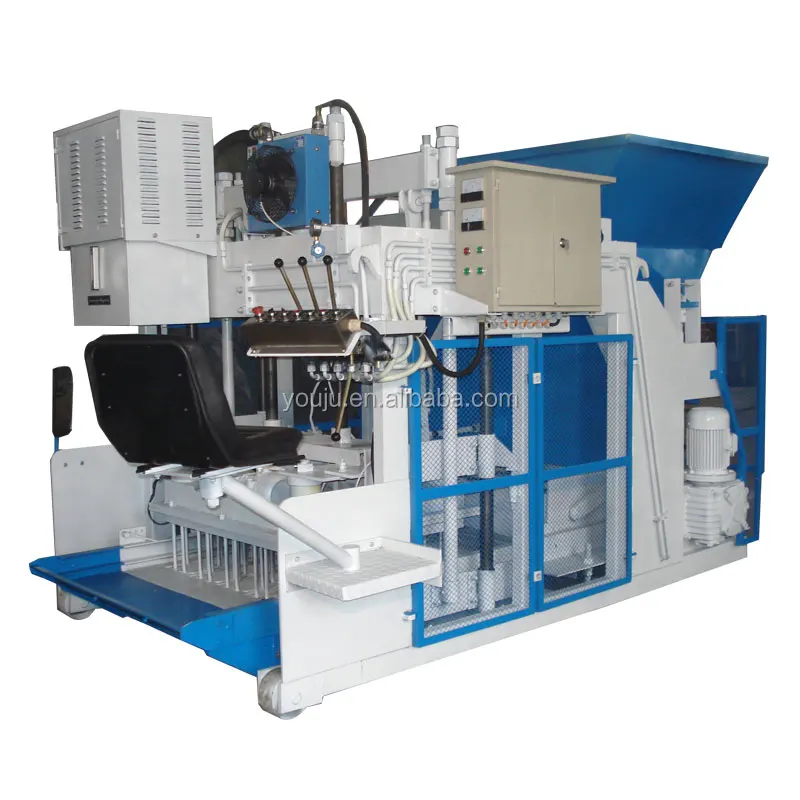
Matched Line Design — every station from raw material feed to curing rack is sized against the QMY12-15 cycle time so the press never waits on upstream or downstream bottlenecks.
Technical Specifications
| Parameter | Value |
|---|---|
| Model | QMY12-15 |
| Product Type | Automatic Hollow Block Making Machine |
| Block Format Capability | 9 / 8 / 6 / 4 inch hollow blocks |
| Drive System | Engine Gear |
| Pressure System | Hydraulic Pressure |
| Line Type | Cement Brick Production Line |
| Automation Level | Automatic (control system details to be confirmed) |
| Rated Power | To be confirmed |
| Voltage & Frequency | To be confirmed |
| Hydraulic Pressure | To be confirmed |
| Vibration Force | To be confirmed |
| Pallet Size | To be confirmed |
| Mould Change Time | To be confirmed |
| Cycle Time per Format | To be confirmed |
| Output Capacity | Basis to be confirmed |
| Assembly State | Production Line configuration |
| Shipping / Packing | Nude loading or seaworthy wood carton package; LCL or FCL sea shipping |
Application Suitability
| Application | Material or Output |
|---|---|
| Hollow cement block production | 9 / 8 / 6 / 4 inch formats from crushed stone, sand and cement |
| Cement brick production line | Continuous output for construction block plants |
| On-site or fixed-plant block production | Contractors and building material producers requiring format flexibility |
What "Automatic Output" Really Means on the Shop Floor
A press is only as fast as the slowest station feeding or clearing it.
Many buyers compare automatic hollow block making machine production line quotations using a single headline number, usually pieces per hour. That figure assumes one block format, a specific mix design, and perfect pallet circulation. When the actual format changes, or local aggregate differs from the test material, or pallets stack up because the curing rack is full, the real daily output can fall far short. I have seen QMY-class lines lose an entire shift per week because the stacking station could not keep pace with the press, and the operator had no choice but to stop the machine. [NEED_CITE: common causes of output loss in block production lines]
How Line Balance Determines True Throughput
The automatic hollow block making machine production line is not just a press sitting on a floor. Raw material feeding, mixing, pallet feeding, stacking, and curing rack handling each have their own cycle time. If the mixer delivers a batch every four minutes but the press consumes it in three, the press idles. If the stacker clears a pallet every twenty seconds but the press ejects one every fifteen, pallets jam. Every station must be specified against the QMY12-15 cycle time for the exact block format the plant will run most often.
Where Supporting Equipment Fails the Press
Downstream equipment is where most line imbalances surface. Pallet size determines how many blocks fit on the curing rack and whether the buyer’s existing forklift can handle loaded racks. Pallet material — wood, bamboo, or composite — affects block release and surface finish. Stacking height must match curing rack dimensions, or pallets end up on the floor waiting for space. When any of these parameters is guessed rather than calculated, the QMY12-15 sits idle while workers move material by hand. [NEED_CITE: pallet and curing rack matching standards for block plants]
Reading the Specs That Actually Matter
Hydraulic pressure and vibration force work together to compact the mix into the mould cavity. Pressure alone does not guarantee block strength if the vibration frequency does not match the aggregate particle size. The drive system uses an engine gear arrangement, which affects how vibration energy transfers to the mould. Pallet size — still to be confirmed with the buyer — will dictate curing area layout. Mould change time determines how quickly the line can switch between 9, 8, 6, and 4 inch formats; a slow change negates the format flexibility the QMY12-15 is designed to offer.
The Cost of Specifying Stations in Isolation
When the mixer, press, and stacker are sourced from different suppliers without a shared cycle-time calculation, each station arrives with its own assumptions about throughput. The mixer may be rated for a different batch weight than the press hopper can accept. The stacker may require a pallet dimension that the curing racks do not accommodate. I have watched a block plant owner spend weeks rearranging equipment after installation because the line was assembled from catalogue defaults rather than engineered as one system. [NEED_CITE: integration challenges in multi-supplier block production lines]
Why a Single-Source Line Proposal Matters
Block machinery is the sole focus here, which means the QMY12-15 press, moulds, pallets, and handling equipment are specified as one matched set rather than assembled from separate vendors. The line layout is calculated against the buyer’s actual mix design and local aggregate, not a catalogue default. Mould design covers the formats the buyer’s market actually sells, with custom drawings available. Automation level is selectable, allowing a buyer to start with semi-automatic pallet handling and add stacking later. Installation includes operator training so the crew understands why each station must run at its designed rhythm.
Documentation & Verification
- Line layout drawing showing station spacing and pallet flow path for the QMY12-15
- Capacity calculation stating the block format and mix assumption per tier
- Hydraulic and electrical schematic matching the confirmed voltage and frequency
- Factory test record on buyer-specified block format before dispatch
- Mould drawing and format list for all quoted hollow block sizes
- Operation and maintenance manual in the confirmed PLC display language
Installation, Commissioning & Support
- Foundation plan based on QMY12-15 overall dimensions and vibration load distribution
- Electrical connection per confirmed voltage and frequency with dedicated circuit sizing
- Production line assembly sequence from press positioning to pallet return conveyor alignment
- First-run parameter setting for hydraulic pressure, vibration force, and cycle timing per format
- Operator training covering mould change procedure and pallet handling station operation
- Wear parts list with first replacement intervals for hydraulic seals and mould liners
What to Share Before Quoting
To size the supporting equipment around the QMY12-15 accurately, the buyer should provide the target block format and daily volume, the local raw material composition and aggregate source, the available workshop footprint and curing area dimensions, and the site voltage and frequency. Existing forklift capacity and pallet inventory also matter, because the pallet specification must match what is already on the floor.
Frequently Asked Questions
Q: What determines the real daily output of the QMY12-15 line?
A: Output depends on the specific block format being produced, the mix design matched to local aggregate, and whether every supporting station — mixer, pallet feeder, stacker, and curing rack — is cycle-matched to the press. A capacity calculation should state the exact format and material assumption, not a single headline number.
Q: How do you ensure the stacker and curing area keep up with the press?
A: Each downstream station is sized against the QMY12-15 cycle time for the buyer’s primary format. Pallet dimensions, stacking height, and curing rack capacity are calculated together so pallets never pile up on the floor waiting for rack space or forklift clearance.
Q: Can supporting equipment be scaled or added later?
A: Yes. A buyer can begin with manual pallet handling and semi-automatic stacking, then upgrade to full automatic stacking and cubing as volume grows. The QMY12-15 automation level is configurable at order stage, and the line layout leaves room for future station additions.
Q: How are voltage and control language confirmed before shipment?
A: Voltage, frequency, and PLC display language are locked during the proposal stage and documented in the electrical schematic. The factory test runs on the confirmed voltage before dispatch, so the control cabinet arrives ready for the buyer’s power supply without on-site modification.


