
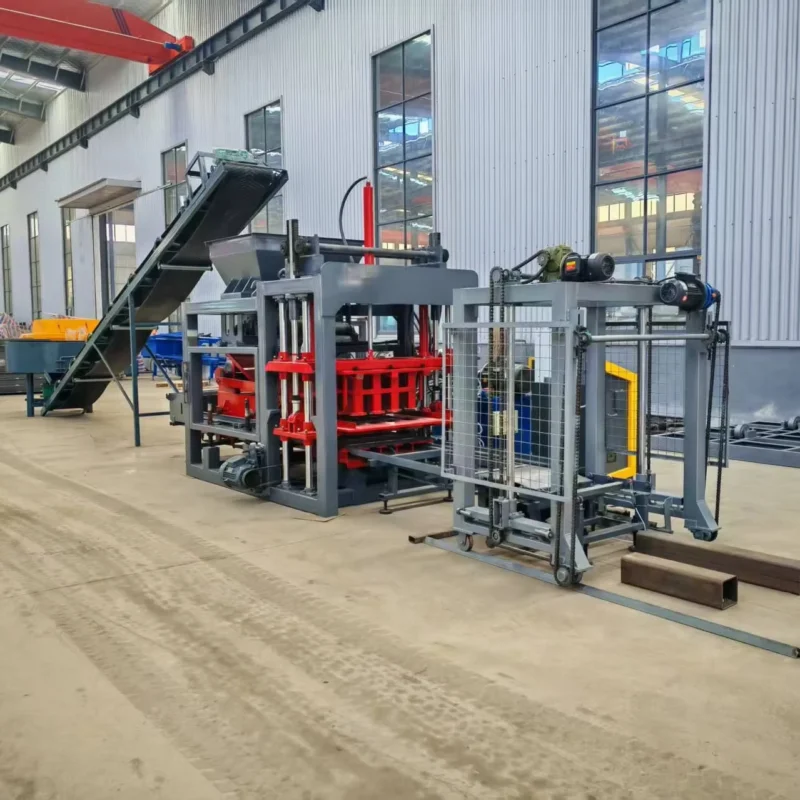
Concrete Block Making Machine Production Line – Turnkey Solution
Press-to-line rhythm matching — Every upstream and downstream station is timed to the QT4-18 molding cycle so the press never idles waiting for the mixer or stacker.
Technical Specifications
| Parameter | Value |
|---|---|
| Product Type | Semi-Automatic Hydraulic Concrete Block Making Machine |
| Model | QT4-18 |
| Overall Dimensions (L×W×H) | 3900×1600×2300 mm |
| Molding Cycle | 15-25s |
| Vibration Force | 40-50 kN |
| Rated Power | 24 kW |
| Mixer Model | JQ350 |
| Pallet Size | 850×550×25 mm |
| Net Weight | 3 T |
| Hydraulic System | Hydraulic station with high pressure for stable operation |
| Automation Level | Semi-automatic, upgradeable to automatic stacking and cubing |
| Applied Products | Paver, solid block, hollow block, curbstone |
| Raw Materials | Crushed stones, sand, cement, dust, fly ash |
| Output Capacity | 1200-1680 pcs/h (based on 400×200×200mm hollow block, 4 pcs/mould) |
| Output Capacity | 1800-2400 pcs/h (based on 400×150×200mm hollow block) |
| Output Capacity | 3240 pcs/h (based on 240×115×53mm solid brick) |
| Daily Output (8hr) | 9600-13440 pcs (based on 400×200×200mm hollow block) |
| Daily Output (8hr) | 14400-19200 pcs (based on 400×150×200mm hollow block) |
| Daily Output (8hr) | 16200-19440 pcs (based on 240×115×53mm solid brick) |
| Mould Change System | Manual mould change |
| Voltage & Frequency | Configurable to target market standard (basis to be confirmed) |
| Control System | Configurable PLC with selectable interface language (basis to be confirmed) |
Application Suitability
| Application | Material or Output |
|---|---|
| Small-to-medium block production plants | Hollow blocks from crushed stone, sand and cement |
| On-site construction block production | Solid bricks using fly ash and cement blends |
| Paving and curbstone manufacturing | Pavers and curbstones from fine aggregate mixes |
| First block plant startups | Multiple formats from one press with pallet handling |
What Quoted Cycle Times Never Tell You About Line Balance
The press cycle is only half the equation; if the mixer or pallet feeder runs slower, the entire concrete block making machine production line stalls every hour.
I once configured a concrete block making machine production line for a West African buyer. The press was rated for 15-25 second cycles, but the JQ350 mixer discharge lagged by several seconds per batch. By mid-shift, the hopper was starved and daily output dropped well below the capacity calculation. The fix was not a bigger mixer — it was recalculating the conveyor belt speed and discharge gate timing so every station matched the press cadence [NEED_CITE: common block line bottleneck causes in small plants]. When one station sets the pace and the rest follow, the line runs without the operator constantly chasing delays.
How Upstream Stations Feed the Press Without Gaps
The concrete block making machine production line begins with raw material feeding and the JQ350 mixer. This mixer is sized to prepare a full batch within the QT4-18 molding window, so the press hopper receives material before the current cycle finishes. The conveyor between mixer and press is specified for length and speed to carry each batch in time. If a buyer switches to a denser local aggregate that mixes more slowly, the conveyor speed or mixer discharge timing must be recalculated — not after arrival, but during layout planning.
Downstream Handling That Keeps the Press Running
Once blocks leave the press, wet product must be moved to the curing area without manual bottleneck. The pallet size of 850×550×25 mm is chosen in context of the buyer’s curing rack spacing and forklift fork width. Pallets that do not fit the curing racks force operators to restack by hand, which defeats the purpose of a mechanized line. The semi-automatic configuration allows manual pallet handling at startup, with a clear upgrade path to automatic stacking and cubing when volume grows [NEED_CITE: curing rack compatibility standards for block plants].
Spec Interpretation for Real Production Conditions
The QT4-18 delivers 40-50 kN vibration force paired with high-pressure hydraulics. In block production, vibration compacts the aggregate while hydraulic pressure determines final density — if either is mismatched to the buyer’s mix design, blocks come out brittle or undersized. The 15-25 second molding cycle is realistic for standard hollow blocks, but denser mixes with high fly ash content may require longer vibration. The 24 kW rated power covers press, hydraulics and vibration motor; buyers must confirm their site transformer capacity before installation. The manual mould change system works for plants producing two or three formats, but if a buyer plans to switch formats multiple times per shift, the mould change time will cut into output and should be factored into the daily capacity calculation.
The Cost of Ignoring Line Rhythm in Quotations
When a buyer purchases the press alone and sources the mixer and conveyor separately, station cycle times rarely align. The mixer discharges too slowly, or the conveyor carries material at the wrong rate. The result is a concrete block making machine production line that produces noticeably fewer blocks per shift than the press spec sheet suggested. Pallet shortages compound the problem: if the curing area holds fewer pallets than the daily output requires, the line must stop while operators clear racks [NEED_CITE: pallet quantity planning for block curing areas]. These gaps are invisible in a press-only quotation but visible in a line layout document.
Why Source the Full Line from One Supplier
Block machinery is our single focus, so the QT4-18 is specified alongside its mixer, conveyor, pallet feeder and stacker as one matched system. We configure the line against the buyer’s actual mix design and local aggregate, not a catalogue default. Pallet size is confirmed against the buyer’s curing area and existing forklift before production begins. Voltage, frequency and PLC display language are verified during the order stage so the line commissions without electrical surprises. The upgrade path from semi-automatic to full stacking is designed in from the start, so future expansion does not require replacing the press.
Documentation & Verification
- Line layout with capacity calculation per block format for the QT4-18
- Pallet specification matched to buyer curing rack and forklift dimensions
- Hydraulic and electrical schematic with confirmed voltage and frequency
- Factory test record on buyer’s target block format before dispatch
- Wear parts and mould list for first replacement cycle planning
Installation, Commissioning & Support
- Foundation plan for the QT4-18 footprint of 3900×1600×2300 mm and 3 T weight
- Dedicated 24 kW circuit with confirmed voltage and frequency at site
- Machine arrives dismantled with reassembly guide and bolt torque specs
- On-site commissioning includes mixer discharge timing calibration
- Operator training covers mould change procedure and daily maintenance
- Wear parts list with hydraulic seals and vibration motor bearings
Before You Request a Quote
To size a concrete block making machine production line correctly, we need your target block format and the daily output you plan to sell — not just the number the press can theoretically produce. Share your local aggregate type, cement availability and the dimensions of your curing area. Confirm your site voltage, frequency and preferred PLC display language. If you have an existing mixer or forklift, tell us the model so we can check station compatibility before quoting the line.
Frequently Asked Questions
Q: How are line station cycle times matched so the press is not left waiting?
A: Each station — JQ350 mixer, conveyor, pallet feeder — is timed to the QT4-18 molding cycle of 15-25 seconds. If the mixer discharge or conveyor speed is slower than the press cycle, the hopper starves and output drops. We calculate each station’s timing during layout and confirm it against the buyer’s specific mix design before production.
Q: What supporting equipment is included and what is optional?
A: The quotation covers the QT4-18 press, JQ350 mixer, conveyor and pallet feeder as standard. Automatic stacking and cubing are optional for buyers who start with manual pallet handling. We specify the pallet quantity recommendation — typically several hundred pieces — based on the buyer’s curing area size and daily output target.
Q: How is pallet size and quantity determined?
A: The 850×550×25 mm pallet is confirmed against the buyer’s curing rack spacing and existing forklift fork width. Pallets that do not match the curing racks force hand restacking and reduce throughput. Quantity depends on how many pallets must be in the curing cycle simultaneously to match daily production volume.
Q: Can the line start semi-automatic and upgrade later?
A: Yes. The QT4-18 semi-automatic configuration supports manual pallet handling at startup. As volume grows, automatic stacking and cubing can be added without replacing the press. The line is designed with this upgrade path from the initial layout stage.
Q: What electrical confirmations happen before shipment?
A: Voltage, frequency and PLC display language are confirmed during the order stage. A machine shipped to a 60 Hz market on a 50 Hz configuration will run at reduced speed and may damage the vibration motor. We verify these parameters and document them before production begins.



