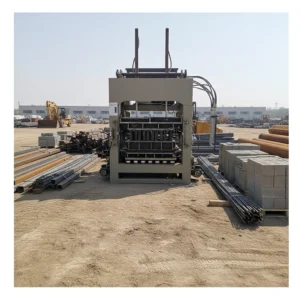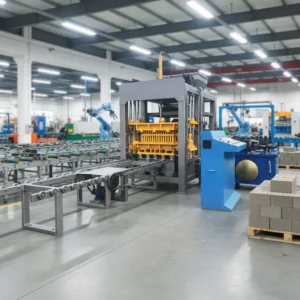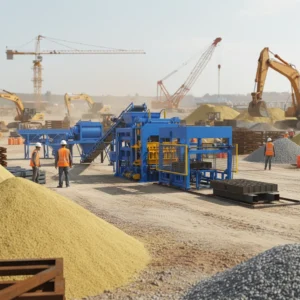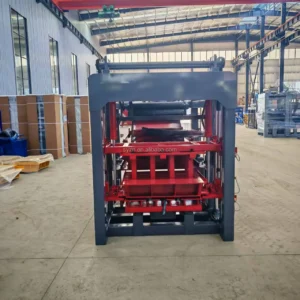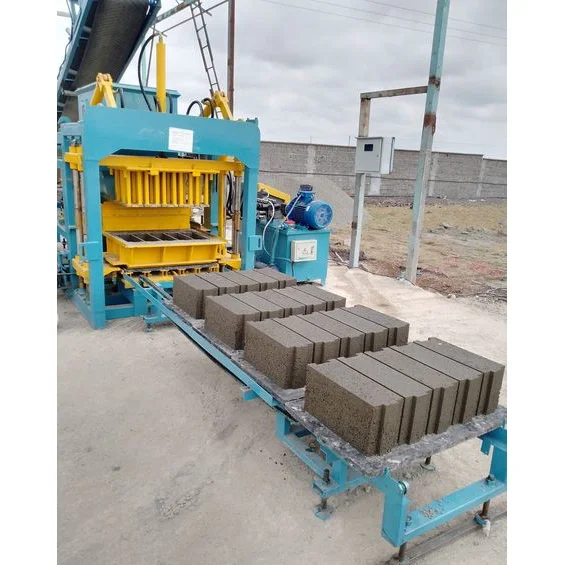
Matched Line Pacing — Mixer, press, pallet feed and stacker are sized against the 15–25 s moulding cycle so no station waits on another.
Technical Specifications
| Parameter | Value |
|---|---|
| Model | QT4-15A |
| Product Type | Concrete Block Making Machine |
| Overall Dimensions (L×W×H) | 7100 × 1600 × 2610 mm |
| Moulding Cycle | 15–25 s |
| Vibration Frequency | 4600 r/min |
| Vibration Force | 40–50 kN |
| Total Power | 18.45 kW |
| Mixer Model | JQ350 |
| Pallet Size | 850 × 550 × 25 mm |
| Total Weight | 3 T |
| Applied Products | Paver, solid block, hollow block, curbstone |
| Raw Materials | Crushed stone, sand, cement, dust, fly ash |
| Output — Hollow Block 400×200×200 mm | 4 pcs/mould, 408 pcs/hr, 3264 pcs/8hr |
| Output — Hollow Block 400×150×200 mm | 5 pcs/mould, 510 pcs/hr, 4080 pcs/8hr |
| Output — Solid Brick 240×115×53 mm | 18 pcs/mould, 2100 pcs/hr, 17000 pcs/8hr |
| Stacking Method | Automatic stacker included |
| Automation Level | Semi-automatic |
| Control System | To be confirmed (PLC / MCC / manual) |
| Voltage & Frequency | To be confirmed before order |
| Hydraulic Pressure | To be confirmed (MPa rating) |
| Mould Change Time | To be confirmed (minutes per change) |
Application Suitability
| Application | Material or Output |
|---|---|
| Hollow block production for wall construction | Crushed stone, sand, cement, fly ash — 400×200×200 mm or 400×150×200 mm formats |
| Solid brick manufacturing | Cement and fine aggregate — 240×115×53 mm standard brick |
| Paver and curbstone production for site works | Crushed stone and sand mixes — format dependent on mould installed |
| On-site block production for housing projects | Local aggregate and cement, semi-automatic operation with automatic stacking |
| First block plant for entrepreneurs | Full line from JQ350 mixer through press to stacker, matched cycle times |
What a "Concrete Block Making Machine Production Line" Actually Means on the Floor
A press is only as fast as the slowest station feeding or clearing it.
I once watched a QT4-15 class line in a contractor’s yard where the mixer could not keep up with the press cycle. The operator stood idle for seconds between presses, and the daily tally ended well below the nameplate figure. The concrete block making machine production line is only honest when every station — material feed, mixing, pallet return, stacking — is paced to the same cycle [NEED_CITE: line pacing principles for concrete block plants].
How Stations Connect Around the Press
The JQ350 mixer must discharge a full batch within the 15–25 s moulding window so the hopper never starves the press. Pallets travel from the curing racks back to the feed station on a loop that must complete within the same window, otherwise the press waits for a clean pallet. When these intervals align, the concrete block making machine production line runs without dead time between cycles.
Where Cycle Mismatches Show Up First
The first symptom is never the press itself — it is the stacker or the pallet return falling behind. Blocks pile up on the off-bearing side because the curing racks are full and no forklift is available to clear them. The press stops, the operator waits, and the quoted capacity per hour becomes a theoretical number [NEED_CITE: curing area and pallet circulation planning].
Reading the Output Table Honestly
The capacity figures in the specification sheet are tied to specific block formats. Hollow blocks at 400×200×200 mm yield 408 pieces per hour, while 400×150×200 mm yields 510 pieces per hour, and solid bricks at 240×115×53 mm yield 2100 pieces per hour. Each number assumes a continuous run on that single format with the corresponding mould installed and a mix that achieves proper compaction within the stated cycle range.
Vibration Force, Pressure and the Local Mix
Vibration at 4600 r/min with 40–50 kN force compacts the mix into the mould cavity. Whether that force is enough depends on the gradation of the crushed stone and the fines content of the sand available locally. A mix with high fly ash content flows differently from one built on coarse river gravel, and the vibration setting must be matched to what actually arrives at the hopper.
Pallet Size and the Curing Area You Already Have
The 850 × 550 × 25 mm pallet must fit the curing racks and the forklift tines already on site. If the racks were built for a different pallet dimension, either the racks or the pallets must change — and that decision affects how many pallets circulate in the loop, which in turn governs whether the press ever waits for a return [NEED_CITE: pallet circulation and curing rack compatibility].
Choosing the Automation Level That Fits the Shift
Semi-automatic operation with an included automatic stacker removes the heaviest manual task from the line. The operator loads pallets and monitors the cycle while the stacker handles off-bearing. For plants planning to grow, the control architecture can accommodate a future move to full automatic pallet feed and cubing without replacing the press.
The Cost of Leaving Stations Unspecified
When a quotation covers only the press, the buyer sources the mixer, conveyors and pallets separately — and the cycle times never quite match. The result is a line that runs but never reaches the throughput on paper. Budget overruns appear later when a faster mixer or additional pallets are purchased to chase the original capacity target [NEED_CITE: hidden costs of unmatched block line equipment].
Why Buyers Source the Full Line Here
Block machinery is the single focus, so the QT4-15A press, JQ350 mixer, pallet specification and stacker are proposed as one matched set rather than assembled from separate vendors. Configuration is set against the buyer’s actual mix design and local aggregate, not a catalogue default. Mould design covers the formats the local market sells, with custom drawings available. Automation level is selectable so a plant can start semi-automatic and add stations later. Installation support includes operator training on the full line, not the press alone.
Documentation & Verification
- Line layout and capacity calculation stating the block format assumed for each throughput figure
- Pallet specification and quantity recommendation aligned to your curing rack dimensions
- Voltage, frequency and control language confirmation sheet signed before production starts
- Factory test record covering station-to-station handover, not the press in isolation
- Mould drawing and format list for every block type included in the order
- Hydraulic and electrical schematic for local maintenance team reference
Installation, Commissioning & Support
- Foundation plan based on 7100 × 1600 mm footprint and 3 T operating weight
- Dedicated circuit sized for 18.45 kW total draw with voltage confirmed before build
- Semi-automatic line commissioning with mixer, press and stacker timed as one sequence
- Operator training covering mould change procedure and daily vibration table inspection
- Wear parts and mould list provided at handover for first reorder planning
- Curing rack layout advice matched to 850 × 550 mm pallet circulation rate
Before You Request a Quote
Share the block formats your market actually buys, the daily volume you need per format, and the aggregate sources available near your site. Include your existing voltage and frequency, the pallet dimensions your curing area accepts, and whether you plan to start semi-automatic or go straight to full automation. With those details, the line proposal can be built around your real conditions rather than a default template.
Frequently Asked Questions
Q: How do I verify daily output when the quoted capacity assumes a specific block format?
A: Ask for a capacity table that lists throughput separately for every block format you plan to produce, each tied to its moulding cycle and mould cavity count. The QT4-15A figures — such as 408 pcs/hr for 400×200×200 mm hollow blocks — apply only to that format. Running a different size or shape changes the cycle and the hourly count accordingly.
Q: Are pallet handling, stacking and curing included in the line quotation?
A: The QT4-15A line includes an automatic stacker, but curing racks and pallet quantity depend on your site layout. Confirm the pallet size — 850 × 550 × 25 mm — against your existing racks and forklift, then request a pallet circulation count that prevents the press from waiting for returns during an eight-hour shift.
Q: How do I match the mixer output to the press cycle so the press never waits?
A: The JQ350 mixer must discharge a full batch within the 15–25 s moulding window. Ask for a feed-rate calculation that ties mixer batch size, conveyor speed and hopper capacity together, so material arrives before the press completes each cycle.
Q: What should I confirm on voltage and control language before production starts?
A: Provide your site voltage and frequency in writing, and specify the language for the control display. These are locked in before the electrical panel is built, avoiding rewiring or panel replacement after the line arrives.
Q: How do I plan the curing area around the pallet size and stacking method?
A: The 850 × 550 mm pallet sets the rack bay width and the forklift tine spacing. Request a curing area layout that matches the pallet circulation rate at your target daily volume, so cured blocks are cleared and empty pallets return to the feed station without interrupting the press.