
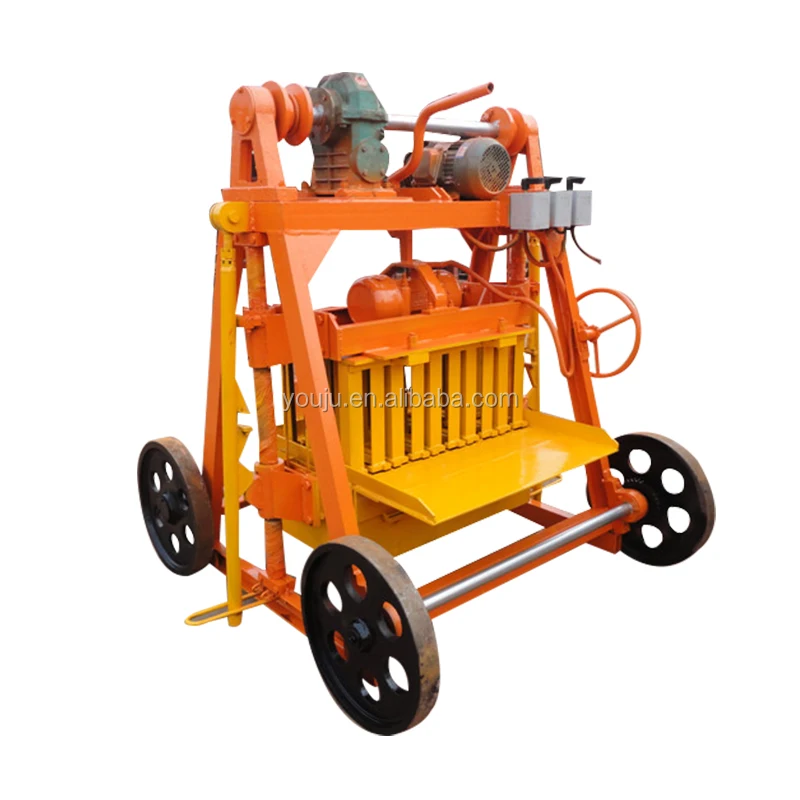
Line-Matched Layout — we configure the QMJ4-45 press, mixer, and material feed as one working line so every station keeps pace without bottlenecks.
Technical Specifications
| Parameter | Value |
|---|---|
| Product Type | Mobile Egg-Laying Block Making Machine |
| Model | QMJ4-45 |
| Molding Capacity | 4 pcs/mould (basis: 400×200×200mm hollow block) |
| Vibration Frequency | 2400 r/m |
| Molding Cycle | 45 s |
| Productivity (400×200×200mm) | 3000 pcs/day (based on 4 pcs/mould, 40–45s cycle, 8-hour shift) |
| Productivity (400×150×200mm) | 3500 pcs/day (based on 5 pcs/mould, 40–45s cycle, 8-hour shift) |
| Productivity (400×120×200mm) | 4500 pcs/day (based on 6 pcs/mould, 40–45s cycle, 8-hour shift) |
| Forming Method | Twice-vibration molding core |
| Demold Method | Manual |
| Total Power | 6 kW |
| Power Source | Diesel / Petrol engine |
| Pallet Requirement | None (egg-laying on cement ground) |
| Automation Level | Manual |
| Certification | CE |
Application Suitability
| Application | Material or Output |
|---|---|
| On-site hollow block production | Crushed stone, sand, cement, water |
| Remote project locations without grid power | Diesel or petrol engine operation |
| Small-scale block yards | 400×200×200mm, 400×150×200mm, 400×120×200mm hollow blocks |
| Housing and development contractors | Locally sourced aggregate and cement |
| First block plant startups | Minimal infrastructure, no fixed plant needed |
Why "3000 Blocks a Day" Can Mean Something Else Entirely
A mobile block making machine production line only meets its rated output when the mixer and material feed keep pace with the press.
I have seen contractors order a mobile egg-laying machine based on a single productivity number, then discover on site that their hand-fed mixer takes longer to prepare a batch than the QMJ4-45 takes to lay a row. The press sits idle, the crew waits, and the daily count falls well short. [NEED_CITE: mobile block machine cycle time and mixer throughput matching] A realistic mobile block making machine production line plan must account for every station, not just the press.
How the Stations Connect Around the QMJ4-45
The QMJ4-45 moves forward on its own wheels, laying hollow blocks directly on a prepared cement floor. Behind it, a mixer feeds raw material into the hopper. If the mixer batch time exceeds the 45-second molding cycle, the press operator stands idle. Sizing the mixer drum and material feed rate to match the mobile block making machine production line throughput is the first step in a line layout that actually works.
What the Ground and Curing Area Demand
Egg-laying machines leave freshly molded blocks on the ground where they cure in place. This eliminates pallet investment and pallet handling equipment, but it shifts the planning burden to the curing area. The ground must be level, swept, and strong enough to bear stacked blocks. Curing time depends on ambient temperature and humidity at the project site, which means the usable floor area must be large enough for a full day’s output plus curing space. [NEED_CITE: concrete block curing time under tropical ambient conditions]
Reading the Specs That Actually Shape Your Output
The twice-vibration molding core on the QMJ4-45 delivers two vibration impulses per cycle instead of one, increasing block density and producing more uniform wall strength across formats. At 2400 r/m vibration frequency, the machine compacts the mix firmly, but the result depends on the aggregate grading and moisture content arriving from the mixer — a dry or poorly graded mix will not compact evenly regardless of vibration force. The 6 kW total power draw from a diesel or petrol engine means the mobile block making machine production line can run at sites without grid electricity, though fuel consumption and engine maintenance become part of the daily operating routine. The 45-second molding cycle is consistent across formats, so output differences come entirely from how many blocks fit in one mould: four for 200mm-wide hollow blocks, five for 150mm, and six for 120mm.
The Cost of Skipping the Line Layout
When a buyer treats the press as the only purchase and sources a mixer locally, the two machines rarely match in throughput. The result is a mobile block making machine production line where the most expensive component spends a large portion of every shift waiting. Manual material feeding adds fatigue and inconsistency, especially in hot climates where the crew slows down by midday. [NEED_CITE: manual block production labor fatigue and output drop in high temperatures] Blocks molded from an under-mixed batch show weak corners and inconsistent weight, which the buyer blames on the press rather than the upstream station.
What Makes This Setup Work as a Line
Block machinery is our single focus, so the QMJ4-45 press, mixer, and material feed are specified as one matched system rather than assembled from separate suppliers. Configuration is set against the buyer’s actual mix design and local aggregate, not a catalogue default. Mould design and supply covers the hollow block formats the buyer’s market sells, including custom drawings when standard sizes do not match. The automation level is selectable — a buyer can start with manual egg-laying and move to a higher-capacity line later without replacing the mould inventory. Installation support includes operator training on site so the crew understands cycle timing and material feed rhythm from the first shift.
Documentation & Verification
- Line layout drawing showing mixer, feed, and QMJ4-45 press positions with station spacing
- Capacity calculation sheet stating block format, cycle time, and shift length assumptions
- Machine specification sheet confirming engine type, vibration frequency, and total power
- Factory test record on buyer’s specified hollow block format before dispatch
- Operation and maintenance manual covering engine service intervals and mould care
- Packing photographs and customs documentation support for export shipment
Installation, Commissioning & Support
- Level cement ground required across the curing area to support egg-laying production without pallets
- Diesel or petrol engine fuel supply and daily service checklist provided with the 6 kW power unit
- Mixer positioned within one batch cycle of the QMJ4-45 hopper to prevent press idle time
- First-day commissioning with mould adjustment to match buyer’s local aggregate and mix moisture
- Operator training on 45-second cycle pacing and manual demold technique for consistent block edges
- Wear parts list covering vibration core and mould liner with reorder lead times stated
What We Need From You to Size the Line
To build a working mobile block making machine production line plan around the QMJ4-45, share your target hollow block format and daily output requirement along with the local aggregate type and cement ratio you plan to use. Let us know the available curing area dimensions, ambient climate conditions, and whether grid electricity exists on site or engine power is essential. If you already own a mixer or material handling equipment, tell us the model and batch capacity so we can check throughput alignment.
Frequently Asked Questions
Q: What supporting equipment does the QMJ4-45 need to form a complete working line?
A: A pan mixer sized so its batch time stays under the 45-second molding cycle, a material feed system to move mixed concrete from the mixer to the press hopper, and a level cement curing area large enough for a full day’s output. The exact mixer capacity depends on which hollow block format you produce and the daily volume you target.
Q: How do cycle times at each station need to match?
A: The QMJ4-45 completes one molding cycle every 45 seconds. If the mixer takes longer than that to deliver the next batch, the press sits idle and daily output drops. We calculate mixer drum size and material feed rate against your chosen block format so no station becomes the bottleneck in the line.
Q: What block formats can the QMJ4-45 produce and what is the realistic output?
A: The machine handles 400×200×200mm, 400×150×200mm, and 400×120×200mm hollow blocks. Realistic daily output is 3000, 3500, and 4500 pieces respectively, based on the corresponding mould cavity count, a 40–45 second cycle, and an 8-hour shift. Actual output depends on material feed rhythm and crew pacing.
Q: What ground conditions are required for egg-laying production?
A: The production floor must be level, clean, and made of cured concrete strong enough to bear freshly laid blocks. No pallets are needed, but the curing area must be large enough for an entire shift’s output to remain in place until blocks reach handling strength, which varies with local temperature and humidity.
Q: How does the line scale when demand grows?
A: A second QMJ4-45 can be added to the same curing area with a shared mixer if batch capacity allows. For larger volume increases, the buyer can move to a pallet-based semi-automatic or automatic line while reusing knowledge gained from the mobile setup. Mould formats selected for the QMJ4-45 can carry over to compatible larger machines.


