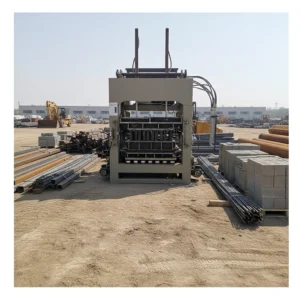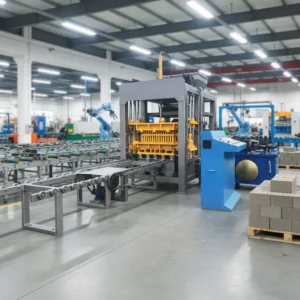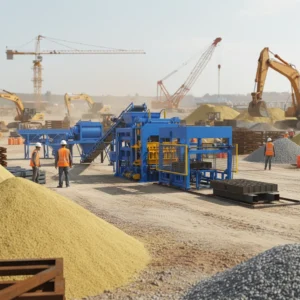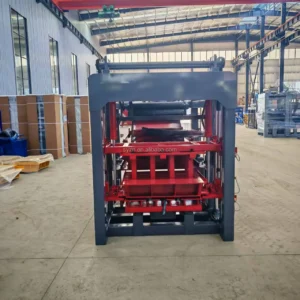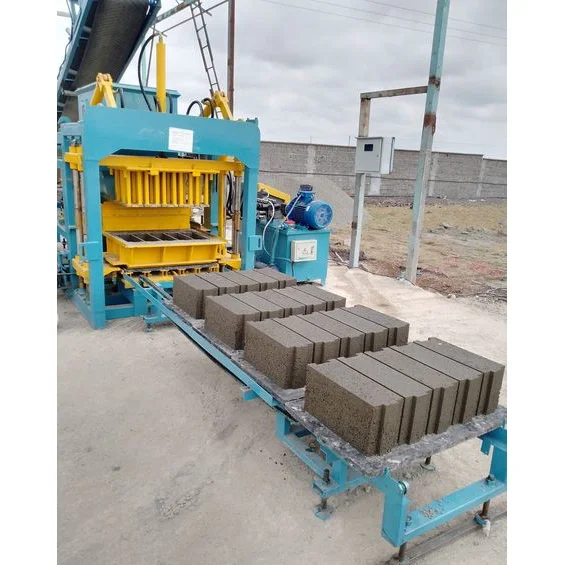
Matched line configuration — the QT4-15 press is specified alongside its mixer, pallet feed, and stacker so cycle times align from raw material through to cured block, not quoted as a standalone machine.
Technical Specifications
| Parameter | Value |
|---|---|
| Product Type | Automatic Concrete Block Making Machine |
| Model | QT4-15A |
| Overall Dimensions (L×W×H) | 7100 x 1600 x 2610 mm |
| Molding Cycle | 15–25 s |
| Vibration Frequency | 4600 r/min |
| Exciting Power (Vibration Force) | 40–50 kN |
| Rated Power | 18.45 kW |
| Mixer Model | JQ350 |
| Pallet Size | 850 x 550 x 25 mm |
| Total Weight | 3 T |
| Applied Products | Paver, solid block, hollow block, curbstone |
| Raw Materials | Crushed stones, sand, cement, dust, fly ash |
| Output Capacity | 408 pcs/h (basis: 400x200x200mm hollow block, 4 pcs/mould) |
| Output Capacity | 510 pcs/h (basis: 400x150x200mm hollow block, 5 pcs/mould) |
| Output Capacity | 2100 pcs/h (basis: 240x115x53mm solid brick, 18 pcs/mould) |
| Daily Output (8 hr) | 3264 pcs (basis: 400x200x200mm hollow block) |
| Daily Output (8 hr) | 4080 pcs (basis: 400x150x200mm hollow block) |
| Daily Output (8 hr) | 17000 pcs (basis: 240x115x53mm solid brick) |
| Automation Level | Semi-automatic |
| Hydraulic Station | Equipped |
| Mould Change | Supported for paver, solid, hollow, curbstone formats |
Application Suitability
| Application | Material or Output |
|---|---|
| Hollow block production for residential wall construction | Crushed stone, sand, cement, fly ash mixes |
| Solid brick manufacturing for load-bearing masonry | Dense aggregate and cement blends |
| Paver and interlocking brick for landscaping | Fine sand, cement, pigment additives |
| Curbstone production for road and sidewalk edging | Coarse aggregate with high cement content |
| On-site block production for housing projects | Locally sourced aggregate and cement |
Why the Mixer Cycle Dictates the Press Output in a block production line equipment Setup
A press that waits for the mixer is a press that never reaches its quoted capacity.
Buyers often focus on the molding cycle of the press itself, but a complete turnkey block making plant lives or dies by how the stations synchronize. I have walked onto sites where a fast-cycling press sat idle because the batch mixer could not discharge quickly enough, cutting real daily output well below the brochure figure. When we configured this line, the JQ350 mixer batch time was checked against the 15–25 second molding cycle to confirm the press would receive a fresh charge every stroke [NEED_CITE: mixer discharge time versus press cycle synchronization].
The conveyor feed rate, pallet indexing speed, and stacker lift interval all fall within the same timing envelope. If any one station runs slower than the press demands, the entire block production line equipment slows to match it.
How Raw Material Feeding Connects to Press Performance
The raw material feeding system delivers measured volumes of crushed stone, sand, cement, and fly ash into the JQ350 mixer. Consistent batch weight and moisture content are essential because the QT4-15 press relies on a specific mix consistency to achieve full compaction under vibration. If the feeder delivers uneven proportions, the vibration force of 40–50 kN cannot compact the material uniformly, and block strength varies from pallet to pallet. In a properly configured block production line equipment layout, the feeder, mixer, and press operate as a closed timing loop rather than independent machines.
Pallet Handling and Stacking as Part of the Line
The 850 x 550 x 25 mm pallet size was chosen to match standard curing rack dimensions and common forklift tine widths. After the press forms the block, the pallet carries the wet product to the automatic stacker, which indexes and lifts pallets into a curing rack configuration. Without this stacker, operators must pull pallets by hand and carry them to the curing yard — a bottleneck that erases any speed advantage the press itself offers. The turnkey block making plant quotation includes the pallet return conveyor so empty pallets cycle back to the press without manual intervention [NEED_CITE: pallet handling labor requirements in semi-automatic block plants].
Reading the Specs That Actually Matter on Site
The vibration frequency of 4600 r/min works together with the hydraulic station to densify the mix during the 15–25 second molding window. Higher frequency alone does not guarantee stronger blocks; the hydraulic pressure must hold the mould box rigid while vibration consolidates the aggregate. The rated power of 18.45 kW covers the press motor, vibration motor, and hydraulic pump running simultaneously — a figure that determines the electrical supply specification for the entire block production line equipment installation. Pallet size directly governs how many pallets fit in a standard curing rack bay, which in turn dictates how much curing area the plant needs to sustain continuous production over an eight-hour shift.
What Happens When Line Stations Are Sourced Separately
When a buyer purchases the press, mixer, and stacker from different suppliers, timing mismatches surface only during commissioning. The mixer may discharge too slowly, the pallet feeder may index at the wrong interval, or the stacker may not accept the pallet dimensions the press ejects. These problems do not appear in any single supplier’s test record because no one runs the full sequence. I have seen plants lose entire production shifts reprogramming PLC signals between mismatched stations [NEED_CITE: integration issues in multi-vendor block production lines]. The hidden cost is not the equipment price — it is the weeks of lost output while technicians rewrite control logic on site.
Why the Line Is Quoted as One System
Every station in this configuration is specified against the same block format, cycle time, and pallet dimension. The capacity calculation states which block format the output figure assumes — 408 pieces per hour based on a 400x200x200mm hollow block at four pieces per mould — so the buyer can project daily volume for the exact product they sell. The hydraulic and electrical schematics cover the complete line, not just the press, giving the site electrician one document to wire from. Mould change procedures account for the conveyor and stacker settings that must shift along with the mould, so format changeover does not extend into the next shift. The voltage, frequency, and PLC display language are confirmed for the destination country before production begins, preventing commissioning delays when the container arrives.
Documentation & Verification
- Line layout drawing showing station spacing and conveyor lengths for the QT4-15A configuration
- Capacity calculation stating block format and mould cavity count for each output figure
- Hydraulic schematic covering press and stacker circuits on a single diagram
- Pallet specification sheet matched to curing rack and forklift dimensions
- Voltage, frequency, and control language confirmation recorded before build
- Factory test record running the full sequence from mixer discharge to stacker output
Installation, Commissioning & Support
- Foundation plan sized to the 7100 x 1600 mm press footprint with anchor bolt locations
- Electrical supply specification for 18.45 kW total load with dedicated circuit breaker sizing
- Mixer and conveyor assembly sequence so the JQ350 discharges directly into the press hopper
- Pallet feeder alignment check ensuring 850 x 550 mm pallets index without jamming
- Operator training covering mould change, hydraulic pressure adjustment, and stacker reset procedures
- Wear parts list identifying vibration motor mounts, hydraulic seals, and pallet guide rails
What to Include in Your Inquiry
To configure the block production line equipment around your actual site conditions, share the block formats your market demands along with target daily output per format. Confirm your local aggregate type and available cement grade so the mixer and feeder can be set for your mix design. Provide your workshop dimensions, curing yard area, and existing forklift capacity so pallet size and stacker height are matched to your facility rather than chosen from a default list.
Frequently Asked Questions
Q: What equipment beyond the press is included in the block production line equipment quotation?
A: The line includes the JQ350 mixer, raw material feeder, belt conveyor, pallet feeding system, automatic stacker, and pallet return conveyor. Each station is matched to the QT4-15A press cycle time. Optional items such as curing racks, forklifts, and batching silos are listed separately so you can scope exactly what you need.
Q: How are cycle times matched between the mixer, press, and stacker?
A: The JQ350 mixer batch time, conveyor feed rate, and stacker lift interval are all calculated against the 15–25 second molding cycle. This ensures the press receives a fresh material charge and an empty pallet every stroke without waiting, and the stacker clears formed pallets before the next ejection.
Q: What pallet size and material is recommended for my curing area?
A: The standard 850 x 550 x 25 mm pallet fits common curing rack bays and forklift tine widths. Bamboo, PVC, and steel pallet options are available depending on your curing environment and expected pallet lifespan. Quantity recommendations typically range from several hundred pieces to sustain continuous production through the curing cycle.
Q: Is the voltage and control language confirmed before the line ships?
A: Yes. Voltage, frequency, and PLC display language are confirmed in writing before production begins. The electrical schematic reflects your site supply specification, and the factory test runs the complete line at the confirmed voltage to prevent commissioning delays on arrival.
Q: What does on-site installation cover for the turnkey block making plant?
A: Installation covers the full line — mixer placement, conveyor alignment, press anchoring on the prepared foundation, stacker assembly, and electrical interconnection of all stations. Commissioning includes running the complete sequence with your local raw materials and adjusting vibration and feed timing to your mix design.