
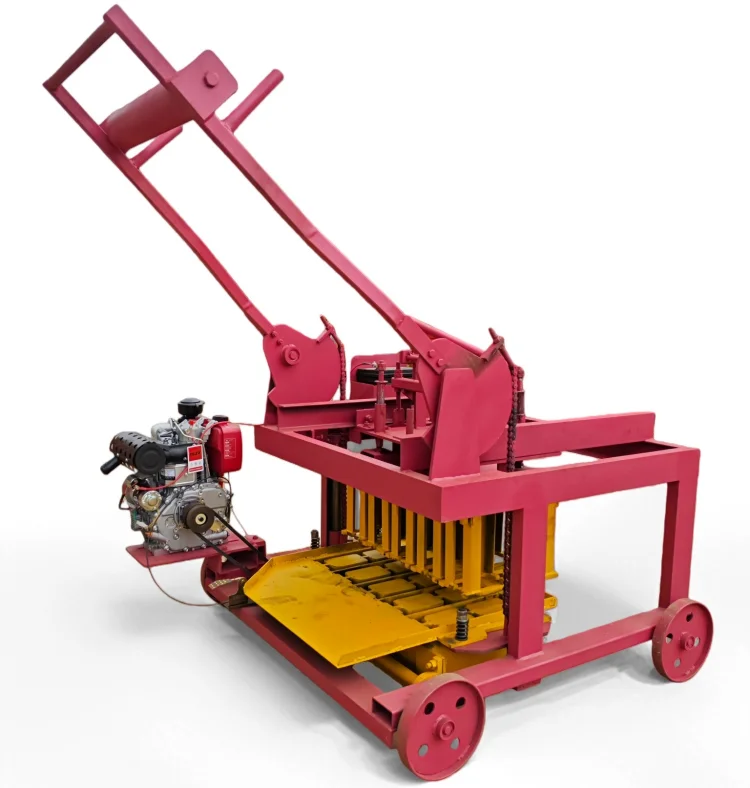
Complete line integration — We treat the press, mixer, and trolley as one timed system, not isolated stations, ensuring the QMR4-45 mobile block making machine production line keeps material flowing without bottlenecks.
Technical Specifications
| Parameter | Value |
|---|---|
| Product Type | Mobile Block Making Machine |
| Model | QMR4-45 |
| Power Source | Diesel (Electric optional) |
| Rated Power | 8 hp |
| Molding Form | Vibration and Pressure |
| Vibration Force | 60 KN |
| Molding Cycle | 45 s (basis not stated in source — confirm block format, material, and thickness) |
| Total Weight | 800 kg |
| Overall Dimensions (L×W×H) | 2420 × 1320 × 1650 mm |
| Pallet Requirement | No pallet required |
| Mobility | Mobile, movable on-site |
| Compatible Block Formats | Hollow block, solid brick, paver brick, fly ash brick, concrete block |
| Basic Equipment Included | JZC350 Diesel Concrete Mixer or JQ350 Diesel Concrete Mixer with Electric Generating Unit; Trolley |
| Automation Level | Manual operation with motorized vibration and pressure |
| Voltage & Frequency | Not stated in source |
| Control System | Not stated in source |
| Certification | Not stated in source |
Application Suitability
| Application | Material or Output |
|---|---|
| On-site block production for building contractors | Crushed stone, sand, and cement blends for hollow and solid blocks |
| Remote project sites without grid power | Diesel-driven mixing and molding of concrete blocks and pavers |
| Small-scale block supply for local markets | Fly ash and aggregate mixes for brick and paver formats |
| Housing development projects with tight deadlines | Continuous block output directly at the construction footprint |
Why Line Synchronization Matters More Than Press Speed Alone
A fast press sitting idle because the mixer cannot keep up is still a slow line.
Buyers often focus on the molding cycle and overlook the stations that feed it. I once watched a QMR4-45 mobile block making machine production line complete a cycle in 45 seconds, then wait another 30 for the trolley to return with fresh mix [NEED_CITE: on-site material flow studies in small block plants]. The press was rated well, but the daily output fell far below what the cycle time suggested. When each station in a mobile line is specified independently, the gaps show up only after the machines arrive and the crew starts running. The result is workers standing around, half-cured blocks stacked unevenly on the ground, and a project schedule slipping day by day.
Matching Mixer Output to the Molding Rhythm
The QMR4-45 ships with either a JZC350 or JQ350 diesel concrete mixer, both sized to keep the 45-second molding cycle supplied without over-mixing. When the mixer batch volume and discharge speed are not aligned with the press cycle, the operator either rushes the mix or lets it sit too long in the drum, both of which affect block density. A mobile block making machine production line must balance these two stations so the press never waits and the mixer never idles.
Trolley Flow and Curing Area Layout
Because this machine operates without pallets, blocks are laid directly on the ground and the trolley must move continuously between the mixer discharge point and the press hopper. If the curing area is too far from the production zone or the ground is uneven, the trolley slows down and the entire mobile block making machine production line loses rhythm [NEED_CITE: curing area planning guidelines for egg-laying block machines]. Planning the travel path before the first block is made prevents the kind of bottlenecks that turn a straightforward on-site operation into a logistical headache.
Reading the Vibration and Pressure Numbers Together
The 60 KN vibration force works alongside mechanical pressure to compact the concrete mix inside the mould. In block making, vibration alone creates density gradients, while pressure alone traps air pockets. When both forces are present at the right ratio for the local aggregate, the blocks cure to a consistent strength across every format. The 8 hp diesel engine drives both the vibration system and the pressure mechanism, so power delivery stays balanced even when the engine is under continuous load at a remote site. The 800 kg machine weight contributes to stability during the vibration phase, reducing the chance that the frame shifts on soft ground and throws the mould alignment off. These parameters only matter when they are read as a group rather than in isolation.
The Hidden Cost of Treating a Mobile Press as a Standalone Unit
Ordering a mobile block machine without planning the mixer capacity, trolley route, and curing zone leaves gaps that only become visible on the first production day. I have seen crews hand-carry wet blocks across a site because no trolley path was cleared, and mixers sitting idle because the press hopper was already full [NEED_CITE: field observations from Middle East block projects]. The machine itself works fine, but the line around it was never configured as a system. That mismatch costs more in lost time and rework than the supporting equipment would have cost upfront.
Why Sourcing the Full Line from One Supplier Changes the Outcome
We specify the QMR4-45, mixer, and trolley together so the batch volume, discharge timing, and travel distance are calculated as one system. The mould set is matched to the block formats the buyer’s market actually sells, not a default catalogue list. Capacity calculations state which block format the cycle time assumes, so there is no surprise on the first production day. Configuration is set against the buyer’s local aggregate and mix design rather than generic defaults. Installation guidance covers trolley path planning and curing zone layout alongside press setup, so the line runs as intended from the first shift.
Documentation & Verification
- Line layout drawing showing mixer, press, and trolley positions with travel distances
- Capacity calculation sheet stating the block format assumed for each cycle time
- Mould drawing and format list clarifying included and optional mould tooling
- Factory test record with photographs taken before dispatch
- Operation manual covering mixer batching sequence and press operating procedure
- Packing photographs documenting machine condition prior to container loading
Installation, Commissioning & Support
- Ground leveling guidance for the 2420 × 1320 mm machine footprint before first run
- Diesel engine start-up and break-in procedure for the 8 hp rated power unit
- Mixer drum and hopper alignment check between the JZC350 or JQ350 and the press
- Trolley route planning with turning radius matched to the curing area layout
- Mould mounting and vibration force calibration for each block format in the set
- Wear parts list covering vibration springs, mould liners, and trolley wheels
Preparing Your Inquiry
To move past generic catalogues, share the block formats your market sells, the daily output you need for each format, and the aggregate available locally. If the site has no grid power, confirm diesel fuel supply logistics. Tell us the curing area dimensions so we can plan trolley paths and stacking zones that keep the mobile block making machine production line moving without interruptions.
Frequently Asked Questions
Q: How is the 45-second molding cycle measured, and which block format does it assume?
A: The 45-second cycle is a general reference value and the source does not state which block format, material blend, or thickness it assumes. Actual cycle time varies with block size, mix consistency, and operator speed. We provide a format-specific capacity calculation that states the assumed block dimensions and mix so you know the realistic output before ordering.
Q: What supporting equipment is included, and where do I need to source additional items?
A: The basic package includes the JZC350 or JQ350 diesel concrete mixer and a trolley. Curing covers, ground preparation materials, and water supply for mixing are not included. If you choose the electric variant, an external generating unit or grid connection must be arranged locally.
Q: Can the machine switch between diesel and electric power, and what are the requirements?
A: The QMR4-45 is available with a diesel engine as standard, with an electric motor option. The electric variant requires confirmed voltage and frequency matching the local supply, which must be stated before production begins. No dual-fuel switching mechanism is provided; the power source is fixed at the time of order.
Q: Which block formats can the QMR4-45 produce, and how does mould changeover work?
A: Standard compatible formats include hollow blocks, solid bricks, paver bricks, fly ash bricks, and concrete blocks. Each format requires its own mould tooling. Mould changeover time is not stated in the source, so we confirm the procedure and required tools during the specification phase based on the formats you select.
Q: How should I plan curing and stacking when no pallets are used?
A: Pallet-free operation means blocks are placed directly on the ground and must cure in place until they gain enough strength to be moved. You need a flat, level curing area sized for your daily output, with clear pathways for the trolley and workers. We include curing area layout guidance in the line planning documentation.


