
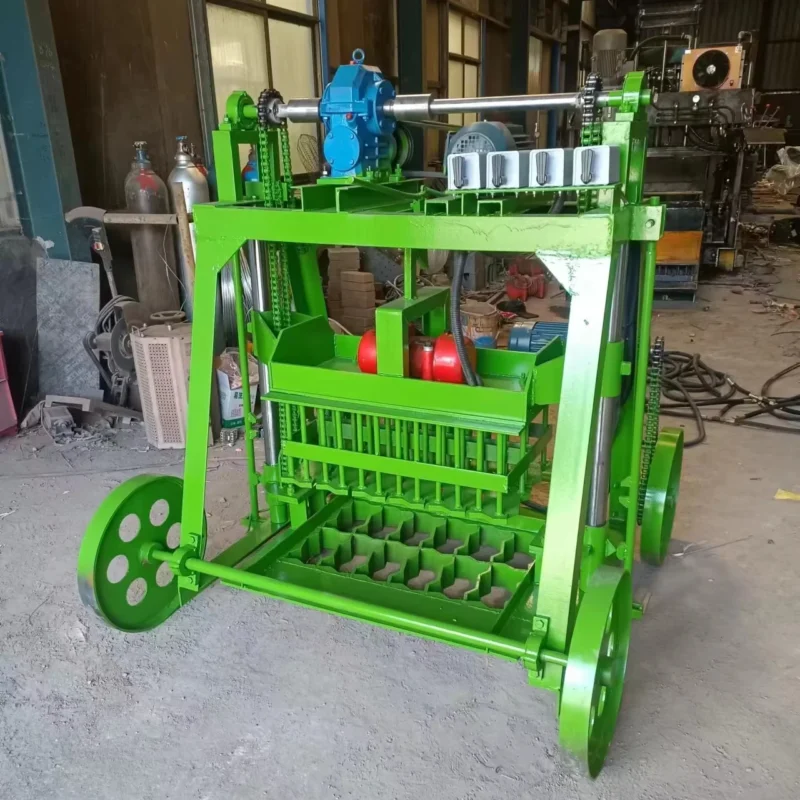
Matched System Design — raw material feeding and mixing stations sized around the QMJ4-45 cycle so the press never idles waiting for the next batch.
Technical Specifications
| Parameter | Value |
|---|---|
| Model | QMJ4-45 |
| Product Type | Mobile Egg Laying Block Making Machine |
| Molding Capacity | 4 pcs/mould (basis: 400×200×200mm hollow block) |
| Molding Cycle | 40–45s |
| Productivity | 3000 pcs/day (basis: 400×200×200mm hollow block, 8-hour shift) |
| Productivity | 3500 pcs/day (basis: 400×150×200mm hollow block, 8-hour shift) |
| Productivity | 4500 pcs/day (basis: 400×120×200mm hollow block, 8-hour shift) |
| Total Power | 6 kW |
| Power Source | Diesel / petrol engine (electric motor option available) |
| Vibration Frequency | 2400 r/m |
| Vibration Type | Twice-vibration molding (upgraded from single vibration) |
| Hydraulic Method | Mold vibration (no hydraulic press) |
| Demold Method | Manual |
| Turning Method | Manual |
| Pallet Requirement | No pallets — egg-laying type, blocks laid directly on ground |
| Automation Level | Manual operation, small-scale |
| Confirmed Mould Formats | 400×200×200mm, 400×150×200mm, 400×120×200mm hollow block |
| Certification | CE (declaration document available upon request) |
| Warranty | One year for the whole machine |
Application Suitability
| Application | Material or Output |
|---|---|
| On-site hollow block production without a fixed plant | Crushed stone, sand, cement, water |
| Small-scale block manufacturing for local construction | Concrete mix with locally available aggregate |
| Contractor self-supply at building project sites | Standard cement-based hollow blocks |
| First block production operation with minimal infrastructure | 400×200×200mm, 400×150×200mm, 400×120×200mm hollow formats |
Why Upstream Timing Matters More Than the Press Itself
A mobile block making machine production line lives or dies on whether the mixer and feeder keep pace with the press.
Buyers often fixate on the molding cycle — 40 to 45 seconds per mould in this case — without checking whether the upstream stations can deliver a fresh batch within that window. If the mixer takes a minute to discharge and the operator is still wheeling the barrow over, the QMJ4-45 sits idle for 15 to 20 seconds every cycle. Across an eight-hour shift that dead time compounds into hundreds of lost blocks. I saw exactly this on a West African site last year: the press was rated correctly, but the pan mixer was undersized, and the daily output fell well short of expectations until we re-matched the batch volume to the cycle [NEED_CITE: matching mixer batch size to block press cycle time].
Feeding and Mixing Station Integration
The QMJ4-45 consumes one mould of concrete every 40 to 45 seconds. That means the upstream mixer must complete a full batch — enough for several consecutive moulds — and discharge it into the feed hopper before the press runs short. A pan mixer or small drum mixer sized to deliver roughly two to three moulds of mix per batch keeps the workflow continuous without flooding the hopper.
On the mobile block making machine production line, the feeder does not need a conveyor belt system; a wheelbarrow or small buggy can bridge the distance from mixer to press if the ground is level and the distance is kept short. What matters is that the operator is never waiting for the next batch to finish mixing.
Ground Preparation and Curing Layout
Egg-laying machines place blocks directly on the ground, so the production area must be flat, compacted, and free of standing water. A concrete-hardened floor is ideal, but well-graded and rolled earth can work for short project runs.
Because no pallets are consumed, there is no pallet return loop, no pallet storage rack, and no pallet cleaning station. This simplifies the mobile block making machine production line considerably, but it also means the curing area must be large enough to hold a full day’s output laid out in rows. Planning the ground space before the machine arrives prevents a situation where the press has to stop because there is nowhere left to lay blocks [NEED_CITE: ground preparation standards for mobile egg-laying block production].
Reading the Specification Sheet Against Your Block Format
The vibration frequency of 2400 r/m is generated by the twice-vibration system — two vibration points rather than one — which distributes compaction force more evenly across the mould cavity. For hollow blocks, this means wall density is more consistent from one end of the block to the other, reducing the weak spots that cause breakage during handling.
The 6 kW total power rating covers the vibration motor and the mold-lifting mechanism. When the diesel or petrol engine option is selected, the machine operates entirely off-grid, which removes the need for a site electrical connection and avoids voltage drop issues that plague remote construction sites.
Mold vibration without hydraulic pressure means compaction relies on the vibration force and the weight of the mix itself. This is standard for egg-laying machines in this class and produces blocks adequate for low-rise construction and wall infill, though it will not match the density achieved by a hydraulic static-press system.
What Happens When the Line Is Not Balanced
When the mixer is too small or too far from the press, operators start rushing batches that have not mixed long enough. The result is inconsistent block density from one mould to the next — some blocks crumble at the corners during curing, others pass inspection but fail under load tests. I have traced this kind of quality variation back to an upstream timing mismatch more than once, and the fix is always the same: match the batch size and mixing time to the press cycle, not the other way around [NEED_CITE: effects of uneven mixing time on concrete block compressive strength].
Why Procurement Should Cover the Whole Line
Every configuration is set against the buyer’s actual mix design, local aggregate, and target block format rather than a catalogue default. The QMJ4-45 mould list is confirmed before order, so the dimensions you receive match what your market sells.
The engine-powered option is specified at inquiry stage based on your site electrical availability, preventing commissioning delays. Mould design and supply extend to custom drawings when standard formats do not match your local standard. The supporting equipment — mixer sizing, feed method, ground layout — is addressed during the proposal stage, not left for the buyer to figure out after delivery. Installation support includes on-site parameter adjustment so the line runs at the stated cycle from day one.
Documentation & Verification
- Line layout showing mixer, feed path, and curing area sized to QMJ4-45 output
- Capacity calculation sheet stating which hollow block format the daily figure assumes
- Mould drawing and dimension confirmation for each ordered format
- Factory test record run on your specified mix design before dispatch
- Voltage and power source confirmation document for engine or electric option
- Operation and maintenance manual covering vibration system and mould change
Installation, Commissioning & Support
- Level compacted ground required across the full laying area before the 6 kW unit arrives
- Diesel engine option eliminates need for dedicated electrical circuit on remote sites
- Machine delivered assembled; mould bolt-on change requires basic hand tools only
- On-site vibration parameter tuning matched to your local aggregate and cement ratio
- Operator training covers mould change sequence and daily vibration system inspection
- Wear parts list with mould liner and vibration motor brush replacement intervals
What We Need to Size Your Line
To prepare a configuration proposal around the QMJ4-45, share your target hollow block dimensions, the daily volume you need to hit, and the raw materials available locally. Let us know whether your site has grid power or needs the engine option, and describe the ground conditions where blocks will be laid. If you already have a mixer in place, send its batch capacity so we can check the timing match.
Frequently Asked Questions
Q: What upstream equipment is needed so the QMJ4-45 is not left waiting between cycles?
A: A pan mixer or drum mixer that can discharge a batch large enough for two to three moulds within the 40–45 second cycle window. The feed path from mixer to press should be short and level — a wheelbarrow works if the distance is under ten meters. We size the mixer during the proposal stage to match the press throughput.
Q: How do I verify daily output — which block format does the 3000 pcs/day figure assume?
A: The 3000 pcs/day figure assumes 400×200×200mm hollow blocks over an eight-hour shift. Smaller formats yield more per day: 3500 pcs/day for 400×150×200mm and 4500 pcs/day for 400×120×200mm. Our capacity calculation sheet states the exact format and shift length behind every output figure we quote.
Q: What ground surface preparation is required for egg-laying block production on site?
A: The laying area must be flat, compacted, and drained. A concrete floor is preferred for long-term production, but well-rolled gravel or hard-packed earth works for project-based runs. The area must be large enough to hold a full day’s output laid in rows with spacing for curing access.
Q: Can the line be expanded later with pallet-based stacking and curing equipment?
A: The QMJ4-45 is designed as a pallet-free machine, so adding pallet-based curing would require a different press type. However, you can add a second machine or move up to a semi-automatic pallet-based line as volume grows. The engine and mixer from the initial setup carry over to the larger line.
Q: What is the engine versus electric motor option, and how does each affect site setup?
A: The diesel or petrol engine option allows fully off-grid operation with no electrical infrastructure, which suits remote construction sites. The electric motor option requires a stable power supply matching the 6 kW total draw. We confirm the power source at inquiry stage based on your site conditions to avoid commissioning delays.


