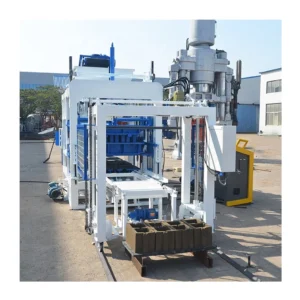
Matched Line Rhythm — every station from the JQ350 mixer through the belt conveyor to the QTJ4-35 host press is specified as one timed system, so the press never idles while upstream catches up.
Technical Specifications
| Parameter | Value |
|---|---|
| Model | QTJ4-35 |
| Product Type | Semi-Automatic Concrete Block Making Machine |
| Line Configuration | Host machine + JQ350 mixer + belt conveyor |
| Automation Level | Semi-automatic |
| Output Capacity (400×200×200mm hollow block) | 4 pcs/mould, 3,200 pcs/8 hours |
| Output Capacity (400×150×200mm hollow block) | 5 pcs/mould, 4,000 pcs/8 hours |
| Output Capacity (225×112.5×60mm paver) | 9 pcs/mould, 7,200 pcs/8 hours |
| Mixer Model | JQ350 |
| Mould Compatibility | Hollow blocks, solid blocks, pavers (changeable moulds) |
| Stacking Method | Manual |
| Control System | To be confirmed against buyer site |
| Voltage & Frequency | To be confirmed against buyer site |
| Pallet Size | To be confirmed against buyer site |
| Certification | CE (company level — verify model applicability) |
Application Suitability
| Application | Material or Output |
|---|---|
| Small-scale block plant start-up | Hollow and solid blocks from locally sourced crushed stone, sand and cement |
| On-site contractor production | Construction blocks for housing projects where a full automatic line is not justified |
| Format expansion for existing plants | Interlocking pavers and solid blocks added to current range using the same host press |
| Rural and peri-urban supply yards | Medium-volume hollow block runs with manual pallet handling and outdoor curing |
What a Single Daily Output Number Hides About Your semi-automatic block making machine production line
Capacity means nothing until you know which mould was in the press when the stopwatch started.
Most quotations for a semi-automatic block machine quote one headline figure for daily output, leaving the buyer to discover after installation that the number assumed a small paver mould while the plant actually runs 400mm hollow blocks most shifts. I have stood on sites in South Asia where the owner counted finished blocks at the end of the day and found the real tally barely reached half the brochure promise. The mismatch is never the machine’s fault — it is the gap between a generic number and a specific format [NEED_CITE: block format assumptions in capacity quotations].
Three Stations That Actually Keep Pace
The QTJ4-35 is quoted here as a three-station semi-automatic block making machine production line, not a standalone press. The JQ350 mixer batch size and the belt conveyor feed rate are chosen so the press hopper stays charged through continuous cycling. When one station runs faster than the others, the bottleneck simply shifts and the whole line slows to its weakest link.
Where the Semi-Automatic Tier Fits
This tier leaves pallet feeding, block take-off and stacking to operators while the press itself runs powered vibration and forming. That division suits plants where labour is available and the curing yard is close to the press, but where consistent block density still depends on machine-controlled vibration rather than hand tamping. Buyers moving up from fully manual egg-laying machines notice the consistency difference immediately [NEED_CITE: semi-automatic versus manual block density comparison].
Reading the Numbers That Matter
The output of 3,200 pieces per eight-hour shift applies specifically to 400×200×200mm hollow blocks at four pieces per mould. Switch to the 400×150×200mm mould and the figure rises to 4,000 pieces per shift because five blocks fit the same platen area. Drop in the 225×112.5×60mm paver mould and the count reaches 7,200 pieces per shift at nine per mould. These differences are geometry, not extra speed — the cycle time remains the constraint, and the mixer plus conveyor must sustain feed across all three formats.
The Cost of Ignoring Upstream Matching
I once spent a week troubleshooting a line in East Africa where the owner had sourced the mixer locally to save on the invoice. The mixer batch cycle was nearly twice as long as the press cycle, so the hopper ran dry every third or fourth press stroke. Workers stood idle while the mixer caught up, and the daily tally dropped to a fraction of what a matched semi-automatic block making machine production line would have delivered. The press was fine; the rhythm was broken [NEED_CITE: upstream equipment mismatch impact on block plant output].
Why Source the Line as One Package
Block machinery is our single focus, so the host press, JQ350 mixer and belt conveyor leave the factory as one matched set rather than three separate purchases that the buyer must reconcile on site. Configuration starts from your actual mix design and local aggregate, not a catalogue default that may not suit the sand and stone available in your region. Moulds are designed for the formats your market buys, including custom drawings when standard sizes do not match local building codes. Automation level is selectable, meaning a plant can begin at this semi-automatic tier and add automatic pallet feeding or stacking later without replacing the press. Installation support includes operator training so your crew understands mould changes, daily greasing points and the signs of uneven vibration before they affect block quality.
Documentation & Verification
- Line layout drawing showing mixer, conveyor and press spacing with capacity noted per block format
- Machine specification sheet covering QTJ4-35 host, JQ350 mixer and belt conveyor as one system
- Mould drawing and format list confirming which hollow, solid and paver sizes are included
- Voltage, frequency and control language confirmation sheet signed before production begins
- Factory test record documenting press cycle on the buyer’s chosen mould before dispatch
Installation, Commissioning & Support
- Foundation pad sized to the QTJ4-35 footprint with anchor bolt template supplied before pour
- Dedicated electrical circuit matched to confirmed voltage and frequency, separate from mixer feed
- Mixer and conveyor assembled on site with belt tension and feed angle set to match press hopper height
- First production run supervised to verify cycle timing across all three stations on your chosen block format
- Operator training covering mould change procedure, vibration adjustment and daily greasing schedule
- Wear parts list with reorder codes for mould liners, vibration springs and conveyor belt splices
What to Share Before Quoting
To size a semi-automatic block making machine production line correctly, we need the block formats your market actually buys, the target daily output for each format, and the raw materials you plan to use — including the type of sand or stone dust available locally. Share your site voltage and frequency, the control panel language your operators read, and whether you already have pallets and a curing area so we can confirm pallet size compatibility. If you have existing upstream or downstream equipment, tell us the model so we can check feed height and take-off clearance.
Frequently Asked Questions
Q: How is the daily output of the QTJ4-35 calculated, and which block format does each figure assume?
A: Every output figure is tied to a specific mould. For 400×200×200mm hollow blocks the line produces 3,200 pieces over eight hours at four per mould. For 400×150×200mm blocks the figure is 4,000 pieces at five per mould, and for 225×112.5×60mm pavers it is 7,200 pieces at nine per mould. No single headline number is used.
Q: Does the quoted line include pallet feeding, stacking and curing, or only the press, mixer and conveyor?
A: The standard quotation covers the QTJ4-35 host press, JQ350 mixer and belt conveyor as a three-station set. Pallet feeding, block take-off and stacking are manual at this semi-automatic tier. Automatic pallet feeders and stackers can be added later if the plant decides to move up in automation level.
Q: How do the mixer capacity and belt conveyor speed match the press cycle?
A: The JQ350 batch volume and the conveyor belt speed are selected so the press hopper stays charged across continuous cycles. If the mixer finished a batch slower than the press consumed it, the hopper would run dry and the press would idle — the exact mismatch this matched-line approach prevents.
Q: What pallet size does the QTJ4-35 require, and will it fit my existing curing area?
A: Pallet size is confirmed during the proposal stage based on the mould formats you plan to run. We check the pallet dimensions against your curing rack spacing and the forklift tine width you already have on site, so pallets ordered for the line work with your existing handling equipment.
Q: How are voltage, frequency and control panel language confirmed before shipment?
A: A confirmation sheet listing your site voltage, frequency and the language for any labels or indicators is signed before production begins. This prevents the situation where a line arrives on site and the electrician discovers the motor winding does not match the local supply.