
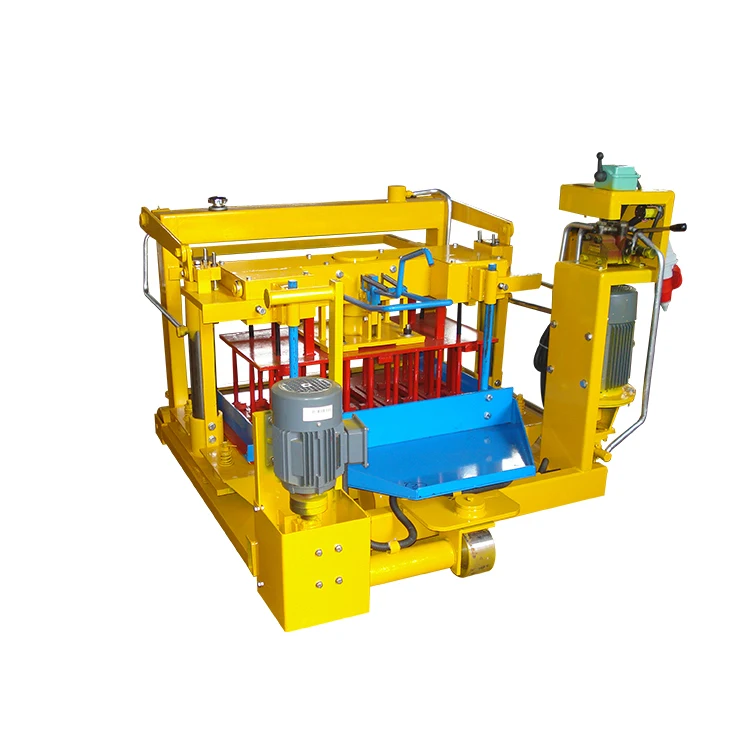
Line Synchronization — Every supporting station from mixer to stacking is matched to the QMY4-30 mobile block making machine cycle so the press is never left waiting for the next batch, based on the buyer’s actual block format and site conditions.
Technical Specifications
| Parameter | Value |
|---|---|
| Product Type | Mobile Concrete Block Making Machine |
| Model | QMY4-30 |
| Rated Power | 5 kW |
| Cycle Time | 30 seconds |
| Overall Dimensions (L×W×H) | 1200 × 1200 × 1100 mm |
| Net Weight | 950 kg |
| Automation Level | Manual / Mobile egg-laying |
| Assembly State | Mobile, no fixed plant required |
| Mould Format | Hollow block, solid brick |
| Raw Materials | Cement, sand, crushed stones, slag |
| Output Capacity (400×200×200 mm hollow block) | 480 pcs/hour, 3840 pcs/8 hours |
| Output Capacity (400×150×200 mm hollow block) | 600 pcs/hour, 4800 pcs/8 hours |
| Output Capacity (400×100×200 mm hollow block) | 840 pcs/hour, 6720 pcs/8 hours |
Application Suitability
| Application | Material or Output |
|---|---|
| On-site housing project block production | Hollow blocks from cement, sand, and crushed stone |
| Entrepreneur first block plant setup | Solid bricks and hollow blocks in multiple formats |
| Contractor relocatable production | Format changes between hollow block and solid brick |
| Building material distributor adding formats | Low-footprint mobile unit for supplementary range |
Why Quoted Capacity Falls Short on a Mobile Block Making Machine Production Line
Real daily output depends on the exact block format you sell, not the headline number on the spec sheet.
When a mobile block making machine production line is quoted at a single output figure, it usually assumes a format the buyer’s market does not actually demand. I saw this on a Dubai site where the contractor ordered a mobile unit expecting a full day’s output of 400×200×200 mm hollow blocks, only to discover the quoted figure was based on a smaller format they never sold. The result was a daily shortfall that pushed the entire project schedule back [NEED_CITE: capacity calculation assumptions by block format in mobile block machines]. Without a format-by-format breakdown, the line’s upstream mixer, water system, and downstream curing area all get sized to the wrong number.
How the Line Flows Around a Mobile Egg-Laying Press
A mobile egg-laying machine like the QMY4-30 produces directly on the ground, which removes pallets and curing racks from the equation but introduces a different synchronization challenge. The mixer must deliver a fresh batch to the machine hopper within the 30-second cycle window, or the press sits idle. On a compact mobile block making machine production line, the distance between the mixer discharge and the press hopper is short, but the batch size must be calculated against the volume of the specific block format being run — a 400×100×200 mm block consumes mix faster than a 400×200×200 mm block, even though the cycle time stays at 30 seconds.
Matching Upstream and Downstream Stations to the Cycle
Every station on a turnkey mobile line must match the press tempo. The raw material feeder delivers aggregate to the mixer at a rate that keeps the mixer from becoming the bottleneck. Water dosing must be precise enough that the operator does not stop to adjust consistency mid-cycle. After pressing, the blocks cure in place on the ground, so the production path must be planned to leave adequate spacing for forklift access during collection. If the downstream collection crew cannot keep up, the operator has to stop the press, and the quoted output evaporates [NEED_CITE: line synchronization requirements for mobile egg-laying block production].
What the Specs Mean for Your Site
The 5 kW rated power draw keeps utility requirements within the range of small-site diesel generators, avoiding the need for a dedicated transformer or heavy grid connection. The 950 kg net weight and 1200 × 1200 × 1100 mm dimensions mean the machine can be transported on a standard flatbed and maneuvered on uneven ground without a fixed foundation. The 30-second cycle time is constant across mould changes, but the output per cycle varies: four 400×200×200 mm hollow blocks, five 400×150×200 mm hollow blocks, or seven 400×100×200 mm hollow blocks per press. This is why capacity must always be stated per format, not as a single number. The raw material range — cement, sand, crushed stones, slag — covers most locally available aggregates, but the gradation must be confirmed against the vibration characteristics of this specific machine to maintain block density.
The Cost of Skipping Line Integration
When a mobile block making machine is purchased as a standalone press without specifying the supporting stations, the hidden costs surface quickly. A mixer that is too small forces the operator to wait between cycles, cutting actual output well below the spec sheet figure. A water system without metering leads to inconsistent mix moisture, which shows up as variable block strength across a single day’s production. I have walked onto sites where blocks from the morning run crumbled under the same load that afternoon blocks handled easily, simply because the water-to-cement ratio drifted [NEED_CITE: effect of inconsistent batching on block compressive strength]. Without a coordinated line layout, these problems are blamed on the press when they actually originate upstream.
Why Source the Full Line from One Supplier
Single-focus sourcing means the QMY4-30 mobile block making machine, its moulds, and the supporting stations are specified as one matched system rather than assembled from separate vendors who do not communicate. Configuration is set against the buyer’s actual mix design and local aggregate, not a catalogue default. Mould design covers the specific formats the buyer’s market sells, including custom drawings when standard formats do not match local demand. The automation level is selectable, so a buyer can start with manual pallet handling and add automatic stacking later as volume grows. Installation and commissioning support includes operator training on the full line, not just the press in isolation.
Documentation & Verification
- Line layout and capacity calculation stating the block format assumed for each output figure
- Machine specification sheet covering power, cycle time, dimensions, and weight for transport
- Mould drawing and format list confirming included and optional block sizes
- Voltage and control language confirmation to prevent commissioning delays
- Factory test record on the buyer’s target block format before dispatch
- Operation and maintenance manual with wear parts and mould replacement list
Installation, Commissioning & Support
- Site ground preparation for mobile operation on compacted, level surface within the 1200 × 1200 mm machine footprint
- Power connection at the confirmed voltage and frequency, dedicated circuit for the 5 kW draw
- Machine assembled on-site from transport condition, no fixed foundation bolts required
- First-run commissioning with mix adjustment to local aggregate for the target block format
- Operator training on cycle timing, mould change procedure, and daily maintenance checkpoints
- Wear parts list with recommended reorder intervals for vibration components and mould liners
Before You Send the Inquiry
To size a mobile block making machine production line accurately, we need to know the specific block formats your market demands and the daily volume for each format. Share the local raw materials available — especially aggregate type and gradation — and the voltage and frequency at your site. If you already have a mixer or material handling equipment, provide those specs so the line can be configured around what you own rather than duplicating it.
Frequently Asked Questions
Q: How is output capacity calculated for each block format?
A: Output is stated separately for 400×200×200, 400×150×200, and 400×100×200 mm hollow blocks, based on a 30-second cycle time. Each figure reflects the number of blocks produced per mould cycle multiplied by the cycles per hour. The actual daily output depends on uninterrupted material supply and operator pace across the full shift.
Q: What supporting equipment completes a mobile block line?
A: A mixer sized to match the press consumption rate, a raw material feeder for consistent aggregate delivery, and a metered water system form the minimum upstream setup. Downstream, you need ground space for in-place curing and a forklift path for block collection after the curing period is complete.
Q: What voltage and frequency options are available?
A: Voltage and frequency must be confirmed before production to match the target market’s electrical standard. The 5 kW power draw is compatible with most small-site generators, but the exact voltage configuration must be specified at order to avoid rewiring after arrival on site.
Q: How long does a mould change take?
A: Mould changes on the QMY4-30 are manual and require basic hand tools. The time depends on operator familiarity — an experienced operator completes a change between hollow block and solid brick formats within a short break, while a first-time change takes longer. Training during commissioning covers this procedure.
Q: What raw material mix works best with this machine?
A: Cement, sand, crushed stones, and slag are all compatible. The aggregate gradation must be matched to the machine’s vibration characteristics to maintain consistent block density. A site-specific mix trial during commissioning confirms the right proportions for local materials and the target block strength.


