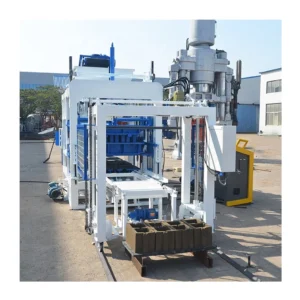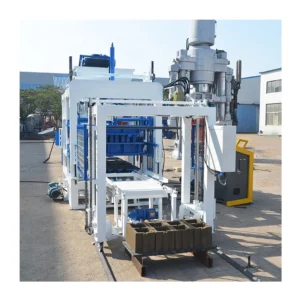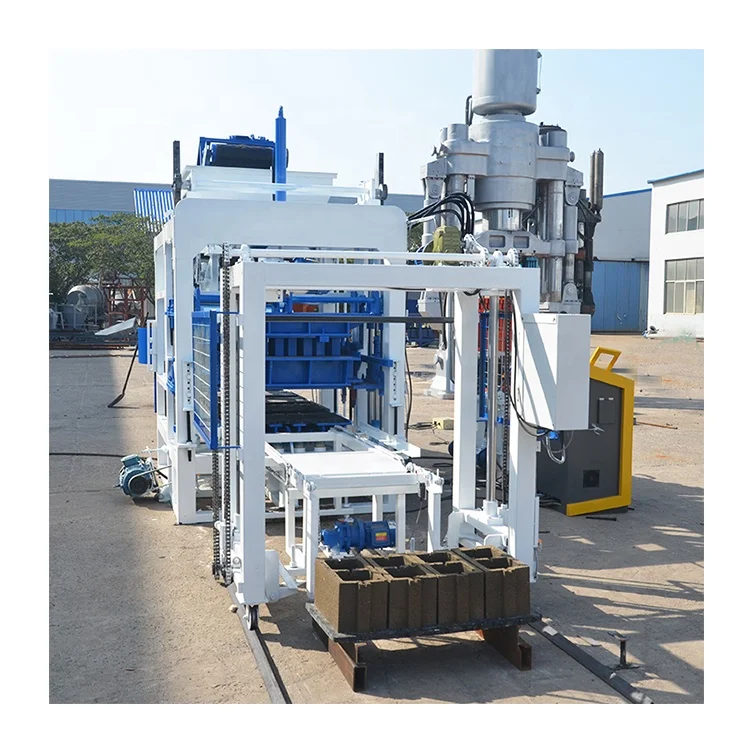
Matched System Sizing — The QT4-18 concrete block production line is configured so mixer discharge, belt conveyor travel, pallet feeder stroke and press cycle are timed against each other, preventing the host machine from sitting idle between stations.
Technical Specifications
| Parameter | Value |
|---|---|
| Model | QT4-18 |
| Product Type | Automatic Concrete Block Making Machine |
| Overall Dimensions | 2500×1750×2200mm |
| Rated Pressure | 16MPa |
| Vibration Form | Platform Vibration |
| Pallet Size | 950×550mm |
| Molding Cycle | 18-25s (basis to be confirmed per block format) |
| Overall Power | 27.5kW |
| Control System | PLC with Frequency Converter |
| Electrical Components | Schneider brand |
| Mould Lifting Mechanism | Double-sided synchronous gears |
| Material Feeder System | Hopper, feeding box, feeding platform, conveyor system |
| Block Receiver | Frame, conveyor system, idler wheels with motor, reducer and triangle belt |
| Automation Level | Automatic with hydraulically driven pallet feeder, PLC controlled |
| Mould Change Method | Manual bolt removal with conveyor-assisted extraction |
| Supporting Equipment | JQ500 pan mixer, 8m/6m belt conveyor, stacker, block clamper, cement silo, batching plant, trolley |
Application Suitability
| Application | Material or Output |
|---|---|
| Hollow block production | Crushed stone, cement, sand aggregate mix for load-bearing walls |
| Solid block production | Dense aggregate blends for foundation and structural masonry |
| Paving block production | Fine aggregate and cement for walkways, driveways and yard surfaces |
| On-site contractor production | Local quarry sand and gravel for housing project blocks |
| Plant expansion format additions | Existing mix designs adapted to new mould configurations |
Why the Upstream Stations Decide Your Real Daily Output
A press rated at 18-25 seconds per cycle only delivers that pace when the mixer, conveyor and pallet feeder keep up without interruption.
The turnkey block making system is quoted by many suppliers as a single press with a cycles-per-hour number attached. In practice, the mixer batch size may not match the hopper capacity, the belt conveyor may feed material slower than the host consumes it, or the pallet feeder may not complete its return stroke before the press is ready for the next cycle. I have seen block lines where the press sat idle for several seconds every cycle because the upstream stations were specified independently, and the daily output dropped noticeably below what the cycle time suggested [NEED_CITE: common causes of throughput loss in concrete block plants]. This concrete block production line addresses that gap by sizing the JQ500 pan mixer, belt conveyor and pallet feeder stroke as a connected sequence rather than a collection of separate machines.
Timing Each Station Against the Press Cycle
The QT4-18 completes a molding cycle in 18-25 seconds depending on the block format. Within that window, the pan mixer must discharge a full batch into the hopper, the belt conveyor must replenish the feeding box, and the hydraulically driven pallet feeder must push the finished product onto the block receiver while loading the next pallet in the same stroke. The concrete block production line is laid out so that each of these actions finishes before the press signals the next demand, eliminating the idle gaps that accumulate across a full shift.
Pallet Handling as Part of the Line, Not an Afterthought
Wet blocks leaving the press must be moved to the curing area without tilting or vibration damage. The pallet feeder on this line pushes cured product onto the block receiver conveyor, which carries it to the stacking station. The pallet itself then recirculates back to the feeder. When pallet handling is excluded from the quotation, workers stack blocks by hand at the press exit, and the actual throughput of the turnkey block making system falls well below the press specification [NEED_CITE: manual versus automatic pallet handling impact on block plant output]. This configuration includes the pallet recycle path from the start, matched to the 950×550mm pallet size.
How Pressure and Vibration Work Together at the Pallet Interface
The 16MPa rated hydraulic pressure and platform vibration act on the material through the 950×550mm pallet surface. Higher pressure alone compresses the mix but does not settle fine particles into voids; vibration alone fluidises the mix but does not consolidate it. The double-sided synchronous gear mould lifting mechanism ensures the mould releases evenly from the compacted block, reducing edge damage during demoulding. The PLC with frequency converter maintains consistent vibration intensity across batches, and the Schneider electrical components provide the switching reliability needed when the press cycles repeatedly through an eight-hour production shift.
What Happens When Line Stations Are Mismatched
When a belt conveyor runs slower than the mixer discharge rate, material spills at the transfer point. When the pallet feeder stroke is timed too long, the press waits with the mould open and the concrete begins to set prematurely in the hopper. When the block receiver conveyor speed does not match the pallet feeder output, finished blocks queue at the press exit and risk collision damage. These mismatches do not appear in a single-machine quotation but surface during the first week of production, often blamed on operator error rather than line configuration [NEED_CITE: equipment integration failures in small block plants].
What This Configuration Covers That Standalone Quotations Do Not
The mixer, belt conveyor, pallet feeder, host press, block receiver and stacker are specified together so that each station’s cycle aligns with the next. Pallet size 950×550mm is cross-checked against the buyer’s curing rack dimensions and forklift capacity before production. Voltage, frequency and PLC display language are confirmed at the quotation stage rather than at commissioning. The line layout drawing shows station positions so that no equipment interferes with adjacent operations. Factory test records are generated on the buyer’s target block format, and the mould list covers hollow, solid and paving block options available for the machine.
Documentation & Verification
- Line layout drawing showing mixer, conveyor, press and pallet recycle positions
- Capacity calculation stating the block format assumed for the 18-25s cycle
- Hydraulic and electrical schematic matching Schneider component list
- Voltage, frequency and PLC display language confirmation sheet
- Factory test record on buyer’s target block format before dispatch
- Pallet specification cross-referenced with curing rack dimensions
Installation, Commissioning & Support
- Foundation plan based on 2500×1750×2200mm overall dimensions and 27.5kW total power draw
- Dedicated electrical circuit sized for 27.5kW with voltage and frequency confirmed before shipment
- Machine arrives with mould removed and reassembled on-site during commissioning
- PLC parameters set to buyer’s block format and local mix design at first startup
- Operator training covers mould change procedure using manual bolt removal method
- Wear parts list provided with hydraulic seals and mould liner replacement intervals
Preparing Your Inquiry
To receive a line layout that matches your site conditions, share the target block format and daily output requirement along with your local aggregate type and available mix materials. Include the curing area dimensions and forklift capacity so the 950×550mm pallet can be verified against your existing handling equipment. Specify your local voltage and frequency, and note the preferred PLC display language for operator training.
Frequently Asked Questions
Q: What block format does the quoted cycle time assume, and how does output change across formats?
A: The 18-25 second molding cycle varies by block format. Hollow blocks require less material per cycle and shorter vibration time than solid blocks, while paving blocks need longer pressurisation. The capacity calculation provided with the quotation states which format the cycle time is based on, so daily output can be projected for each format the buyer plans to produce.
Q: How are mixer batch size, conveyor speed and pallet feeder stroke timed together?
A: The JQ500 pan mixer discharge, belt conveyor feed rate and hydraulically driven pallet feeder stroke are each set so the action completes within the 18-25 second press cycle. The PLC coordinates the pallet feeder return with the press signal, and the frequency converter adjusts vibration duration to match the material consistency arriving from the upstream stations.
Q: Is the pallet size matched to the buyer’s curing area and forklift?
A: The 950×550mm pallet is verified against the buyer’s curing rack spacing and forklift tine width before production. A pallet that is too wide for the curing rack forces manual restacking, and one that does not match the forklift capacity slows transport to the yard. This check is part of the configuration process, not left to catalogue defaults.
Q: What equipment is included in the line quotation scope?
A: The quotation covers the JQ500 pan mixer, 8m or 6m belt conveyor, host press with PLC and frequency converter, hydraulically driven pallet feeder, block receiver conveyor, stacker, block clamper and pallet trolley. Each station is listed with its specification so the buyer can see what is included and what remains the buyer’s responsibility on site.