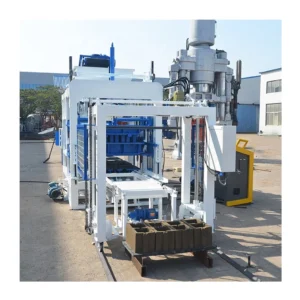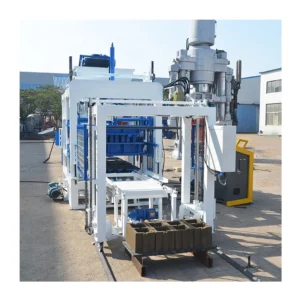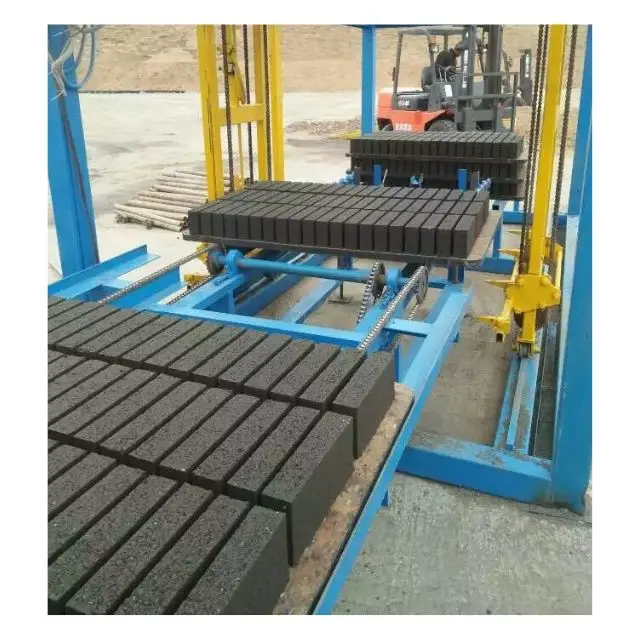
Matched System Line Design — every station from raw material feeding to stacking is configured around the QT10-15 press cycle so no single point bottlenecks the output.
Technical Specifications
| Parameter | Value |
|---|---|
| Model | QT10-15 |
| Product Type | Fully Automatic Concrete Block Making Machine |
| Overall Dimensions (L×W×H) | 9350×2320×2950 mm |
| Rated Hydraulic Pressure | 21 MPa |
| Main Vibration Form | Platform vibration |
| Vibration Frequency | 4500–5100 r/min |
| Pallet Size | 1100×900 mm |
| Moulding Area | 1025×810 mm |
| Forming Height Range | 40–250 mm |
| Molding Cycle | 15–25 s |
| Overall Power | 44 kW |
| Mixer Model | JS750 |
| General Water Consumption | 12 T/day |
| Voltage | Configured to local request |
| Control System | PLC (Mitsubishi) |
| Hydraulic Unit | Taiwan Jiugang |
| Switches | Omron |
| Electrical Elements | Schneider |
| Host Machine & Mixer Motor | Siemens |
| Other Motors | European CE standard |
| Mould Treatment | High temperature carburizing heat treatment |
| Output (400×200×200 mm hollow block, 10 pcs/mould) | 1800–2400 pcs/h, 14400–19200 pcs/8h |
| Output (400×150×200 mm hollow block, 12 pcs/mould) | 2160–2880 pcs/h, 17280–23040 pcs/8h |
| Output (240×115×90 mm solid brick, 52 pcs/mould) | 9360–12480 pcs/h, 74880–99840 pcs/8h |
Application Suitability
| Application | Material or Output |
|---|---|
| Hollow block production | Crushed stone, sand, cement, fly ash aggregates |
| Solid brick manufacturing | River sand, stone dust, cement blends |
| Paving block and interlock brick | High-density concrete mixes with fine aggregate |
| Curbstone and kerbstone forming | Coarse aggregate concrete with extended vibration |
| Fly ash brick production | Fly ash, lime, gypsum and sand combinations |
Why Mixer Discharge Timing Decides Your Real Output
A press rated at 15–25 seconds per cycle is only as fast as the mixer feeding it.
When a concrete block production line is quoted with the press as the headline number, the supporting stations often receive less attention. I once visited a plant in West Africa where the host machine was cycling on schedule, but the JS500 mixer upstream could not discharge fast enough, leaving the press idle for several seconds every other cycle. The daily tally ended up well below what the brochure promised. Sizing the JS750 mixer to match the QT10-15 press cycle is the reason this line configuration exists as a complete set rather than a standalone machine order [NEED_CITE: mixer-to-press cycle matching in block plant layout].
How the Stations Connect Across the Block Line
A turnkey block making plant must move material through raw material feeding, mixing, pressing, pallet circulation and stacking without any station waiting on the next. The QT10-15 sits at the centre of this sequence, and every upstream and downstream component is selected so its cycle time falls inside the 15–25 second window the press demands. If the pallet feeder delivers late, the press holds. If the stacker cannot clear cured pallets quickly enough, the wet-side output piles up at the press exit.
Balancing Pallet Circulation With Press Speed
Pallet size is fixed at 1100×900 mm, which means the entire pallet return loop — from the wet stacker through the curing racks back to the press infeed — must handle that dimension at the rate the press produces. A line that runs 400×200×200 mm hollow blocks at ten pieces per mould will push a pallet through every cycle. If the curing rack system or the forklift on site cannot move pallets at that pace, the concrete block production line slows to the speed of the weakest link, not the press [NEED_CITE: pallet circulation rate and curing area capacity planning].
Reading the Numbers Behind the Press
The 21 MPa rated hydraulic pressure and the 4500–5100 r/min platform vibration work together: hydraulic pressure compacts the mix from above while vibration settles the aggregate from below. If the buyer’s local sand is fine and low in angularity, higher vibration frequency helps lock particles into position; if the aggregate is coarse crushed stone, the 21 MPa pressure does more of the densification work. The moulding area of 1025×810 mm sets the maximum mould footprint, and the 40–250 mm forming height range determines whether the line can switch from a 90 mm solid brick to a 200 mm hollow block without mechanical modification. Power draw sits at 44 kW across the host machine, meaning the site transformer and cable run must be confirmed before installation day.
What Happens When Pallet Handling Is Left Out of the Quote
I saw a block plant owner in East Africa receive a press quotation that listed only the host machine and mixer. When the line arrived, wet blocks exited the press and sat on pallets at the outfeed conveyor because no stacker or curing rack handler was included. Workers moved pallets by hand to a makeshift curing yard, and the press operator had to pause every few cycles. The rated output on paper never materialised. A turnkey block making plant quotation must show every station from material infeed to cured product stacking, or the buyer is paying for capacity that will not reach the yard [NEED_CITE: incomplete line quotations and their effect on realised output].
Why Buyers Specify the Line With Us
Block machinery is our single product focus, so the QT10-15 press, its moulds, pallets and handling equipment are specified as one matched system rather than assembled from separate suppliers. Configuration is set against the buyer’s actual mix design and local aggregate, not a catalogue default. We design moulds for the block formats the buyer’s market actually sells, including custom drawings when standard sizes do not match. The automation level is selectable, allowing a buyer to start with semi-automatic pallet handling and add automatic stacking later. Installation includes operator training so the crew understands cycle timing across every station.
Documentation & Verification
- Line layout drawing showing station spacing and pallet flow path for the QT10-15
- Capacity calculation table stating the block format assumed for each output figure
- Pallet specification sheet matched to your curing rack and forklift dimensions
- Voltage, frequency and PLC display language confirmation before production starts
- Hydraulic and electrical schematic with Siemens motor and Schneider component references
- Factory test record on your selected mould format before container loading
Installation, Commissioning & Support
- Foundation plan sized to the 9350×2320 mm footprint with vibration isolation pads
- Dedicated 44 kW circuit with voltage and frequency confirmed to local grid standards
- Press and JS750 mixer shipped in dismantled state with reassembly supervised on site
- First-run cycle timing adjusted across mixer discharge, pallet feed and stacking stations
- Operator training covering PLC menu navigation, mould change and safety interlocks
- Wear parts list with mould carburizing treatment intervals and hydraulic seal replacement schedule
What We Need to Size Your Line
To build a station-by-station proposal around the QT10-15, share the block formats your market sells, the daily output target per format and the raw materials available locally. We also need your site voltage and frequency, the curing area dimensions and the forklift capacity already on the floor. If you are replacing a press inside an existing line, tell us which upstream and downstream equipment stays so we can match the cycle times.
Frequently Asked Questions
Q: How is daily output calculated per block format and what changes when the format switches mid-shift?
A: Each output figure is tied to a specific mould and block dimension. The 1800–2400 pieces per hour rating applies to 400×200×200 mm hollow blocks at ten pieces per mould. When the operator changes to a different format, cycle time and pieces per mould shift, so the daily total must be recalculated from the new combination.
Q: Which supporting stations are included in the quotation and which remain optional?
A: The line proposal covers the QT10-15 press, JS750 mixer, pallet feeder and the chosen stacking arrangement. Curing rack systems, yard forklifts and raw material silos are quoted separately unless the buyer requests a full turnkey block making plant package with every station itemised.
Q: How does the 1100×900 mm pallet size affect my curing area layout?
A: The pallet dimensions determine rack slot spacing, forklift tine width and the turning radius needed between press exit and curing yard. If your existing racks were built for a different pallet size, we adjust the pallet spec or redesign the rack layout before the line ships.
Q: What is the mould change procedure and how does it influence uptime?
A: The mould bolts onto the vibration platform within the 1025×810 mm moulding area. Change time depends on whether the line uses manual or hydraulic clamping. On a multi-format shift, we recommend scheduling format runs in batches to keep changeovers grouped and preserve cycle time consistency.
Q: How are voltage and PLC language confirmed before shipment?
A: We request your site voltage, frequency and preferred PLC display language during the proposal stage. The Mitsubishi PLC is loaded with the agreed language file, and the electrical panel is wired to match. A confirmation document is signed off before the factory test begins.