
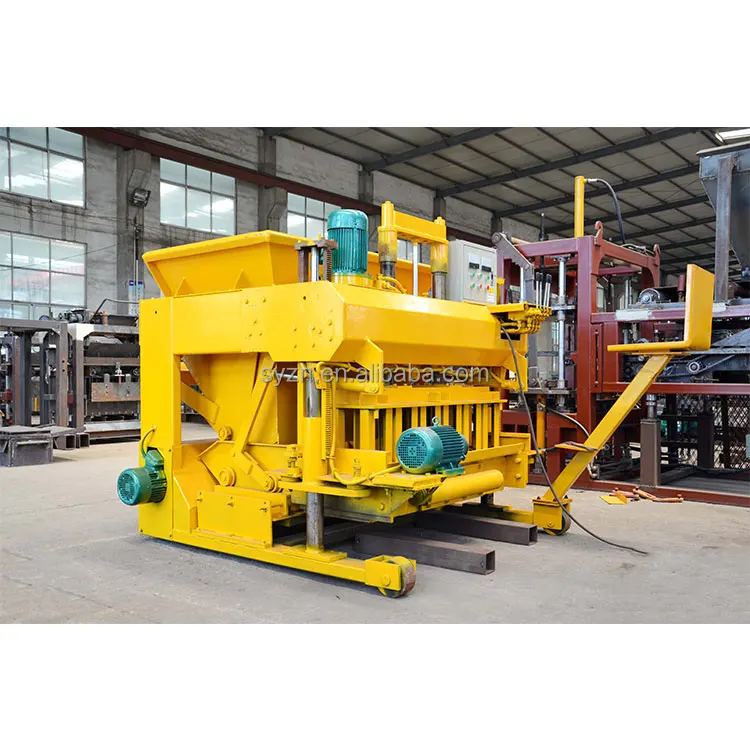
Matched System Integration — The QMY6-25 mobile block machine is specified alongside its upstream mixer and downstream curing layout so the line operates as one coordinated system rather than a collection of disconnected stations.
Technical Specifications
| Parameter | Value |
|---|---|
| Model | QMY6-25 |
| Product Type | Mobile Hollow Block Making Machine |
| Main Vibration Form | Three-dimensional excitation |
| Vibration Frequency | 3200 Hz |
| Overall Power | 9.6 kW |
| Moving Method | Automatically move and hydraulic steering |
| Overall Dimensions | 2000 × 2100 × 1650 mm |
| Moulding Cycle | 25–30 s |
| Output Capacity | 1080 pcs/h (based on 400×200×200mm hollow blocks, 6 pcs/mould) |
| Output Capacity | 1260 pcs/h (based on 400×150×200mm hollow blocks, 7 pcs/mould) |
| Output Capacity | 1620 pcs/h (based on 400×120×200mm solid blocks, 9 pcs/mould) |
| Output Capacity | 1800 pcs/h (based on 400×100×200mm solid blocks, 12 pcs/mould) |
| Pallet Requirement | No pallet required (egg-laying / mobile type) |
| Automation Level | Semi-automatic, single-operator capable |
| Control System | Not stated in source — confirm PLC / relay logic |
| Voltage & Frequency | Not stated in source — confirm before commissioning |
| Hydraulic Pressure | Not stated in source — confirm MPa rating |
| Vibration Force | Not stated in source — confirm kN rating |
| Mould Change Time | Not stated in source — confirm minutes per change |
| Mould Formats Supported | Hollow blocks, solid blocks (custom sizes available) |
| Warranty | 1 year on whole machine (excluding spare parts) |
Application Suitability
| Application | Material or Output |
|---|---|
| On-site hollow block production for housing projects | Concrete with crushed stone and sand aggregate, cement binder |
| Solid block manufacturing for load-bearing walls | Dense concrete mix with local gravel and cement |
| Remote construction site block supply | Soil-cement and concrete blends using locally sourced aggregates |
| Small-scale entrepreneurial block plants | Standard concrete mixes without pallet handling infrastructure |
| Supplementary capacity for existing fixed lines | Hollow and solid formats produced directly on the curing yard |
Why the Curing Yard Layout Decides Your Real Daily Output
A mobile block machine production line supporting equipment plan that ignores the curing surface will bottleneck the press within the first hour.
The QMY6-25 lays blocks directly on the ground as it travels. If the curing yard is uneven, too small, or poorly drained, the machine stops more often than it runs. I have seen contractors prepare a dirt lot without compacting it, only to watch the hydraulic steering drag and the vibration table tilt mid-cycle. The blocks come out warped, the operator spends half the shift repositioning, and the rated output becomes meaningless. The mobile block machine production line supporting equipment around this press must start with the ground it rolls on [NEED_CITE: ground preparation standards for mobile block curing yards].
Upstream Feed Rate Must Match the 25–30 Second Moulding Cycle
The QMY6-25 completes a moulding cycle every 25 to 30 seconds. That means the mixer must deliver a fresh batch to the hopper within that same window, or the press sits idle waiting for material. A mixer that is too small forces the operator to pause production repeatedly. A mixer that is too large dumps material faster than the hopper can accept it, causing spillage and inconsistent fill. The mobile block machine production line supporting equipment upstream of this press must be calculated against the batch volume per cycle and the number of blocks per mould to maintain continuous operation.
Curing Area Dimensions and Surface Preparation
Because the QMY6-25 requires no pallets, every block it produces occupies floor space on the curing yard for the entire curing period. A full shift of egg-laying output demands a prepared surface large enough to hold thousands of blocks in neat rows with walking aisles between them. The surface must be compacted, level, and ideally sealed with a thin concrete screed so the blocks do not settle unevenly. Drainage channels prevent water pooling after rain, which softens the base and destabilizes freshly laid blocks. Planning this curing footprint before the machine arrives is a core part of mobile block machine production line supporting equipment coordination [NEED_CITE: concrete block curing area planning guidelines].
What the Vibration and Power Specs Mean for Block Density
The three-dimensional excitation at 3200 Hz drives compaction from multiple axes, which matters when switching between hollow and solid block formats. Hollow blocks need enough vibration to consolidate the thin walls without collapsing the cores, while solid blocks require sustained force throughout the deeper cavity. The 9.6 kW total power draw sets the electrical supply requirement for the entire mobile block machine production line supporting equipment setup, including the mixer and any conveyor feeding the hopper. A generator undersized for this combined load will cause voltage dips during vibration peaks, producing blocks with inconsistent density from one cycle to the next.
The Hidden Cost of Skipping the Line Layout
When a buyer purchases the QMY6-25 without specifying the mixer capacity, feed conveyor length, or curing yard dimensions, the machine arrives and the problems begin. The operator hand-feeds material from a bag mixer that cannot keep up, the blocks are laid on soft ground that shifts under their weight, and the daily output falls to a fraction of what the specification sheet promised. I once worked with a contractor who bought this class of mobile press and paired it with an undersized pan mixer. The press waited for material more than it ran, and the crew blamed the machine. A complete mobile block machine production line supporting equipment proposal prevents this by sizing every station to the press cycle [NEED_CITE: block production line bottleneck analysis].
Why Procure the Full Line from One Source
Block machinery is our single focus, so the QMY6-25, its moulds, and the upstream mixing station are specified as one matched system rather than assembled from separate suppliers. Configuration is set against your actual mix design and local aggregate, not a catalogue default. Mould design covers the hollow and solid formats your market sells, with custom drawings available. The automation level is selectable, letting you start with semi-automatic operation and add feeder automation later. Installation support includes operator training on the specific cycle timing and steering controls of this machine. Documentation covers the line layout with capacity calculations stated per block format.
Documentation & Verification
- Line layout drawing showing mixer placement, feed path, and curing yard dimensions for the QMY6-25
- Capacity calculation sheet stating output per block format with the moulding cycle assumption
- Machine specification sheet confirming vibration frequency, power rating, and overall dimensions
- Mould drawing and format list for each hollow and solid block size ordered
- Voltage and control language confirmation document signed before production begins
- Factory test record showing the QMY6-25 running through complete moulding cycles before dispatch
Installation, Commissioning & Support
- Curing yard must be compacted and level to support the 2000 × 2100 mm machine footprint and hydraulic steering travel
- Dedicated electrical circuit sized for the 9.6 kW total power draw plus upstream mixer load
- Machine arrives assembled; verify hydraulic steering fluid and vibration motor connections on site
- First-day commissioning includes cycle timing adjustment to match your specific mix and mould format
- Operator training covers mould change procedure, hydraulic steering controls, and hopper feed pacing
- Wear parts list provided with recommended replacement intervals for vibration components and hydraulic seals
What We Need to Size Your Line
Send us the block formats you intend to produce, including exact dimensions and whether hollow or solid. Tell us the daily output target and the number of shifts you plan to run. Share your local aggregate type and any existing mixer or feeding equipment already on site. Confirm your site voltage and frequency, along with the preferred control display language.
Frequently Asked Questions
Q: How do I match the mixer batch output to the QMY6-25 cycle so the press does not wait for material?
A: Calculate the batch volume needed per moulding cycle based on the block format and number of cavities. The mixer must deliver that volume within the 25–30 second cycle window. We size the mixer drum capacity and discharge rate to match, and include a feed conveyor or hopper extension if the distance between stations requires it.
Q: What curing yard dimensions and surface preparation are needed for a full shift of egg-laying output?
A: The yard must hold every block produced in one shift until initial set is achieved. We calculate the required area based on your target block format and daily output, then specify compaction, leveling, and drainage requirements. A sealed concrete screed is recommended for consistent block base contact.
Q: Which raw material feeding stations connect upstream to a mobile machine with no pallet return loop?
A: The QMY6-25 receives material from a mixer via a conveyor or direct hopper feed. Since there is no pallet circuit, the feeding station must be positioned along the machine travel path or use a mobile hopper that follows the press. We specify the feed arrangement based on your site layout.
Q: How do I plan stacking and cubing when blocks cure in-place on the ground?
A: Blocks remain on the curing yard until they reach sufficient strength for handling. After curing, a forklift or manual crew collects and stacks them. We provide a curing schedule and collection workflow that accounts for your yard size and available handling equipment.
Q: What voltage and frequency confirmation is required before the QMY6-25 ships?
A: We need your site voltage, phase configuration, and frequency to match the motor and control wiring. The control display language must also be confirmed so the operator can read cycle parameters on arrival. These details are documented and signed off before production begins.


