
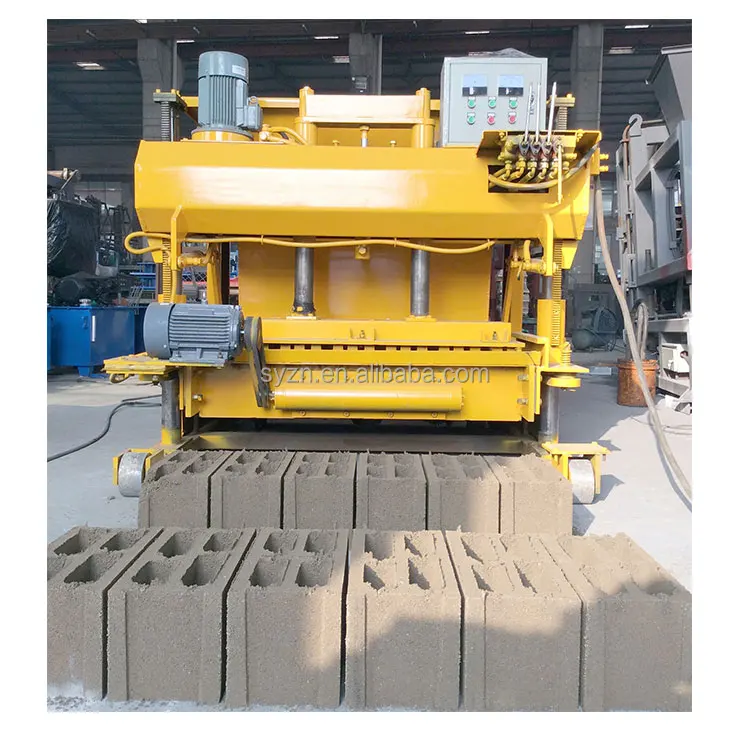
Integrated Press Line — the QMY6-25 mobile block machine is specified as part of a matched system with mixer output and curing area, not quoted as a standalone press.
Technical Specifications
| Parameter | Value |
|---|---|
| Model | QMY6-25 |
| Product Type | Mobile Concrete Block Making Machine |
| Main Vibration Form | Three-dimensional excitation |
| Overall Power | 9.6 kW |
| Moving Method | Automatic movement with hydraulic steering |
| Overall Dimensions | 2000 × 2100 × 1650 mm |
| Moulding Cycle | 25–30 s |
| Vibration Frequency | 3200 Hz |
| Output (Hollow 400×200×200mm) | 1080 pcs/h, 8600 pcs/shift (basis: stated block format) |
| Output (Hollow 400×150×200mm) | 1260 pcs/h, 10000 pcs/shift (basis: stated block format) |
| Output (Solid 400×120×200mm) | 1620 pcs/h, 12960 pcs/shift (basis: stated block format) |
| Output (Solid 400×100×200mm) | 1800 pcs/h, 14400 pcs/shift (basis: stated block format) |
| Pallet Requirement | No pallet required |
| Operation | Single operator capable |
Application Suitability
| Application | Material or Output |
|---|---|
| On-site hollow block production | Crushed stone, sand, cement, water |
| Solid block production at housing projects | Local aggregate blended with cement |
| Mobile production for remote construction sites | Mix designs compatible with regional raw materials |
| Contractor-run block yards without fixed plant | Standard concrete mixes, no pallet dependency |
Why the Mixer Often Becomes the Real Bottleneck in a Mobile Block Machine Production Line
A mobile press only runs as fast as the mixer feeds it.
Contractors who focus on the press cycle time often overlook the upstream station. When the mixer batch size does not match the QMY6-25 cycle of 25–30 seconds, the press stands idle waiting for the next load. The result is that actual daily output falls well below the numbers quoted per hour. I have walked onto sites where a mobile block machine production line was stopped three times an hour simply because the pan mixer could not discharge fast enough. [NEED_CITE: mixer batch sizing relative to press cycle in mobile block operations]
Matching the Feeding Station to Continuous Press Movement
The QMY6-25 moves forward automatically after each moulding cycle, laying blocks directly on the ground. Because the press does not return to a fixed position, the raw material feed must either travel with it or be staged at intervals along the production path. A mobile block machine production line planned without this coordination forces the operator to stop and walk back to the mixer, breaking the rhythm of the 25–30 second cycle.
Curing Area Logistics Without Pallets
Since the QMY6-25 requires no pallets, freshly formed blocks sit on the ground until they gain enough strength to be moved. This removes the cost and handling of pallet return systems but shifts the planning burden to the curing zone. The site must provide a flat, level surface long enough to accommodate a full shift of output before blocks can be relocated. Contractors who underestimate this footprint end up stacking wet blocks too early, damaging edges and compromising strength. [NEED_CITE: ground curing requirements for pallet-free mobile block production]
What Three-Dimensional Excitation and 9.6 kW Mean on the Ground
The three-dimensional vibration at 3200 Hz compacts the concrete mix from multiple directions, which is critical when producing hollow blocks with thin walls. At 9.6 kW total power, the QMY6-25 draws a manageable load that most temporary site generators can supply — but only if the generator is sized for the starting surge, not just the running wattage. The hydraulic steering system adds a further draw during movement, so the power supply must account for both vibration and travel loads occurring within the same window. Block density and wall integrity depend directly on whether vibration force and hydraulic pressure are matched to the specific mix design and local aggregate being used, not a catalogue default.
When Supporting Equipment Is Left Out of the Quote
A mobile press quoted without its feeding, mixing, and curing handling leaves the buyer to solve integration alone. Pallet handling, stacking, and curing are often excluded from mobile machine quotations, which means output sits on the ground until someone moves it by hand. I have seen contractors allocate two extra labourers just to relocate blocks from the production path to the curing area, erasing the single-operator advantage the QMY6-25 was supposed to provide. [NEED_CITE: labour allocation for manual block handling in pallet-free mobile operations]
Why Buyers Source the Full Line Here
Block machinery is our single focus, so the QMY6-25 is specified alongside its mixer, material feed, and curing logistics as one matched system. We set the configuration against the buyer’s actual mix design and local aggregate rather than a catalogue default. Automation level is selectable, allowing a contractor to begin with manual material feeding and add a travelling hopper later. Mould design covers the formats the buyer’s market actually sells, including custom drawings. Installation support includes operator training on the complete line, not just the press.
Documentation & Verification
- Line layout drawing showing mixer position relative to QMY6-25 travel path
- Capacity calculation sheet stating assumed block format and shift length
- Hydraulic and electrical schematic for site generator sizing
- Factory test record on buyer’s specified block dimensions before dispatch
- Operation and maintenance manual with wear parts list
Installation, Commissioning & Support
- Site must provide level ground at least 2000 × 2100 mm clear for machine passage
- Power supply rated for 9.6 kW running load plus hydraulic steering surge
- Machine ships as a single unit requiring no major on-site assembly
- Commissioning includes cycle timing verification against actual site mix
- Operator training covers mould change procedure and daily inspection points
- Wear parts list supplied with first recommended replacement intervals
What to Prepare Before Requesting a Quote
To size a mobile block machine production line correctly, share the block formats your market requires, the target daily output, and the raw materials available locally including aggregate type and grading. Confirm whether a site generator will supply power or a grid connection is available, and describe the space you can allocate for ground curing. If you already own a mixer, provide its batch capacity and discharge time so we can verify it matches the press cycle.
Frequently Asked Questions
Q: How do I match the mixer output with the QMY6-25 cycle time?
A: The QMY6-25 completes a moulding cycle every 25–30 seconds, so the mixer must discharge a full batch within that window. We calculate the required batch volume based on the block format you are producing and recommend a mixer with a discharge rate that keeps the press running continuously without waiting.
Q: What site conditions does the curing area need for pallet-free production?
A: The QMY6-25 places blocks directly on the ground, so the curing area must be flat, level, and firm enough to support wet blocks without settling. You need sufficient length to hold a full shift of output before blocks are moved. We include curing area dimensions in the line layout based on your chosen format and daily target.
Q: How is raw material feeding synchronized with the mobile press?
A: Because the QMY6-25 moves forward along the production path, the feeding station must either travel with it or be staged at set intervals. We specify the feeding method — travelling hopper or fixed station with conveyor — based on your site length and daily output requirement so the press is never left waiting.
Q: What is the total footprint including material storage and stacking?
A: The QMY6-25 itself is 2000 × 2100 mm, but the full footprint depends on your production path length, aggregate stockpile area, and curing zone. We provide a scaled line layout that accounts for material storage, mixing station, press travel distance, and block curing space based on your target output and block format.


