
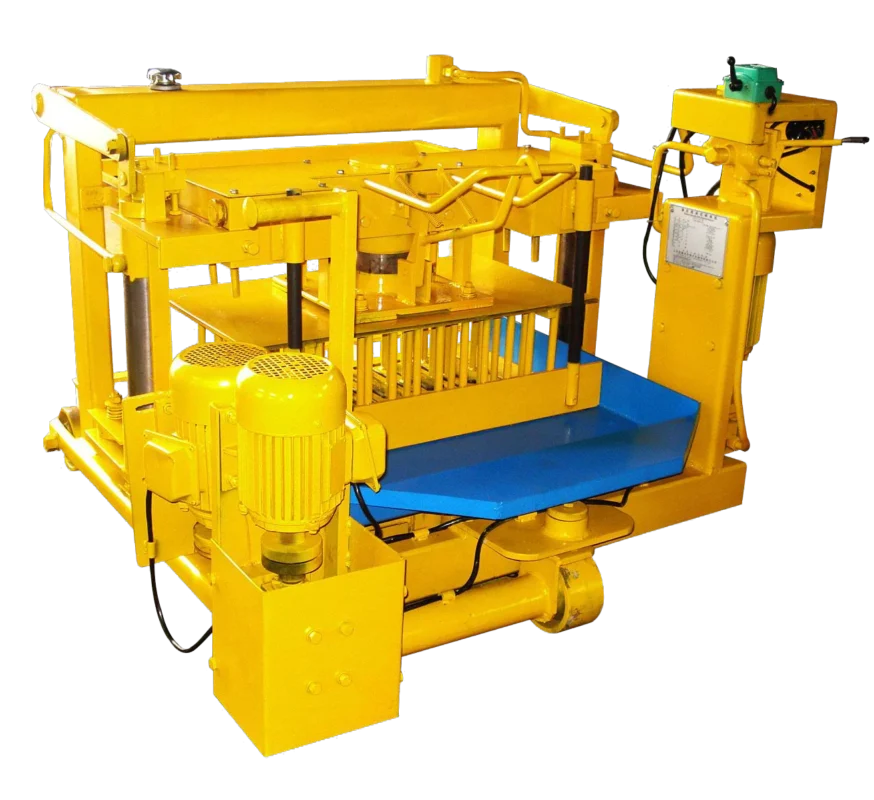
Matched System Specification — We configure the QMY4-30 mobile egg-laying block machine alongside its raw material feed, mixing station, and ground-curing layout so the press never waits for material and blocks cure in place without manual handling.
Technical Specifications
| Parameter | Value |
|---|---|
| Model | QMY4-30 |
| Product Type | Mobile Egg-Laying Concrete Block Making Machine |
| Rated Power | 5 kW |
| Voltage & Frequency | Configurable to buyer’s site supply (basis to be confirmed) |
| Control System | Manual operation |
| Overall Dimensions (L×W×H) | 1200 × 1200 × 1100 mm |
| Net Weight | 950 kg |
| Cycle Time | 30 seconds |
| Output Capacity | 480 pcs/h based on 400×200×200 mm hollow block, 4 pcs/mould |
| Output Capacity | 600 pcs/h based on 400×150×200 mm hollow block, 5 pcs/mould |
| Output Capacity | 840 pcs/h based on 400×100×200 mm hollow block, 7 pcs/mould |
| Mould Format | 400×200×200 mm / 400×150×200 mm / 400×100×200 mm hollow block; solid brick mould available |
| Mould Change System | Changeable moulds (change time basis not stated in source) |
| Pallet Requirement | Not applicable — egg-laying type lays blocks directly on ground |
| Automation Level | Manual / semi-manual mobile egg-laying |
| Raw Materials | Cement, sand, crushed stones, slag |
| Assembly State | Skid-mounted mobile unit |
| Warranty | Five year guarantee (source value — verify against manufacturer catalog) |
Application Suitability
| Application | Material or Output |
|---|---|
| On-site hollow block production for housing projects | Cement, sand, and crushed stone mixed locally, blocks cured on prepared ground |
| Small block yard startups with limited capital | Hollow and solid brick formats from a single skid-mounted press |
| Contractor-produced blocks at infrastructure job sites | Slag and sand blends, machine relocated as project phases shift |
| Supplementary capacity for existing concrete product manufacturers | Additional format runs without occupying fixed-plant floor space |
Why the Curing Area Determines Real Daily Output
The press lays blocks on the ground, so your curing footprint is your production ceiling.
I watched a contractor in Southeast Asia buy a mobile block machine and park it on a 50-square-meter patch of uneven dirt. By midday the freshly laid blocks were cracking because the ground absorbed moisture unevenly, and the crew had to stop production to clear space for the next cycle. The hourly capacity figures mean nothing if the curing area cannot absorb a full shift of output. When we plan a mobile block machine production line, we map the ground area, surface preparation, and material feed route together before the machine ships [NEED_CITE: ground curing standards for concrete masonry units].
Raw Material Feed and Mixing Coordination
The QMY4-30 completes a mould cycle in 30 seconds, which means the mixer and feed system must deliver a fresh batch within that same window. On a job site where a single operator is shovelling material into a drum mixer, the press will sit idle between batches. We specify the mixer capacity and feed conveyor length so the mobile block machine production line maintains continuous rhythm rather than stopping every few cycles. This is where egg laying block machine supporting equipment becomes the real bottleneck, not the press itself.
Planning the Ground Curing Layout
Since the machine deposits blocks directly onto the ground and moves forward with each cycle, the curing zone must be a flat, prepared surface long enough to hold an entire shift of output. We calculate the linear distance the press will travel based on the target format and daily volume, then confirm the buyer has that length of cleared, levelled area available. If the site slopes or has soft patches, blocks will settle unevenly and crack before they cure [NEED_CITE: concrete block curing conditions and compressive strength development].
Reading the Specification Sheet Honestly
The rated power of 5 kW reflects a compact drive system suited to job-site generator supply rather than full industrial mains. The overall dimensions of 1200 × 1200 × 1100 mm mean the unit fits through standard site access and can be lifted by a small forklift or telehandler. The net weight of 950 kg keeps the machine stable during vibration without requiring a bolted foundation, which is exactly what a mobile egg-laying press demands when it relocates between project phases. The cycle time of 30 seconds applies across all listed hollow block formats, but the piece count per cycle changes with mould selection, which is why capacity must always be stated per format.
When Supporting Equipment Is Left Out of the Plan
The quotation arrives with the press price and nothing else, so the buyer sources a random mixer and a wheelbarrow for material transport. Within a week the crew is spending more time moving raw material than running the machine, and the daily output falls to a fraction of what the hourly figure suggested. Ground surface preparation gets skipped, blocks crack, and the buyer blames the press. Every mobile block machine production line needs a defined material route and a flat curing zone, and those have to be planned before the machine leaves the factory [NEED_CITE: mobile block production site preparation checklist].
Why Source the Line from One Supplier
The QMY4-30 arrives configured against the buyer’s actual mix design and local aggregate, not a default setting from a catalogue. Raw material feed, mixing capacity, and curing area are specified as one matched system, so the press does not sit idle waiting for material or space. Mould drawings and format lists are provided before production, letting the buyer verify that block dimensions match what the local market actually sells. Installation support covers ground preparation and feed layout, not just bolting the press in place. Every voltage and control parameter is confirmed against the buyer’s site supply before shipment, avoiding the delays that happen when a machine arrives and the generator cannot run it.
Documentation & Verification
- Line layout and capacity calculation stating the block format assumed for each hourly figure
- Mould drawing and format list confirming block dimensions match local market demand
- Voltage and frequency confirmation sheet signed before production begins
- Factory test record with photographs showing the QMY4-30 running the buyer’s specified mould
- Raw material compatibility statement based on the buyer’s local aggregate sample
- Packing photographs documenting skid-mounted assembly and protective crating
Installation, Commissioning & Support
- Ground must be level and compacted to support 950 kg machine weight plus freshly laid blocks without settling
- Site power supply must match confirmed voltage and frequency; a dedicated 5 kW circuit or equivalent generator is required
- Machine arrives skid-mounted and can be offloaded by a small forklift at the job site without a crane
- First-cycle commissioning includes adjusting vibration intensity to match the buyer’s local mix design and aggregate
- Operator training covers mould change procedure, feed timing, and daily maintenance of moving parts
- Wear parts list and mould inventory provided for the buyer’s first replacement order
Preparing Your Inquiry
Send us the block formats your market sells, the daily volume you need to hit, and the raw materials available within hauling distance of your site. Include your site supply voltage and frequency so we can configure the QMY4-30 before production starts. If you already have a mixer or conveyor on site, share the make and capacity so we can tell you whether it will keep up with the press cycle.
Frequently Asked Questions
Q: How is hourly capacity verified, and which block format does each figure assume?
A: Each capacity figure on our specification sheet names the exact block dimensions and piece count per mould. The 480 pieces per hour figure, for example, applies only to the 400×200×200 mm hollow block at four pieces per cycle. We provide a written capacity calculation showing the format assumed so your daily planning matches reality.
Q: What raw material feed and mixing setup is needed to keep the press running without waiting?
A: The 30-second cycle means your mixer must deliver a fresh batch within that window. We specify the mixer drum size, feed conveyor length, and material staging area based on your target output, so the QMY4-30 never sits idle between batches.
Q: How should the curing area be planned when blocks are laid directly on the ground?
A: We calculate the linear travel distance of the press over a full shift based on your chosen block format and daily target. The ground surface must be flat, compacted, and long enough to hold that entire output without relocation.
Q: Can this mobile unit be integrated into a larger line with automatic batching and stacking later?
A: Yes. The QMY4-30 is designed as an entry point. As volume grows, you can add a batching station, enclosed mixer, and pallet-based handling equipment to transition from ground-cured mobile production to a fixed semi-automatic or automatic line.
Q: What voltage and frequency must be confirmed before the machine ships to your site?
A: We require your site supply voltage, frequency, and phase before production begins. Job sites often run on generators with different output than grid power, and confirming this upfront prevents commissioning delays when the QMY4-30 arrives.


