
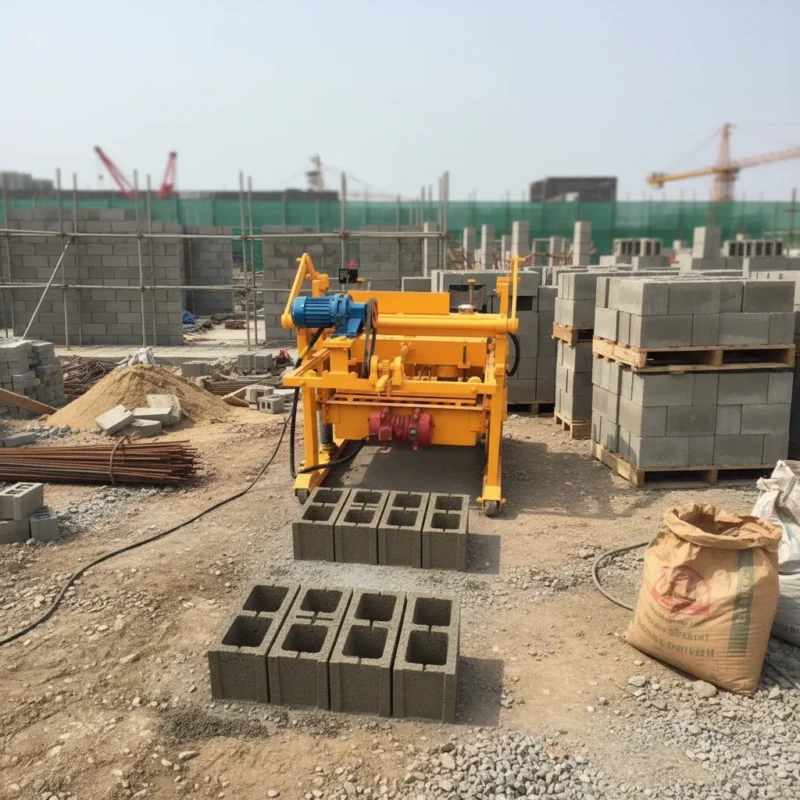
Single-focus block line engineering — the QMY4-30 is specified as a press station within a complete mobile production workflow, so supporting stations are matched to its cycle time before quotation.
Technical Specifications
| Parameter | Value |
|---|---|
| Product Type | Mobile Concrete Block Making Machine |
| Model | QMY4-30 |
| Overall Dimensions (L×W×H) | 1300 × 1500 × 1000 mm |
| Net Weight | 950 – 1000 kg |
| Vibration Method | Mold Vibration |
| Vibration Force | 28.6 kN |
| Excitation Frequency | 4500 r/min |
| Total Power | 5.95 kW |
| Output Capacity | 3000 pcs/day (basis not stated in source — confirm block format / material / thickness) |
| Raw Material Compatibility | Concrete, fly ash, cinder, coal gangue, river sand, gravel, cement, industrial waste residue |
| Voltage & Frequency | 380V ±10% (verify against site supply before order) |
| Automation Level | Manual |
| Mobility | Mobile / Egg-laying |
| Brand | YOUJU |
Application Suitability
| Application | Material or Output |
|---|---|
| On-site hollow block production | Crushed stone, river sand, and cement blends without fixed plant infrastructure |
| Solid brick manufacturing for housing projects | Fly ash, cinder, and coal gangue mixed with local aggregates |
| Paving block and kerbstone runs for municipal works | Gravel and cement with pigment additives where site casting is required |
| Small-scale entrepreneurial block plants | Locally sourced sand and industrial waste residue with manual batching workflow |
Why the Press Is Never the Only Station That Matters
A mobile block machine production line is only as fast as its slowest supporting station.
I once watched a QMY4-30 run flawlessly on its own, but the manual mixer could not discharge fast enough to keep the operator fed. The result was an idle press and a crew standing around waiting for the next batch. The rated cycle of the press meant nothing because the material flow upstream had not been matched to it [NEED_CITE: line balancing principles for manual block production]. That is why the mobile block machine production line must be quoted as a system, not a single machine.
Sizing the Mixing and Feeding Workflow Around the Press
The QMY4-30 draws 5.95 kW in total, which means a portable generator or site power supply must be sized to handle that load alongside a mixer and any water pump in the mobile block machine production line. A pan mixer with a discharge cycle that exceeds the press molding cycle will leave the operator waiting, so the mixer batch size and discharge rate should be calculated against the press cycle time and block format before equipment is ordered.
Curing Area and Pallet Return Logistics for Egg-Laying Operation
Since the QMY4-30 is an egg-laying machine, it deposits blocks directly on the ground or a prepared surface. The curing area must be flat, swept, and large enough to hold a full day’s output before blocks are moved. Pallets are not used in egg-laying mode, but the space required for wet blocks to cure before handling is a constraint that buyers frequently underestimate [NEED_CITE: curing time requirements for cement-based concrete blocks]. Planning this footprint is part of the line layout, not an afterthought.
How Vibration Force and Frequency Shape Block Density
The mold vibration system delivers 28.6 kN of force at 4500 r/min excitation frequency. In a mobile block machine production line, this vibration specification must be matched to the aggregate gradation and cement content the buyer can source locally. Coarser aggregate may require higher force to consolidate, while fine sand blends respond well to the standard setting. The vibration force and frequency together determine how tightly the mix compacts inside the mold cavity, which directly affects block strength and surface finish.
The Hidden Cost of Skipping Line-Level Configuration
When the mixer output, curing area, and material staging are not planned alongside the press, the daily count drops well below what the press specification suggests. Operators spend shifts waiting for material or moving cured blocks out of the way instead of producing. The labor cost of an unbalanced line compounds every day the plant runs [NEED_CITE: productivity losses from unbalanced manual production lines]. This is why I always map each station’s cycle before confirming the machine model.
Why Buyers Configure the Line Here
Block machinery is our single focus, so the QMY4-30 is never quoted as a standalone press — the mixer capacity, material feed method, and curing area are discussed in the same conversation. We configure the mobile block machine production line against the buyer’s actual mix design and local aggregate, not a default catalog entry. Molds are supplied for the formats the buyer’s market actually sells, including custom drawings. Installation support covers the entire workflow so operators understand how each station connects to the press cycle.
Documentation & Verification
- Line layout showing mixer, material staging, and curing area dimensions matched to the QMY4-30 footprint
- Machine specification sheet confirming 380V ±10% supply requirement and 5.95 kW total power draw
- Mold drawing and format list detailing cavity dimensions for each block type ordered
- Factory test record documenting vibration performance at 28.6 kN before dispatch
- Operation manual covering mold change procedure and daily maintenance checkpoints
Installation, Commissioning & Support
- Site surface must be level and compacted to support the 950–1000 kg machine weight during egg-laying operation
- Dedicated 380V circuit required to handle the 5.95 kW load without voltage drop during vibration cycles
- Machine ships assembled; on-site setup focuses on mold installation and power connection verification
- First-day commissioning includes vibration frequency check and block density sampling across the mold cavity
- Operator training covers manual feed timing to keep the press cycle continuous without material gaps
- Wear parts list supplied at delivery for planning first mold and vibration component replacement
What to Include in Your Inquiry
To size a mobile block machine production line around the QMY4-30, share the block formats your market demands, the daily output target, and the aggregates available within your supply radius. Confirm your site voltage and frequency, and describe the curing space you can allocate. If you already own a mixer or other handling equipment, include its specifications so we can check whether it matches the press cycle.
Frequently Asked Questions
Q: How is the 3000 pcs/day capacity calculated and which block format does it assume?
A: The published figure does not state which block format, wall thickness, or mix design it assumes. Realistic daily output depends on the specific mold installed, the operator’s feed cycle, and the mixer discharge rate. We calculate capacity per format during the line layout stage so you see a number tied to your actual product.
Q: What supporting equipment is needed around the QMY4-30?
A: At minimum, a pan mixer sized to the press batch volume, a reliable water supply, and a flat curing area large enough for a full day’s output. Since this is an egg-laying machine, no pallets are required, but the ground surface must be prepared. A small loader or wheelbarrow system for material staging keeps the operator moving.
Q: How does the vibration force match my local aggregate and mix design?
A: The 28.6 kN mold vibration at 4500 r/min works across a range of aggregate sizes, but the ideal mix proportions depend on what you can source locally. Coarser gravel may need adjusted cement ratios to achieve target block strength. We review your aggregate sieve analysis before confirming the mold and vibration settings.
Q: What voltage and frequency options are available for my site power supply?
A: The standard specification is 380V ±10%, but site conditions vary by region. Before production begins, we confirm the buyer’s actual voltage and frequency so the motor and vibration system are wound correctly. If you run a generator on-site, its rated output must cover the 5.95 kW draw plus mixer load without voltage sag.
Q: How long does mold change take and what formats can the QMY4-30 produce?
A: The QMY4-30 can run hollow blocks, solid bricks, paving blocks, and curb stones with the appropriate mold. Change time depends on operator familiarity and the mold locking mechanism. We provide a mold change procedure in the operation manual and recommend practicing the swap during commissioning so the crew is confident before production starts.


