
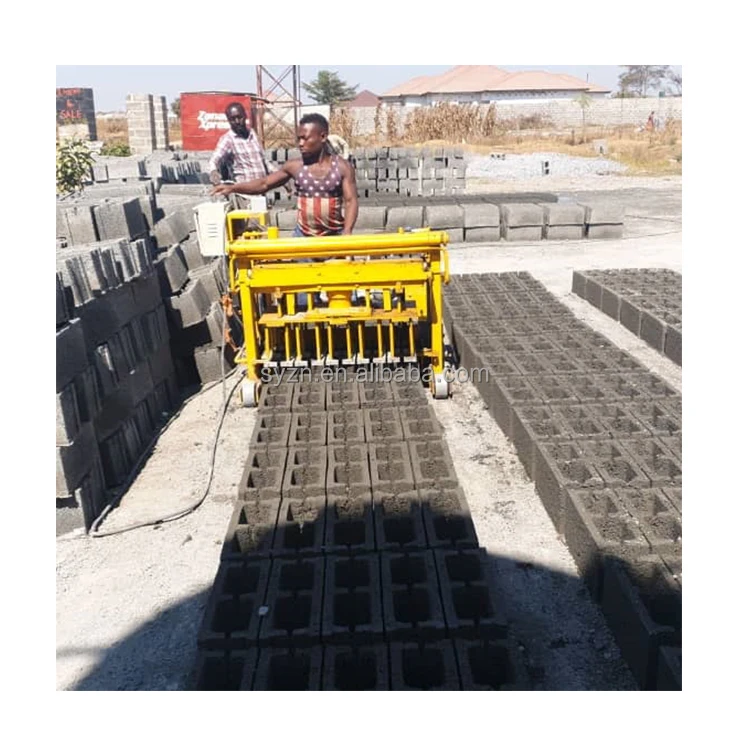
Single-focus block machinery supply — the QMY4-30 mobile block machine is specified alongside its mixer, feeder, and curing method as one matched line rather than a standalone press.
Technical Specifications
| Parameter | Value |
|---|---|
| Model | QMY4-30 |
| Product Type | Mobile Block Making Machine |
| Hydraulic Method | Mould vibration |
| Demold Method | Hydraulic |
| Molding Cycle | 30 seconds (basis not stated in source — confirm block format / material / thickness) |
| Total Power | 5.95 kW |
| Output Capacity | 480 pcs/h (based on 400×200×200mm hollow block, 4 pcs/mould) |
| Output Capacity | 600 pcs/h (based on 400×150×200mm hollow block, 5 pcs/mould) |
| Output Capacity | 840 pcs/h (based on 400×100×200mm hollow block, 7 pcs/mould) |
| Output per 8-hr Shift | 3,840 pcs (400×200×200mm) / 4,800 pcs (400×150×200mm) / 6,720 pcs (400×100×200mm) |
| Pallet Requirement | Pallet-free (mobile egg-laying type) |
| Automation Level | Manual operation with hydraulic assistance |
| Voltage & Frequency | To be confirmed before order |
| Control System | PLC or relay — to be confirmed |
| Overall Dimensions | To be verified against manufacturer catalog |
| Net Weight | To be verified against manufacturer catalog |
| Vibration Force | To be verified against manufacturer catalog |
| Hydraulic Pressure | To be verified against manufacturer catalog |
Application Suitability
| Application | Material or Output |
|---|---|
| On-site hollow block production at building projects | Cement, crushed stone, sand, water |
| Remote or difficult-terrain construction sites | Locally sourced aggregate with cement binder |
| Small-scale block production with low infrastructure | Standard concrete mix without pallet fleet |
| Contractor self-supply of masonry units | Hollow blocks in multiple wall thicknesses |
What the "Cycle Time" Number Hides About Your Actual Daily Output
A 30-second cycle only means something when you know which block format it was measured on.
Catalog sheets often quote a single cycles-per-hour figure and leave the buyer to assume it applies to every format they plan to produce. On a project site in West Africa, I watched a contractor lose nearly half a shift because the machine he received was tuned for a lightweight paver cycle, not the 200mm hollow block his masons actually needed. The mobile block machine production line must be configured around the specific block dimensions you sell, and every capacity figure must state the format it assumes. [NEED_CITE: block format and cycle time relationship in concrete block production]
How the Line Connects Around a Pallet-Free Press
The QMY4-30 lays blocks directly on the ground, which removes pallets and curing racks from the equipment list entirely. That simplification shifts the planning burden to other stations in the mobile block machine production line: raw material feeding must keep pace with the press, and the mixer must deliver a consistent batch every cycle. If the mixer is undersized or placed too far from the machine, operators spend idle time waiting for the next batch, and the quoted output never materializes.
Ground Preparation and Curing Without a Fixed Plant
Egg-laying machines require a flat, compacted surface — typically a concrete floor or well-graded hardcore — so that each block settles evenly before the machine moves forward. Curing happens in place: blocks remain on the ground and are watered or covered with sheeting for the required period. On a remote mining camp in southern Africa, I saw crews skip ground leveling to save a day of work and then lose far more time replacing cracked and uneven blocks after demolding. [NEED_CITE: ground preparation standards for mobile egg-laying block machines]
Reading the Specs That Matter Most
The 5.95 kW total power rating means the QMY4-30 can run from a portable diesel generator on sites without grid access — a practical reality for hillside housing projects or coastal developments. Mould vibration combined with hydraulic demolding produces consistent block density across all three hollow block formats (200mm, 150mm, and 100mm wall thickness), though the vibration force and hydraulic pressure must still be matched to your local aggregate and mix design. Manual operation with hydraulic assistance keeps the operator count low while ensuring the demold stroke is repeatable. Voltage and frequency must be locked in before production so the motor winding and control panel match the site’s generator or grid supply. [NEED_CITE: voltage and frequency standards by export market]
The Cost of Skipping Line-Level Planning
Ordering the press alone and sourcing the mixer, feeder, and water supply locally seems cheaper until you discover the mixer batch size does not match the mould volume, forcing operators to run two half-batches per cycle. I have seen mobile block machine setups stalled for weeks because the water pump could not keep up with the mixer demand on a dry site. When the line is not specified as a whole, the press sits idle and the daily output figure on paper stays on paper. [NEED_CITE: production line integration for mobile concrete block machines]
Why This Supply Point Fits Mobile Production
Block machinery is the single focus here, so the QMY4-30 is not treated as a standalone item — it is specified alongside the mixer, feeder, and pallet-free curing approach as one system. Configuration is set against the buyer’s actual mix design and target block format rather than a catalogue default, meaning the vibration and pressure settings match the aggregate you can actually source. Mould design covers the formats your market sells, and custom drawings are available when standard sizes do not fit. The automation level is selectable, so a buyer can begin with manual pallet-free operation and add supporting equipment later. Installation support includes operator training at the site, and wear parts are listed before the machine ships.
Documentation & Verification
- Line layout and capacity calculation stating which hollow block format is assumed
- Machine specification sheet with confirmed voltage and control language
- Mould drawing and format list for all three hollow block sizes
- Hydraulic and electrical schematic matching the delivered control system
- Factory test record run on buyer-specified mix design before dispatch
- Operation and maintenance manual with wear parts and mould replacement list
Installation, Commissioning & Support
- Ground leveling to flatness tolerance before first egg-laying run with the QMY4-30
- Power supply matching the 5.95 kW total load, including generator sizing for remote sites
- Mixer and feeder positioning within operator reach to maintain the 30-second cycle rhythm
- Voltage and frequency verified against site supply before the control panel is energized
- On-site operator training covering mould change, demold stroke, and daily greasing points
- Wear parts list provided before shipment so first replacements are on hand
Preparing Your Inquiry
To size the mobile block machine production line correctly, share the hollow block formats your market demands, the aggregate type available near your site, and the daily output you need per format. Confirm the site power supply — grid voltage and frequency or generator rating — so the motor and controls are wound correctly before production begins. If you already own a mixer or water supply system, provide its batch capacity so the line can be balanced around existing equipment.
Frequently Asked Questions
Q: How is daily output calculated and which block format does it assume?
A: Every output figure on this page states the exact block format and pieces-per-mould it is based on. For the QMY4-30, an 8-hour shift yields 3,840 pieces at 400×200×200mm, 4,800 at 400×150×200mm, or 6,720 at 400×100×200mm. Actual daily output depends on mixer batch time, operator rhythm, and site conditions.
Q: What supporting equipment does the mobile block machine need?
A: The QMY4-30 requires a pan or drum mixer sized to fill the mould each cycle, a water supply with adequate flow for both mixing and curing, and raw material stockpiles positioned near the mixer. No pallets, curing racks, or stacking equipment are needed because blocks are laid directly on the ground.
Q: How do I match power to my site generator or grid?
A: The machine draws 5.95 kW total. Confirm your site voltage and frequency before ordering so the motor winding and control panel are built to match. For generator-powered sites, size the generator to handle starting current plus the mixer and any feeder motors running simultaneously.
Q: What ground preparation is needed for pallet-free operation?
A: The surface must be flat and compacted — a concrete slab, well-graded hardcore, or firmly leveled earth. Uneven ground causes blocks to tilt or crack during demolding. The area must also allow curing in place, with space for watering or covering blocks after they are laid.
Q: How are blocks cured without pallets and curing racks?
A: Blocks remain on the ground where they were laid. Crews water the blocks regularly or cover them with plastic sheeting to retain moisture during the curing period. This eliminates the cost of pallet fleets and rack infrastructure while requiring adequate flat ground area for the curing duration.


