
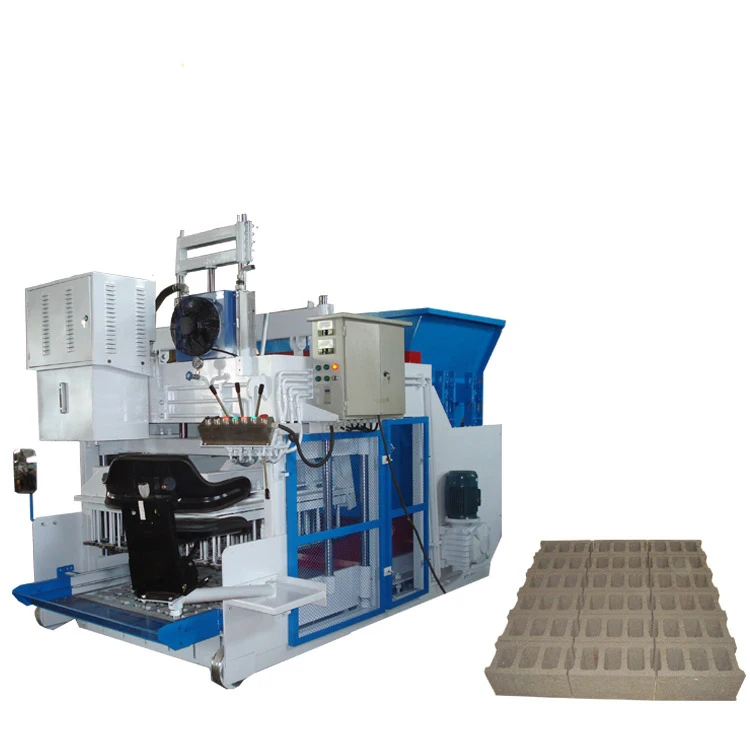
Integrated Line Engineering — Every station from raw material mixing to ground curing is specified as one matched system around the QMY18-15, so the mobile press never waits on upstream or downstream bottlenecks.
Technical Specifications
| Parameter | Value |
|---|---|
| Model | QMY18-15 |
| Product Type | Mobile Hydraulic Egglaying Block Making Machine |
| Machine Type | Mobile / Egglaying (pallet-free) |
| Hydraulic System | Upgraded hydraulic pressure system (based on QMY12-15 platform) |
| Pallet Requirement | No pallet needed |
| Block Density | High density |
| Block Dimensional Accuracy | Accurate size |
| Block Surface Finish | Smooth appearance |
| Operating Pressure | High pressure (exact MPa basis not stated in source) |
| Automation Level | Man-machine unity, reduces unnecessary labor (source value — verify against manufacturer catalog) |
| Energy Consumption | Low energy consumption (source value — verify against manufacturer catalog) |
| Overall Dimensions | Not stated in source |
| Net Weight | Not stated in source |
| Rated Power | Not stated in source |
| Voltage & Frequency | Not stated in source |
| Control System | Not stated in source |
| Cycle Time | Not stated in source |
| Output Capacity | Not stated in source (basis not stated in source — confirm block format / material / thickness) |
| Mould Format | Not stated in source |
| Mould Change Time | Not stated in source |
| Vibration Force | Not stated in source |
| Certification | Not stated in source |
Application Suitability
| Application | Material or Output |
|---|---|
| On-site concrete block production for housing projects | Crushed stone, sand, cement, and water mixed locally |
| Contractor-owned block manufacturing at infrastructure sites | Aggregate sourced from nearby quarries with varying gradation |
| Small-scale block production with lower initial investment | Locally available sand, fly ash, or gravel as primary aggregate |
| Mobile production for remote development projects | Raw materials transported to site without fixed batching plant |
What "Cycles Per Hour" Hides About Your Actual Daily Output
Capacity only means something when the block format, mix design, and supporting equipment are all named alongside the number.
I once quoted a mobile block making machine production line at a daily output figure based on a standard hollow block cycle. The customer’s local sand had a high clay content, which slowed the mix water absorption and forced a longer vibration cycle. Actual daily output dropped to roughly half the quoted figure, and the customer nearly rejected the machine on site. That kind of mismatch is common when a supplier states cycles per hour without saying which block format, which mix, and which curing arrangement the number assumes [NEED_CITE: block machine capacity calculation methods and format dependency].
Line Station Sequencing for Pallet-Free Production
The QMY18-15 removes the pallet loop entirely, which changes how the rest of the mobile block making machine production line is arranged. Without a pallet feeder, pallet return conveyor, or pallet storage rack, the station count drops and the floor space requirement shifts toward a longer, clearer travel path. The mixer must discharge within reach of the machine hopper, and the operator moves the unit forward after each lay cycle, so the raw material supply point must be repositioned or the mixer must be portable.
Ground Curing Area Allocation and Block Spacing
Because the QMY18-15 lays blocks directly onto the ground surface, the curing area is not a rack system but a flat, level floor zone that must be prepared before production starts. The required area depends on the block format and the number of production days before blocks are moved to the yard [NEED_CITE: concrete block curing duration standards by climate zone]. If the curing zone is too small, freshly laid blocks will be stepped on or driven over before they gain enough green strength, causing corner damage and rejection. Planning the curing rectangle length and marking travel lanes for the machine and any site vehicles is a station in its own right, even though no mechanical equipment sits there.
Reading the Specs That Actually Govern Line Balance
The hydraulic pressure system on this model is described as upgraded from the QMY12-15 platform. Higher hydraulic pressure increases compaction force on the concrete mix inside the mould, which directly affects block density and green strength at demoulding. When green strength is low, blocks deform under their own weight before curing begins, especially on uneven ground.
Man-machine unity design defines how many operators the line needs and where they stand. For a mobile egglaying machine, one operator typically manages the machine controls and travel while another handles the mixer feed. If the mixer output per batch is smaller than the hopper volume, the press idles between batches and the cycle time elongates beyond the machine’s mechanical capability.
Block density and dimensional accuracy are outcomes of matching vibration force, hydraulic pressure, and mix moisture together. Changing any one variable without adjusting the other two shifts the result, which is why testing with the buyer’s actual aggregate sample before finalizing the line configuration prevents costly on-site re-tuning [NEED_CITE: concrete block compressive strength testing standards].
The Cost of Skipping Line-Level Specification
When the mixer capacity, water supply volume, and curing area dimensions are left to the buyer to figure out after the machine arrives, the mobile block making machine production line stalls at the weakest unquoted link. A mixer that is too small means the machine waits. A curing area that is too small means blocks are stacked before they cure, cracking under their own weight. Voltage and control language left unconfirmed until the container arrives can add weeks of idle time while an electrician rewires the panel or the operator cannot read the display [NEED_CITE: industrial equipment voltage and frequency compatibility by country]. These are not machine defects — they are specification gaps that turn into on-site delays.
Why Source the Full Line From One Configuration Point
Block machinery is our single focus, so the QMY18-15 is never quoted as a standalone press disconnected from its mixer, feeder, and curing layout. Every line configuration is set against the buyer’s actual mix design, local aggregate type, and target block format rather than a catalogue default. Mould selection covers the formats the buyer’s market actually sells, with custom mould drawings available when standard formats do not match local demand. The automation level is selectable, meaning a buyer can begin with manual material handling and add feeding equipment later as production volume grows. Installation and commissioning support includes operator training on the specific block format and mix the buyer will run. Factory test records document the machine running the buyer’s specified block size before the line ships.
Documentation & Verification
- Line layout drawing showing mixer position, machine travel path, and curing zone dimensions
- Capacity calculation sheet stating the block format and mix proportion assumed
- Mould drawing with block dimensions and format list matching buyer’s market
- Hydraulic and electrical schematic with confirmed voltage and control language
- Factory test record running buyer’s specified block size before dispatch
- Packing photographs and customs documentation support for shipment
Installation, Commissioning & Support
- Ground leveling tolerance specified for the QMY18-15 travel path to prevent block tilt during laying
- Power supply circuit sized for the machine’s rated motor draw with dedicated breaker
- Mixer placement within reach of the QMY18-15 hopper to minimize manual transfer distance
- First-day commissioning includes cycle timing verification against the quoted block format
- Operator training covers mould handling, mix consistency checks, and machine travel sequence
- Wear parts list identifies hydraulic seals and mould liner plates with reorder codes
Planning Your Mobile Line Inquiry
When you are ready to specify a mobile block making machine production line, start by sharing the block format your site will produce — hollow, solid, or paving — along with the target daily output in pieces. Include a description or sample of the local aggregate you plan to use, especially sand type and clay content, so the mix can be tested against actual material. Confirm your site voltage, frequency, and the language you need on the control panel, as these affect commissioning timing once the equipment arrives.
Frequently Asked Questions
Q: What supporting equipment is needed around the QMY18-15 to form a complete line?
A: The core supporting stations include a pan mixer sized to match the machine’s hopper volume per cycle, a water metering supply, and a prepared ground curing area with marked travel lanes. Since the QMY18-15 is pallet-free, no pallet feeder, return conveyor, or stacking system is required, which simplifies the line considerably.
Q: How should mixer output capacity match the mobile machine’s cycle time?
A: The mixer must discharge one full batch into the QMY18-15 hopper before the press completes its current mould cycle, otherwise the machine idles and actual output drops below its mechanical capacity. Mixer batch volume and mixing time should be calculated against the machine’s hopper capacity and the cycle time of the specific block format being produced.
Q: What curing area layout is required when blocks are laid directly on the ground?
A: The curing zone must be a flat, level surface long enough to hold multiple days of production without blocks being moved prematurely. Travel lanes for the QMY18-15 and any site vehicles should be marked to avoid driving over freshly laid blocks before they reach sufficient green strength.
Q: How is raw material feeding configured for a mobile machine?
A: Raw materials are typically mixed in a portable or fixed pan mixer positioned along the production path. As the QMY18-15 advances after each lay cycle, the mixer or material supply point must either move with it or be placed at intervals so the operator can refill the hopper without walking excessive distance.
Q: What electrical details must be confirmed before the line ships?
A: Voltage, frequency, and control panel display language must be matched to the destination site before the QMY18-15 leaves the factory. An incorrect voltage requires transformer or motor replacement on arrival, and an unreadable display delays operator training and commissioning by days or weeks.


