
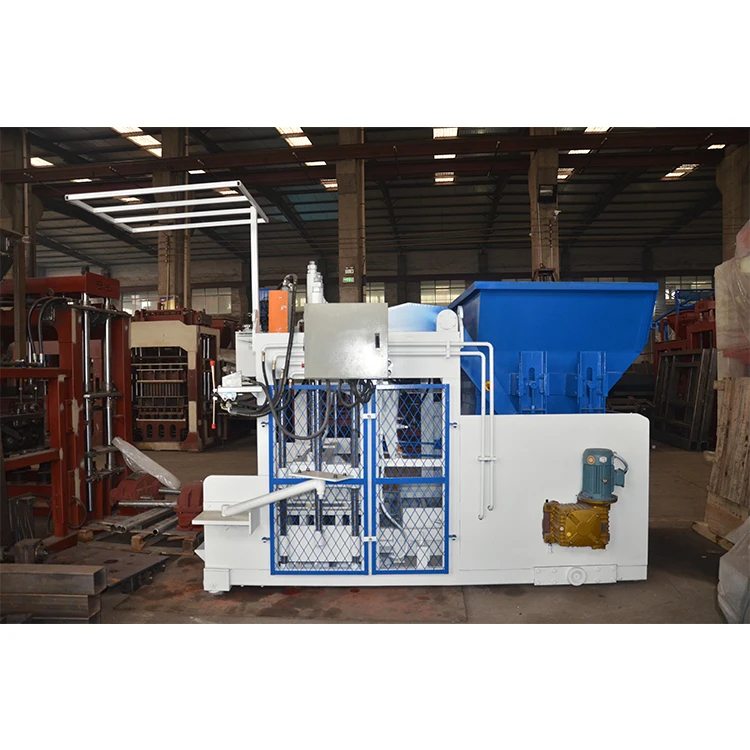
Matched System Integration — The QMY12-15 egg-laying block machine is specified alongside its upstream mixer and material feed stations so the press cycle is never starved for concrete during continuous production.
Technical Specifications
| Parameter | Value |
|---|---|
| Model | QMY12-15 |
| Product Type | Mobile Hydraulic Hollow Block Making Machine |
| Overall Dimensions (L×W×H) | 3250×2100×2300 mm |
| Rated Power | 16 kW |
| Net Weight | 4500–4600 kg |
| Pressure Type | Hydraulic |
| Motor Brand | Siemens |
| Moulding Cycle | 10–15 s |
| Capacity per Mould (400×200×200 mm) | 12 pcs/mould |
| Daily Capacity (400×200×200 mm, 8 h) | 23040 pcs/day |
| Capacity per Mould (400×150×200 mm) | 14 pcs/mould |
| Daily Capacity (400×150×200 mm, 8 h) | 2680 pcs/day (basis to be confirmed) |
| Capacity per Mould (400×100×200 mm) | 122 pcs/mould (basis to be confirmed) |
| Daily Capacity (400×100×200 mm, 8 h) | 42240 pcs/day (basis to be confirmed) |
| General Output Capacity | 12000–13000 pcs/day (basis not stated in source) |
| Pallet Requirement | No pallet required (egg-laying / mobile type) |
| Vibration System | Twice-vibration of molding core |
| Workers Required | 2–3 |
| Voltage & Frequency | Configurable (to be confirmed before order) |
| Control System | PLC / MCC (to be confirmed before order) |
| Standards | ISO 9001:2008, SGS, CE |
Application Suitability
| Application | Material or Output |
|---|---|
| On-site hollow block production for contractors | Concrete mixed from crushed stone, sand, cement, and water directly on the project site |
| Block variety expansion at existing cement yards | Hollow blocks in 400×200×200 mm, 400×150×200 mm, and 400×100×200 mm formats |
| Startup production without fixed plant investment | Egg-laying hollow blocks laid directly on a prepared concrete floor |
| Remote project supply for housing developments | Pallet-free hollow blocks produced adjacent to the construction footprint |
Why a Mobile Block Machine Production Line Still Needs Upstream Timing
A mobile press only produces as fast as its mixer can deliver concrete.
I once saw a mobile block line in West Africa where the QMY12-15 cycled through its moulding sequence perfectly, but the crew spent half the shift waiting for the next batch. The mixer upstream was rated for a smaller volume, and by the time it completed a batch, the press had already burned through the previous one and sat idle. The contractor had paid for a high-capacity press but received a bottleneck instead. This is the gap that mobile block machine production line planning must close before the equipment ships [NEED_CITE: line synchronization standards for mobile block production].
How the Feed Station Sets the Real Cycle Time
The QMY12-15 completes a moulding cycle in 10–15 seconds, and each cycle for a 400×200×200 mm hollow block consumes a fixed volume of concrete. If the upstream mixer and feed conveyor cannot replenish that volume within the same window, the press operator either shortens the fill or pauses the machine. Egg-laying block machine supporting equipment must therefore be sized by batch delivery rate, not just by mixer drum capacity. A mixer that holds enough raw material on paper may still deliver too slowly if its discharge gate or conveyor angle restricts flow.
Ground Preparation and Curing Logistics Without Pallets
The pallet-free design of the QMY12-15 eliminates the cost and handling loop of return pallets, but it shifts the burden to ground preparation. The machine lays blocks directly onto a concrete floor, which must be level enough to prevent fresh blocks from slumping or cracking under their own weight before initial set. Curing area planning also changes: without pallets to stack on racks, blocks cure in rows on the ground, meaning the yard must be wide enough to hold a full day’s output without forklifts crossing over freshly laid units [NEED_CITE: ground flatness tolerances for egg-laying block production].
Reading the Specs That Actually Determine Daily Output
The hydraulic pressure system and the twice-vibration molding core work together to compact concrete into the mould cavity. Higher vibration frequency combined with hydraulic force produces denser block walls, which is critical for hollow blocks where the shell thickness must carry structural load. The Siemens motor delivers 16 kW to drive both the hydraulic pump and the vibration unit simultaneously. The 2–3 worker requirement covers one operator at the machine controls, one managing the feed hopper, and one handling the finished block area. Voltage and control language remain configurable and must be confirmed before production begins, since a mismatch at the site will delay commissioning regardless of how well the rest of the line is planned.
What Happens When the Line Stations Are Mismatched
When a mobile block machine is quoted without its supporting equipment, the buyer is left to source a mixer and feed system independently. The result is often a line where one station runs at full pace while another forces the entire operation to idle. Contractors working against a project deadline cannot absorb that lost time. A mixer that is too small causes the press to wait; a feed conveyor that is too slow causes the hopper to run dry mid-cycle, producing partially filled moulds and inconsistent block dimensions. These failures are not machine faults — they are line design faults [NEED_CITE: common causes of mobile block line downtime].
Why Sourcing the Complete Setup from One Point Matters
Block machinery is the single focus here, which means the QMY12-15 is not shipped as a standalone press but as part of a line where the mixer, feed conveyor, and curing logistics are specified to match its cycle rate. Configuration is set against the buyer’s actual mix design and local aggregate, not a catalogue default. Mould design covers the hollow block formats that the buyer’s market actually purchases. Automation level is selectable, so a buyer can start with manual feed and add automated stations later. Installation support includes operator training on-site, and the line layout document states the capacity calculation per block format so there is no ambiguity about what the daily output figure assumes.
Documentation & Verification
- Line layout with capacity calculation stating the assumed hollow block format and shift length
- Machine specification sheet covering hydraulic ratings, motor brand, and vibration system details
- Mould drawing and format list for 400×200×200 mm, 400×150×200 mm, and 400×100×200 mm blocks
- Voltage and control language confirmation document signed before production
- Factory test record with actual cycle timing per mould format
- CE declaration and ISO 9001:2008 compliance documentation
Installation, Commissioning & Support
- Ground slab must be level and cured before the QMY12-15 arrives, since egg-laying production depends on floor flatness
- 16 kW rated power requires a dedicated circuit with voltage and frequency confirmed before wiring
- Machine ships assembled; on-site setup covers hopper alignment and hydraulic line pressure check
- First-run commissioning includes cycle timing verification per block format and mould change practice
- Operator training covers twice-vibration control, hydraulic pressure adjustment, and daily greasing points
- Wear parts list identifies mould liners and hydraulic seals with recommended replacement intervals
What to Prepare Before Requesting a Quote
To size the QMY12-15 and its supporting equipment correctly, share the hollow block formats your market requires, your target daily output, and the shift length you plan to run. Include the local aggregate type and any existing mixer or feed equipment you intend to keep in the line. Confirm the site voltage and frequency, and the control panel language your operators need.
Frequently Asked Questions
Q: What block format is the 12000–13000 pcs/day output based on?
A: The source does not state which hollow block format the 12000–13000 pcs/day figure assumes. The confirmed figure is 23040 pcs/day for 400×200×200 mm hollow blocks over an 8-hour shift. Request a capacity calculation that names the format and shift length explicitly before placing an order.
Q: What does the ground need to look like for pallet-free egg-laying production?
A: The floor must be a cured, level concrete slab. Uneven ground causes freshly laid hollow blocks to lean or crack before initial set. The curing yard must also be wide enough to hold a full shift’s output in ground-level rows, since blocks cannot be racked without pallets.
Q: How large should the upstream mixer be so the QMY12-15 never waits?
A: The mixer must deliver a full batch of concrete within the press cycle window of 10–15 seconds per mould. Batch volume and discharge speed both matter. The line layout document should state the required mixer delivery rate matched to the target block format and daily output.
Q: How are voltage, frequency, and PLC language handled before shipment?
A: These are not stated in the base specification and must be confirmed before production. A voltage and control language confirmation document is signed off during the ordering process so the machine arrives ready to connect and operate in the local language.


