
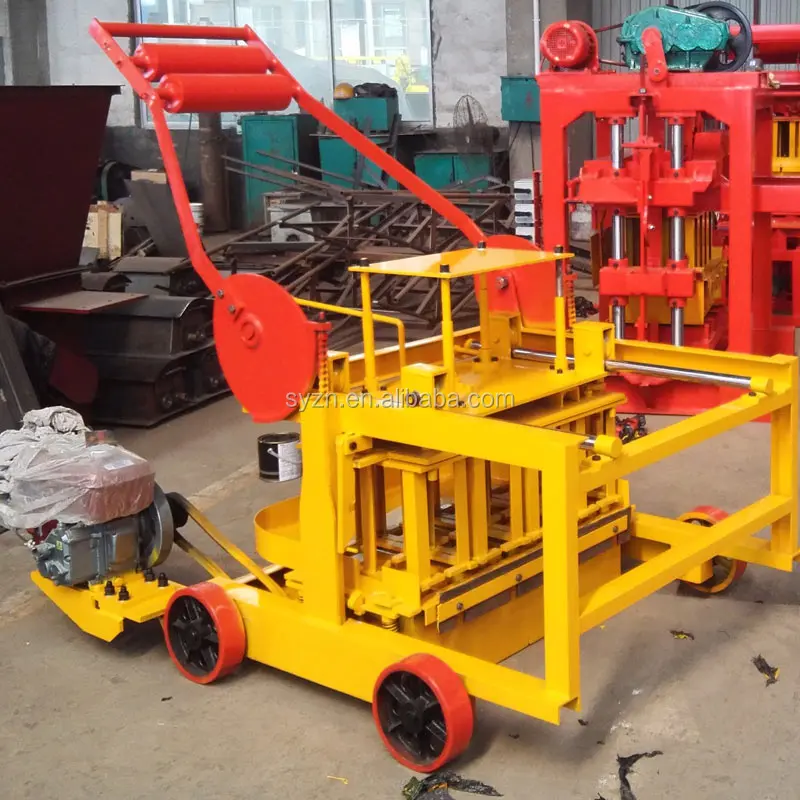
Matched System Design — The QMR4-45 is configured as a complete on-site production line with mixer, trolley, and curing workflow specified together so every station keeps pace with the press cycle.
Technical Specifications
| Parameter | Value |
|---|---|
| Model | QMR4-45 |
| Product Type | Mobile Concrete Block Making Machine |
| Power Source | Diesel / Petrol Engine / Electric |
| Overall Dimensions (L×W×H) | 1100 x 950 x 2100 mm |
| Net Weight | 810 kgs |
| Molding Cycle | 30–45 s |
| Output Capacity | 2560 pcs/day (basis not stated in source — confirm block format) |
| Pallet Requirement | No pallet required (egg-laying / mobile type) |
| Mould Format | Paver brick, hollow block, concrete block, solid brick, fly ash brick |
| Automation Level | Manual / semi-mobile operation |
| Included Equipment | JZC350 Diesel Concrete Mixer or JQ350 Diesel Concrete Mixer (Electric Generating Unit); Trolley |
| Warranty | 1 Year |
Application Suitability
| Application | Material or Output |
|---|---|
| Housing project sites | Hollow and solid concrete blocks from crushed stone, sand, and cement |
| Remote or rural construction | Fly ash bricks and pavers using locally sourced aggregate and diesel power |
| First-time block entrepreneurs | Ground-cured concrete blocks without fixed plant infrastructure |
| On-site contractor production | Interlocking bricks and kerbstones directly at the job site |
What "2560 Pieces per Day" Actually Means on the Ground
Daily output depends entirely on which block format you run and how fast your mixer feeds the press.
I have seen mobile block machine production line setups where the press sits idle for half a minute every cycle because the mixer batch time was never matched to the molding stroke. The buyer blames the machine, but the bottleneck is upstream. A 30–45 second molding cycle only holds if fresh concrete arrives on time, every time. When the JZC350 or JQ350 mixer is paired correctly, the line flows; when it is not, you are paying for capacity you never see [NEED_CITE: typical mixer batch-to-press cycle matching in small-scale block plants].
How the No-Pallet Design Reshapes the Line Layout
The egg-laying principle eliminates three stations that fixed plants require: pallet feeding, pallet return conveyors, and curing rack handling. For a mobile block machine production line, this means the workflow collapses to mixer, press, trolley, and ground curing area. The trade-off is that you need a prepared, level curing surface large enough to hold a full day’s output before blocks can be moved.
Matching Mixer Output to the Press Cycle Without Idle Time
The QMR4-45 completes a molding stroke every 30–45 seconds. The JZC350 diesel mixer produces a batch in roughly two to three minutes depending on aggregate size and moisture. If the trolley transport time from mixer to press exceeds the press cycle, the operator waits. Line configuration must account for transport distance, mixer placement relative to the curing area, and the number of trolleys in rotation so the press never starves [NEED_CITE: material flow synchronization in mobile concrete production setups].
Reading the Specs That Actually Affect Daily Output
The 810 kg net weight provides enough mass for the vibration force to compact concrete without the machine walking across the ground during operation. Lighter mobile units tend to shift position mid-cycle, producing uneven block density. The diesel power option means the entire mobile block machine production line runs off-grid — critical for rural housing projects where three-phase electricity is unavailable. Mould format flexibility across hollow block, solid brick, and paver brick allows a single machine to serve multiple product lines, though each format change requires manual mould swap and cycle time recalibration.
When the Supporting Equipment Is Missing from the Quote
Buyers frequently receive quotations for the press alone, then discover that mixer, trolley, and curing workflow were never specified. The result is a machine that technically works but produces far below its capability because concrete arrives late, blocks are moved by hand, and the curing area is too small. Line-level thinking prevents this gap [NEED_CITE: common quotation omissions in small block machine procurement].
Why Sourcing the Line Together Matters
Block machinery as a single focus means the QMR4-45, its mould, the JZC350 or JQ350 mixer, and the trolley are specified as one matched system rather than assembled from separate suppliers. Configuration is set against the buyer’s actual mix design and local aggregate, not a catalogue default. Mould design covers the formats the buyer’s market actually sells, with custom drawings available. The automation level starts at manual operation with a clear upgrade path to semi-automatic when production volume justifies it. Installation support includes operator training so the crew understands cycle timing and mixer-press synchronization from day one.
Documentation & Verification
- Line layout stating which block format the daily capacity figure assumes
- Machine specification sheet with power source and dimension confirmation
- Mould drawing and format list showing included versus optional moulds
- Mixer batch-to-press cycle matching calculation for your target product
- Voltage and control language confirmation for the electric variant
- Factory test record before dispatch
Installation, Commissioning & Support
- Level, compacted ground surface required for egg-laying operation across the 1100 x 950 mm machine footprint
- Diesel fuel supply or electric connection confirmed before the 810 kg unit is positioned
- Mixer placed within trolley transport distance to maintain the 30–45 second press cycle
- First-day production run with operator training on mould change and cycle timing
- Wear parts list covering vibration components and mould surfaces for local sourcing
- Daily greasing schedule for moving parts under continuous on-site dust exposure
What to Prepare Before Requesting a Quotation
Specify the block formats your market sells and the daily volume you need for each. Confirm whether your site has grid electricity or requires full diesel operation. Provide your local aggregate type and any existing equipment like forklifts or curing space so the line layout accounts for what you already have.
Frequently Asked Questions
Q: How is the 2560 pcs/day capacity calculated, and which block format does it assume?
A: This figure requires confirmation of the specific block format, wall thickness, and material mix used during testing. Hollow blocks, solid bricks, and pavers each have different cycle times and volumes per stroke. Request a capacity calculation that states the exact format and mix design assumed so you can compare it against your actual product requirements.
Q: What supporting equipment is included versus what must be sourced separately?
A: The QMR4-45 package includes either a JZC350 diesel mixer or JQ350 electric mixer plus a trolley. Curing area preparation, water supply, aggregate stockpiling, and block transport after curing are site responsibilities. Confirm whether additional trolleys are needed for your specific transport distance to keep the press fed continuously.
Q: How do I match the mixer batch cycle to the press cycle so neither station waits?
A: The mixer must deliver a fresh batch within the time it takes the press to complete one or two molding strokes. Trolley transport distance and return time factor into this calculation. A line layout document should show mixer placement, trolley rotation count, and expected batch timing matched to your 30–45 second molding cycle.
Q: What are the curing area requirements when blocks are laid directly on the ground?
A: Egg-laying machines need a flat, compacted surface large enough to hold a full day’s output without blocks touching. The area must be accessible for water curing and protected from vehicle traffic until blocks reach handling strength. Calculate square meters required based on your target daily volume and block footprint dimensions.
Q: Can the line be expanded from mobile egg-laying to a semi-automatic setup later?
A: Starting with manual mobile operation keeps initial investment low. When volume grows, upgrading to a pallet-based semi-automatic line with stacking equipment is possible, though it involves different press architecture rather than adding modules to the QMR4-45. Plan your site layout to accommodate future expansion if needed.


